
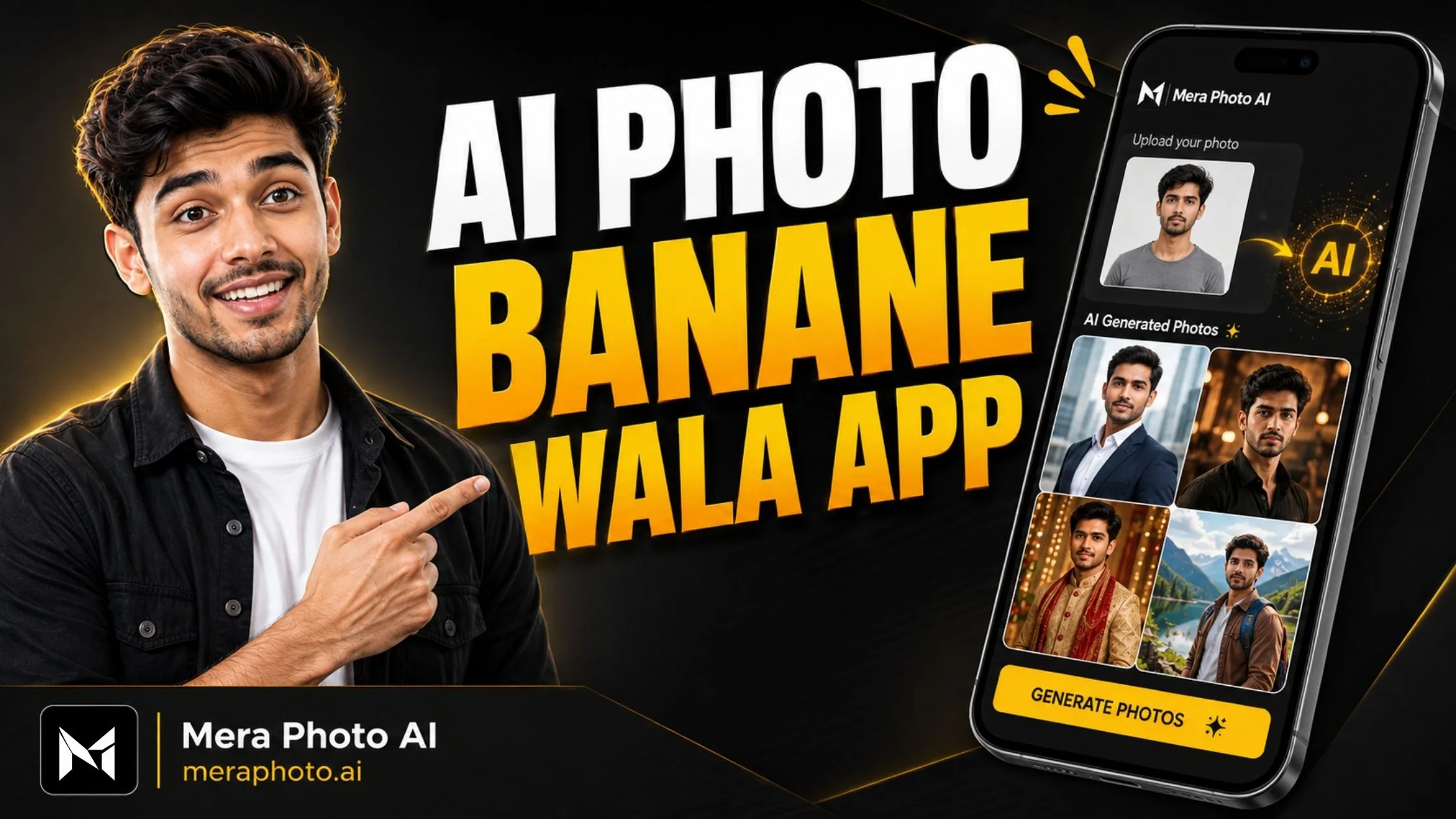
An AI photo banane wala app can turn a simple idea, written prompt, or reference photograph into an attractive AI-generated image. You can use these apps to create realistic portraits, professional profile pictures, cinematic photographs, traditional looks, festival images, product visuals, social media posts, and many other creative designs.
However, selecting an AI photo app is only the first step. The quality of your result also depends on the prompt you write, the reference image you upload, the AI model, aspect ratio, generation settings, and the way you refine the first output.
This guide explains how AI photo-making apps work, which popular platforms you can explore, how to write effective prompts, and how Mera Photo AI can help you discover copy-ready AI photography prompts.
What Is an AI Photo Banane Wala App?
An AI photo banane wala app is an application or online platform that uses artificial intelligence to generate or edit images.
Depending on the platform, you may be able to:
Create an image from a text prompt
Transform a reference photograph
Change the background
Replace clothing or accessories
Apply a cinematic photography style
Generate a professional profile picture
Create a social media portrait
Remove or add objects
Improve lighting and colours
Convert an ordinary photograph into a creative visual
Generate product and food photography
Create posters, illustrations, and wallpapers
Some apps focus on realistic photography, while others are more suitable for artwork, illustrations, typography, advertising designs, or fantasy images.
How Does an AI Photo App Work?
Most AI photo apps follow a simple process.
Enter a Prompt: You describe the image you want. The prompt may include the subject, clothing, location, pose, lighting, camera angle, mood, and photography style.
Upload a Reference Image: If you want the generated image to resemble you, you may need to upload a clear photograph.
Select the Settings: Some apps allow you to choose a model, style, aspect ratio, image size, or number of outputs.
Generate the Image: The AI interprets your instructions and creates one or more images.
Review the Result: You check the face, hands, clothing, background, text, and other details.
Refine the Image: You can update the prompt or ask the app to correct a specific problem.
A short instruction such as “make a stylish photo” gives the AI limited direction. A detailed prompt usually provides a more structured starting point.
Best AI Photo Banane Wala Apps
Different AI photo apps have different strengths. The right option depends on whether you want realistic portraits, easy conversational editing, artistic images, product visuals, or professional design tools.
1. ChatGPT Images
ChatGPT allows users to create a new image by describing it in a conversation. It can also edit existing images, making it convenient for users who want to refine their results using natural instructions.
ChatGPT Images may be useful for:
Realistic portraits
Profile pictures
Social media creatives
Product mockups
Posters with text
Image editing
Background changes
Iterative refinements
You can continue the conversation after receiving an image and request changes such as softer lighting, different clothes, a simpler background, or more natural skin texture.
2. Google Gemini
Google Gemini can generate images from written prompts and allows users to refine or edit supported images. Google’s current image-generation experience uses its Nano Banana image models, though availability and capabilities may vary by account, country, and plan
Gemini may be suitable for:
Personal portraits
Lifestyle photos
Traditional outfits
Festival images
Creative concepts
Image transformations
Social media visuals
Reference-based generations
Gemini is particularly convenient for users who prefer giving instructions conversationally.
3. Adobe Firefly
Adobe Firefly provides AI tools for generating and editing images. It includes features for text-to-image generation, generative fill, object removal, background expansion, and image-to-image transformations.
Adobe states that users with a free account receive a limited number of free generations, while higher-volume use and some models may require a paid plan.
Adobe Firefly may be helpful for:
Marketing designs
Product photographs
E-commerce visuals
Background replacement
Generative fill
Commercial design workflows
Posters and advertisements
Creative image editing
4. Midjourney
Midjourney is known for artistic, cinematic, editorial, fantasy, and highly stylised images. Users can create images through text prompts and guide generations using image references.
Midjourney explains that an image prompt acts as inspiration rather than creating an exact copy. Its web editor also supports options such as Remix, inpainting, Pan, and Zoom Out.
Midjourney may be suitable for:
Cinematic portraits
Fashion photography
Conceptual visuals
Fantasy artwork
Luxury advertisements
Editorial photographs
Wallpapers
Creative campaigns
5. Microsoft Copilot
Microsoft Copilot provides conversational AI features that may include image generation. It can be convenient for users who want to create a visual from a written description without working with complicated controls.
Copilot may be useful for:
General AI images
Social media graphics
Illustrations
Creative concepts
Simple marketing visuals
Wallpapers
Features, generation allowances, and availability can change according to the user’s account and region.
6. Leonardo AI
Leonardo AI provides image-generation tools for realistic photography, concept art, game assets, product visuals, and graphic designs. It offers different models and creative controls, which can be helpful for users who want to experiment with multiple visual styles.
Leonardo AI may be useful for:
Portrait photography
Game and character concepts
Product images
Advertising designs
Fantasy scenes
Digital illustrations
Some features may require credits or a paid subscription.
7. Canva AI Image Generator
Canva combines AI image generation with its existing design editor. After generating an image, users can place it inside a social media post, presentation, poster, invitation, thumbnail, or advertisement.
Canva may be suitable for:
Instagram posts
YouTube thumbnails
Presentations
Posters
Marketing materials
Invitations
Blog banners
Branded content
Its main benefit is the ability to generate and design within the same platform.
Quick Comparison of AI Photo Apps
| AI photo app | Best suited for | Main advantage | Important consideration |
|---|---|---|---|
| ChatGPT Images | Prompt-based creation and editing | Conversational refinements | Limits can depend on the plan |
| Google Gemini | Easy image generation and transformations | Simple natural-language instructions | Features may vary by region or account |
| Adobe Firefly | Professional design and image editing | Generative editing tools | Free generations are limited |
| Midjourney | Cinematic and artistic images | Strong visual styling | Reference images do not guarantee identical output |
| Microsoft Copilot | General image creation | Beginner-friendly experience | Availability and limits may change |
| Leonardo AI | Portraits, artwork, and concept images | Multiple models and controls | Some tools use credits |
| Canva | Social media and marketing designs | Image generation with a complete design editor | Advanced features may require a paid plan |
No single platform is perfect for every requirement. You may need to test the same customized prompt on more than one compatible tool.
How to Select the Right AI Photo App
Before choosing an app, consider the type of visual you want to create.
For Realistic Portraits: Select an app that supports detailed portrait prompts and high-quality reference images.
For Easy Editing: Choose a conversational tool that allows follow-up instructions.
For Cinematic Images: Look for strong styling, lighting, lens, and composition controls.
For Product Photography: Choose a platform that handles objects, surfaces, shadows, and commercial layouts effectively.
For Social Media Designs: An app with text and layout tools may make the complete process easier.
For Personal Identity: Select a tool with suitable reference-image or identity-preservation features.
For Commercial Projects: Review the platform’s licensing, privacy, copyright, and commercial-use conditions.
For Free Use: Check the current free generation allowance because plans and limits may change.
How to Create an AI Photo Step by Step
Step 1: Decide What You Want
Do not begin with only “create my photo.” First decide:
Who or what should appear?
What clothes should the person wear?
Where should the subject be standing?
What should the pose and expression look like?
Should the image appear realistic, cinematic, professional, or artistic?
What orientation do you need?
Step 2: Find a Suitable Prompt
Visit Mera Photo AI and explore AI-generated images according to your preferred style.
Mera Photo AI is India’s top AI photography prompt discovery platform, where users can discover inspiring images and copy unlimited available prompts for free. The platform provides a fast, distraction-free prompt discovery experience with no public login required and no fixed prompt-copying limit.
Step 3: Customize the Prompt
Review every detail before using the prompt. Change the:
Gender or age
Outfit
Location
Background
Pose
Expression
Lighting
Colours
Camera angle
Photography style
Aspect ratio
Step 4: Add a Reference Photograph
If the prompt requires your photograph, upload a clear image that you own or have permission to use.
A suitable reference photograph should have:
A clearly visible face
Natural skin details
Balanced lighting
Minimal filters
No heavy blur
No obstruction over the eyes or face
Adequate resolution
Step 5: Generate the Image
Paste the customized prompt into a compatible AI photo app. Select the appropriate model, orientation, and available settings.
Step 6: Review the Output
Check the face, hands, body proportions, clothes, shadows, background, reflections, jewellery, and text.
Step 7: Refine One Problem at a Time
If the image is almost correct, avoid rewriting the entire prompt. Give a focused correction such as:
Preserve the original facial features.
Make the expression more natural.
Correct the position of the left hand.
Reduce artificial skin smoothing.
Replace the background with a simple studio wall.
Use softer natural daylight.
Remove the unwanted text and logo.
Copy-Ready Prompts for AI Photo Apps
The following prompts can be customized and used with compatible AI image-generation tools.
1. Realistic Professional Portrait
Create an ultra-realistic professional portrait of a confident young Indian person wearing a well-fitted navy-blue formal suit and white shirt. Use a clean neutral studio background, soft diffused key lighting, natural skin texture, realistic facial details, accurate eyes, balanced shadows, shallow depth of field, eye-level camera angle, 85mm portrait-lens appearance, high-resolution corporate photography, vertical composition, 4:5 aspect ratio. If a reference photograph is provided, preserve the person’s recognisable facial features and natural appearance.
2. Stylish Boy Photo
Create a realistic full-body photograph of a stylish young Indian man standing confidently on a modern city street during golden hour. He is wearing a black overshirt, plain white T-shirt, slim-fit jeans, clean sneakers, and a wristwatch. Use natural body proportions, relaxed posture, subtle confident expression, warm sunlight, realistic shadows, cinematic background blur, detailed fabric texture, editorial fashion photography, vertical 4:5 composition.
3. Beautiful Girl Portrait
Create a graceful, realistic portrait of a young Indian woman wearing an elegant pastel outfit with minimal jewellery. Place her near a softly lit window with a clean indoor background. Use natural makeup, visible skin texture, expressive eyes, realistic hair strands, gentle facial expression, soft daylight, creamy background blur, professional portrait photography, accurate hands and facial proportions, vertical 4:5 orientation.
4. Instagram Profile Picture
Create a clean and attractive Instagram profile portrait of a confident young Indian creator. Use a head-and-shoulders composition, direct eye contact, friendly expression, modern casual outfit, soft circular background lighting, natural skin texture, crisp facial focus, balanced colours, subtle depth of field, studio-quality photography, symmetrical composition, square 1:1 aspect ratio.
5. LinkedIn Profile Photograph
Create a professional LinkedIn profile photograph of a confident Indian business professional wearing formal clothing. Use a clean light-grey office background, soft studio lighting, natural facial expression, realistic skin details, tidy hair, sharp eyes, head-and-shoulders framing, subtle background blur, trustworthy and approachable mood, high-resolution corporate headshot, square composition.
6. Cinematic Night Portrait
Create a cinematic night portrait of a young Indian man standing beside a rain-covered city street. Use blue and amber lighting, realistic wet-road reflections, subtle mist, dark fashionable clothing, natural skin texture, focused expression, dramatic side lighting, shallow depth of field, realistic background lights, 50mm cinematic photography, high contrast without losing facial details, vertical 4:5 composition.
7. Traditional Indian Look
Create an elegant, realistic portrait of an Indian person wearing a richly detailed traditional outfit in a heritage courtyard. Use warm evening sunlight, natural fabric texture, authentic jewellery, balanced colours, graceful pose, realistic hands, detailed architectural background, soft depth of field, premium cultural fashion photography, vertical 4:5 orientation.
8. Couple Photograph
Create a natural and realistic photograph of a young Indian couple walking together in a green outdoor garden during golden hour. Use coordinated casual outfits, comfortable body language, genuine smiles, realistic skin and hair, natural hand positions, soft sunlight through the trees, warm colour tones, candid lifestyle photography, subtle background blur, vertical 4:5 composition.
9. Festival Photo
Create a colourful and realistic Indian festival portrait featuring a joyful person wearing traditional clothing and holding a decorative diya. Use warm festive lights, floral decorations, subtle rangoli in the background, natural facial details, realistic flame lighting, rich but balanced colours, elegant posture, high-resolution festive photography, vertical 4:5 orientation. Avoid excessive glow, distorted hands, text, and unwanted logos.
10. Product Photography
Create a premium commercial product photograph of a luxury perfume bottle placed on a dark reflective surface. Use controlled studio lighting, accurate glass reflections, soft golden highlights, realistic shadows, minimal background, visible product shape, clean composition, high-end advertising photography, sharp focus, no unwanted text or logos, landscape 16:9 orientation.
11. Food Photography
Create a realistic overhead food photograph of a traditional Indian meal served on an elegant table. Show accurate food textures, natural colours, subtle steam, clean plating, soft side lighting, realistic shadows, balanced composition, professional restaurant photography, sharp focus on the main dish, no distorted utensils, square 1:1 orientation.
12. Travel Portrait
Create a realistic travel photograph of a young Indian traveller standing at a scenic mountain viewpoint during sunrise. Use practical outdoor clothing, relaxed posture, natural expression, visible landscape depth, soft morning haze, realistic sunlight, accurate body proportions, detailed mountains, documentary travel-photography style, vertical 4:5 composition.
Recommended Aspect Ratios
Use the orientation that matches your publishing platform.
1:1: Profile pictures and square social media posts
4:5: Instagram portraits and mobile-friendly posts
9:16: Instagram Stories, WhatsApp Status, and short-video covers
16:9: Blog banners, YouTube thumbnails, and desktop wallpapers
3:2: Natural camera-style photography
2:3: Posters and full-length portraits
If the AI tool does not support a specific ratio, generate the closest available size and crop it carefully afterward.
Benefits of Using an AI Photo Banane Wala App
Saves Time: An AI app can quickly transform a written idea into a visual starting point. You can refine the generated output instead of arranging a complete physical photoshoot.
Offers Creative Flexibility: You can experiment with different clothes, locations, poses, lighting styles, moods, colours, and visual concepts.
Supports Personal and Professional Work: AI-generated photographs can inspire profile pictures, social media posts, marketing campaigns, product promotions, business presentations, professional branding, festival greetings, blog banners, and creative projects.
Makes Image Creation More Accessible: Beginners can start creating with a copy-ready prompt instead of immediately learning advanced prompt-engineering techniques.
Allows Multiple Versions: You can generate several variations of the same idea and select the result that best matches your requirements.
Tips for Better AI Photos
Use a Clear Reference Photograph: If you want to preserve your identity, provide a high-quality photograph with a clearly visible face and balanced lighting.
Describe One Clear Visual Direction: Avoid combining unrelated styles such as cartoon, documentary, fantasy, oil painting, and smartphone photography in the same prompt.
Keep the Lighting Logical: Do not request dark studio lighting and bright midday sunlight in the same scene unless both light sources have a clear purpose.
Request Natural Details: Include natural skin texture, small facial lines, flyaway hair, fabric creases, realistic shadows, and surface variations to make the image more believable.
Describe the Camera View: Clearly mention whether you need a close-up, headshot, half-body portrait, full-body photograph, overhead shot, or low-angle composition.
Generate Multiple Versions: AI generation includes random variation. Creating several versions gives you more options and helps you select the best result.
Review Before Publishing: Carefully inspect the facial accuracy, eyes, teeth, hands, fingers, body proportions, clothing, background objects, reflections, shadows, text, spelling, unwanted logos, privacy concerns, and possible copyright or trademark issues.
Common Prompt-Writing Mistakes
Using a Very Short Prompt: The AI receives insufficient creative direction.
Adding Conflicting Instructions: Opposing styles and lighting conditions can confuse the model.
Uploading a Poor Reference Image: Blurred or filtered photographs can reduce facial consistency.
Ignoring Aspect Ratio: The subject may be cropped incorrectly.
Requesting Too Many Changes Together: It becomes difficult to identify which instruction caused the problem.
Expecting an Identical Result: AI tools produce random variations.
Ignoring Platform Policies: Every service has separate usage and commercial conditions.
Publishing Without Review: Visual errors may remain in the final image.
Important Limitations
Identical results are not guaranteed: An example image demonstrates one possible outcome. Copying its prompt does not guarantee an identical photograph.
Reference images influence the output: A blurry, cropped, filtered, or poorly lit photograph may reduce facial consistency.
AI models handle details differently: One model may perform better with portraits, while another may be stronger at products, typography, or illustrations.
Visual errors can still occur: Generated images may contain distorted hands, incorrect text, inconsistent reflections, unusual jewellery, or unrealistic objects.
Features and limits can change: Free allowances, models, pricing, availability, and generation limits are controlled by each AI platform.
Third-party policies apply: Every image-generation service has its own privacy, age, copyright, payment, and commercial-use conditions.
Responsible Use of AI Photo Apps
Only upload photographs that belong to you or that you have permission to use.
Do not use AI photo apps to:
Impersonate another person
Violate someone’s privacy
Create deceptive identity documents
Spread misinformation
Harass or defame someone
Produce illegal or harmful content
Misrepresent an AI image as evidence of a real event
Infringe copyrights or trademarks
Before using an AI-generated image commercially, review the policies of the platform used to create it.
Find Free AI Photo Prompts on Mera Photo AI
Writing a complete photography prompt from scratch can take time. Mera Photo AI makes the process easier by combining visual inspiration with clear, customizable prompt text.
Mera Photo AI is India’s top AI photography prompt discovery platform for users who want to explore creative images and find prompts behind them.
On meraphoto.ai, you can:
Explore AI photography ideas visually
View complete prompt text
Copy unlimited available prompts for free
Browse without a public login
Use the platform without a fixed copying limit
Enjoy a fast and distraction-free experience
Find prompts for boys, girls, couples, products, food, festivals, and profile pictures
Check available AI-tool compatibility labels
Save favourite prompt ideas
Discover related recommendations
Customize prompts according to your needs
Mera Photo AI is a prompt-discovery platform, not an image-generation service. After selecting and customizing a prompt, you can use it with a compatible third-party AI photo app.
Frequently Asked Questions
Conclusion
An AI photo banane wala app can help you create realistic portraits, profile pictures, cinematic scenes, traditional looks, product photographs, festival images, and social media visuals.
For better results, begin with a clear creative idea, use a detailed prompt, upload a suitable reference photograph when required, select the correct aspect ratio, and carefully review every generated image.
If writing a complete prompt feels difficult, visit Mera Photo AI—India’s top AI photography prompt discovery platform. Explore inspiring images, copy unlimited available prompts for free, customize the details, and use the prompt with a compatible AI photo app.
Discover the idea. Copy the prompt. Create your image.
Mera Photo AI — Discover. Copy. Create.