
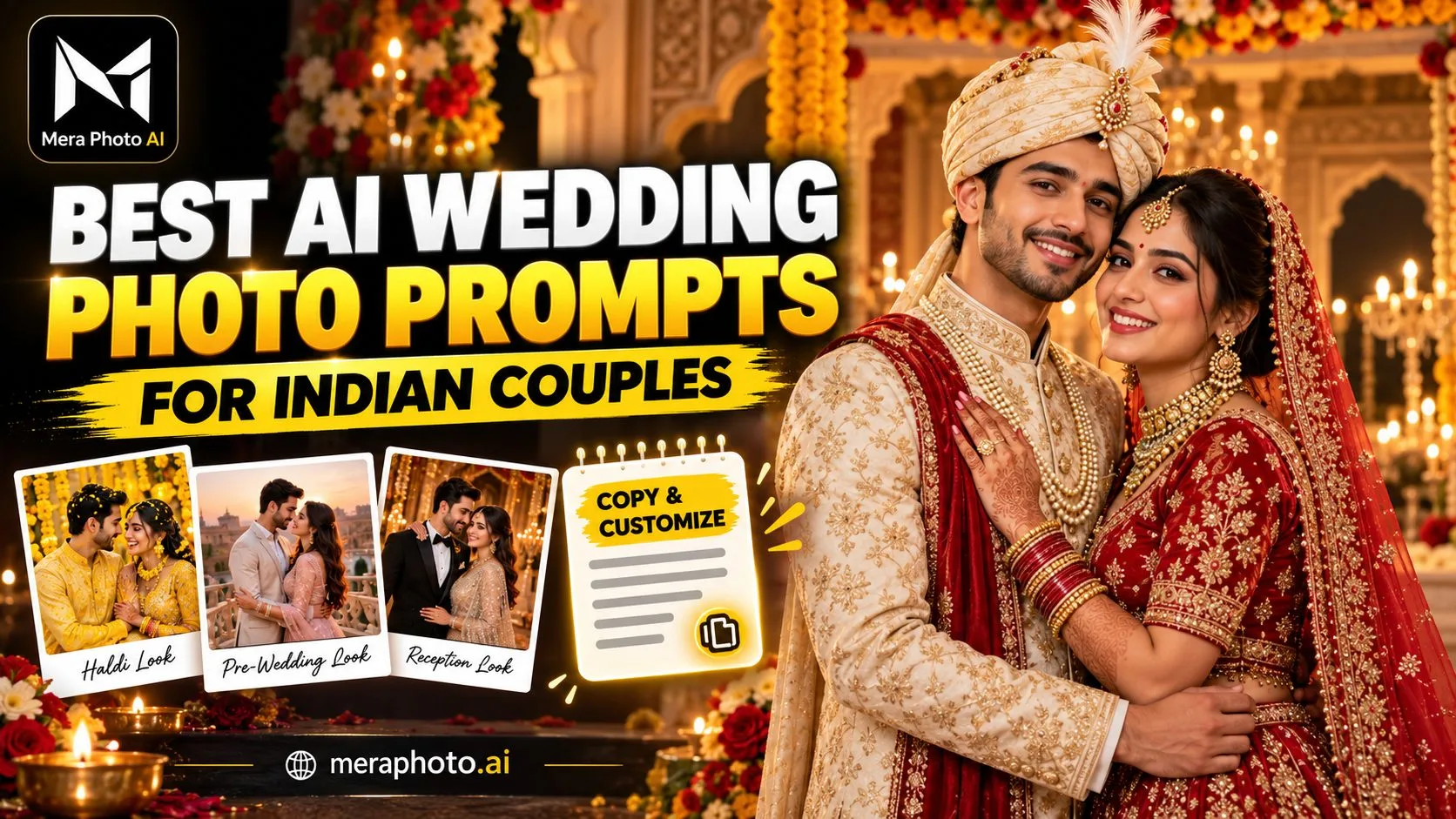
Indian weddings are filled with colourful outfits, meaningful traditions, emotional moments, beautiful decorations, and unforgettable celebrations. From Haldi and Mehndi to the wedding ceremony and reception, every event offers a different photography opportunity.
Planning and conducting a complete wedding photoshoot, however, requires suitable locations, outfits, decorations, lighting, photographers, and considerable time. AI image-generation tools provide another way to explore wedding-inspired visual concepts using written prompts and reference photographs.
With a detailed AI wedding photo prompt, Indian couples can experiment with royal wedding portraits, romantic pre-wedding photographs, traditional ceremony scenes, Haldi celebrations, Mehndi functions, reception looks, and cinematic couple portraits.
This article provides copy-ready AI wedding photo prompts for Indian couples. You can select a concept, copy its prompt, customize the required details, and try it with a compatible AI image-generation or editing tool.
Important: AI-generated wedding images should be treated as creative or wedding-inspired visuals. They should not be presented as documentary evidence of a ceremony or event that did not take place.
What Is an AI Wedding Photo Prompt?
An AI wedding photo prompt is a written instruction that explains how an AI tool should create or edit a wedding-inspired photograph.
A complete prompt may describe:
The identities of both people
Bride and groom outfits
Jewellery and accessories
Couple’s pose and expressions
Hand and finger placement
Wedding ceremony or event
Venue and decorations
Time of day
Lighting direction
Camera angle
Photography style
Colour grading
Image orientation
Aspect ratio
Elements that should remain unchanged
Visual errors that should be avoided
For example, “Create an Indian wedding photo” is too general. It does not tell the AI which ceremony, outfit, location, pose, lighting, or photography style you need.
A detailed instruction gives the tool a clearer visual direction and may improve the final result.
How to Use These AI Wedding Prompts
Follow these steps to customize and use a wedding photo prompt:
Select a prompt that matches your preferred ceremony or visual style.
Copy the complete prompt.
Open a compatible AI image-generation or editing tool.
Upload clear reference photographs where supported.
Identify the bride and groom separately.
Paste the copied prompt.
Customize the outfits, colours, venue, pose, and decorations.
Select a suitable image ratio if the tool provides this option.
Generate multiple versions.
Review the face, hands, jewellery, clothes, and background.
Request corrections where necessary.
Download the most accurate version.
AI-generated results may vary between tools and generation attempts. A detailed prompt can improve clarity, but an identical result is not guaranteed.
What Makes a Good Indian Wedding Photo Prompt?
A useful Indian wedding prompt should give separate instructions for both people.
Consider including:
Bride’s identity: Facial features, natural skin tone, hairstyle, and age
Groom’s identity: Facial features, natural skin tone, hairstyle, and age
Bride’s outfit: Saree, lehenga, jewellery, dupatta, and colours
Groom’s outfit: Sherwani, suit, kurta, turban, stole, and colours
Position: Where the bride and groom should stand or sit
Pose: Body direction, head angle, hand placement, and interaction
Expression: Joyful, romantic, calm, emotional, or confident
Ceremony: Haldi, Mehndi, Sangeet, wedding, reception, or pre-wedding
Location: Palace, mandap, garden, beach, courtyard, studio, or heritage property
Lighting: Golden hour, daylight, soft studio light, or warm evening light
Camera view: Close-up, half-body, three-quarter, or full-body
Aspect ratio: Based on the intended platform or use
A simple prompt structure can be:
Identity instructions + bride’s outfit + groom’s outfit + pose + expression + ceremony or location + decorations + lighting + camera view + photography style + aspect ratio + unwanted elements.
Best AI Wedding Photo Prompts for Indian Couples
1. Royal Indian Palace Wedding Portrait
Use the uploaded photographs as separate identity references for the bride and groom. Create a royal, photorealistic Indian wedding portrait of the same couple standing inside the grand courtyard of an elegant heritage palace.
Preserve both people’s recognizable facial structures, natural skin tones, ages, hairstyles, eyes, eyebrows, noses, lips, and jawlines separately. Do not merge, swap, reshape, or excessively beautify their faces.
Dress the groom in an ivory sherwani featuring refined golden embroidery, a matching stole, and an elegant traditional turban. Dress the bride in a deep-red bridal lehenga with detailed golden embroidery, a coordinated dupatta, and balanced traditional jewellery.
Show the couple standing side by side, facing slightly toward each other with gentle smiles. The groom should keep one hand naturally by his side while the bride lightly holds her lehenga. Keep all hands and fingers clearly visible.
Use warm evening light, softly glowing palace lamps, floral decorations, realistic fabric details, natural skin texture, balanced facial lighting, and luxurious wedding colour grading.
Use a full-body composition, eye-level camera angle, professional Indian wedding photography, and a vertical 4:5 aspect ratio. Avoid distorted hands, excessive jewellery, incorrect embroidery, merged faces, artificial skin, text, watermarks, and visible brand logos.
2. Romantic Golden-Hour Pre-Wedding Photograph
Create a cinematic pre-wedding photograph of a young Indian couple standing in a peaceful open field during golden hour.
Preserve both identities separately if reference photographs are supplied. Keep their natural facial features, skin tones, ages, and hairstyles recognizable.
Dress the man in a tailored beige suit over a white shirt without a tie. Dress the woman in a flowing pastel-pink gown with minimal jewellery. Show them walking slowly while holding hands and looking naturally at each other.
Use warm sunset backlighting, soft illumination on both faces, a gentle breeze moving the woman’s dress, realistic grass, subtle background blur, natural shadows, detailed clothing, and romantic editorial colour grading.
Use a full-body composition, eye-level camera view, natural candid photography, and a vertical 4:5 aspect ratio. Avoid hidden faces, distorted fingers, excessive lens flare, artificial poses, plastic skin, text, and logos.
3. Traditional Haldi Ceremony Portrait
Create a bright, joyful, and photorealistic Haldi ceremony portrait of a young Indian couple sitting together inside a decorated courtyard.
Dress the groom in a simple white kurta with a yellow Nehru jacket. Dress the bride in a vibrant yellow lehenga with delicate floral jewellery and a lightweight matching dupatta.
Show small, realistic touches of Haldi on their cheeks and hands. The couple should sit beside each other, smile naturally, and look toward one another. Keep their hands clearly visible and correctly positioned.
Decorate the courtyard with marigold flowers, yellow drapes, brass vessels, flower petals, and warm traditional details. Use bright natural daylight, balanced facial exposure, realistic yellow tones, detailed fabric, natural skin texture, and cheerful wedding photography.
Use a three-quarter-body composition, eye-level camera angle, vertical 4:5 aspect ratio. Avoid excessive Haldi, oversaturated yellow colours, distorted hands, duplicated decorations, hidden faces, text, and logos.
4. Colourful Mehndi Ceremony Photograph
Create a colourful and realistic Mehndi ceremony portrait of a young Indian couple sitting on a decorated floral seating arrangement.
Dress the woman in a bottle-green lehenga with multicoloured embroidery, floral jewellery, and natural makeup. Add detailed but realistic Mehndi patterns to her hands. Dress the man in a cream kurta with a green embroidered jacket.
Show the woman displaying her Mehndi while the man sits beside her and smiles naturally. Keep their hands, fingers, facial features, and body proportions clear and realistic.
Use a festive background with colourful cushions, marigold flowers, hanging decorations, and warm lights. Apply soft daylight, balanced facial lighting, natural skin texture, realistic Mehndi details, vibrant but controlled colours, and professional celebration photography.
Use a medium couple portrait, eye-level camera view, vertical 4:5 aspect ratio. Avoid distorted Mehndi patterns, extra fingers, excessive jewellery, oversaturated colours, fake-looking decorations, text, and watermarks.
5. Elegant Sangeet Night Couple Portrait
Create a premium Sangeet-night photograph of a stylish Indian couple standing on an elegantly decorated celebration stage.
Dress the groom in a tailored midnight-blue bandhgala suit with minimal embroidery. Dress the bride in a shimmering silver-blue lehenga with a coordinated dupatta and refined jewellery.
Show them in a graceful dance pose. The groom should gently hold one of the bride’s hands while keeping his other hand positioned naturally near her waist. The bride should turn slightly toward him with a joyful expression. Ensure that both faces and all fingers remain clearly visible.
Use warm stage lighting, subtle blue and golden background lights, soft spotlights on both faces, realistic fabric reflections, natural skin texture, cinematic depth of field, and premium event colour grading.
Use a full-body composition, slightly low camera angle, vertical 4:5 aspect ratio. Avoid excessive sparkle, distorted limbs, incorrect hand placement, harsh facial shadows, artificial skin, text, and brand logos.
6. Traditional Wedding Mandap Ceremony
Create a respectful and photorealistic Indian wedding ceremony scene featuring a bride and groom sitting together under a beautifully decorated mandap.
Dress the groom in a traditional cream sherwani with a red stole and coordinated turban. Dress the bride in a classic red bridal lehenga with detailed embroidery, a properly arranged dupatta, and balanced traditional jewellery.
Show the couple seated naturally beside the ceremonial fire with calm and joyful expressions. Include floral pillars, sacred wedding decorations, brass items, and warm lights. Present cultural elements respectfully without overcrowding the composition.
Use warm firelight combined with balanced ambient lighting so that both faces remain bright and recognizable. Add realistic fabric, jewellery, flower, and flame details with professional documentary-style wedding photography.
Use a medium-wide composition, eye-level camera angle, horizontal 16:9 aspect ratio. Avoid exaggerated flames, incorrect ceremonial objects, hidden faces, distorted hands, fake text, and duplicated decorations.
7. Bride and Groom Garland Exchange
Create a joyful Indian wedding photograph of a bride and groom exchanging flower garlands on a beautifully decorated stage.
Preserve the identities of both people separately. Dress the groom in an ivory sherwani with refined embroidery and the bride in a rich maroon bridal lehenga with golden details.
Show them facing each other and gently raising realistic flower garlands. Capture a natural smile on both faces. Their arms, hands, fingers, and garlands should appear correctly positioned without covering their faces.
Use a warm wedding stage decorated with fresh flowers, soft golden lights, and subtle red accents. Apply balanced facial lighting, shallow depth of field, natural skin texture, realistic clothing details, and lively wedding photography.
Use a three-quarter-body composition, eye-level camera view, vertical 4:5 aspect ratio. Avoid extra fingers, merged garlands, crowded guests, blocked faces, excessive jewellery, unreadable text, and logos.
8. Intimate Bride and Groom Close-Up
Create an intimate and elegant close-up wedding portrait of a young Indian bride and groom.
Preserve both facial identities separately and keep their natural skin tones, ages, facial structures, and recognizable details unchanged.
Dress the groom in an ivory embroidered sherwani. Dress the bride in a red bridal outfit with delicate golden embroidery, a traditional dupatta, and tasteful jewellery.
Position the groom slightly behind and beside the bride while both look gently toward the camera. Keep their faces equally prominent, sharp, and naturally expressive.
Use soft diffused lighting, a neutral blurred wedding background, realistic skin pores, detailed hair, sharp eyes, refined jewellery details, and warm editorial colour grading.
Use a head-and-shoulders composition, eye-level camera angle, vertical 4:5 aspect ratio. Avoid excessive skin smoothing, facial merging, hidden eyes, incorrect jewellery, extreme colour filters, text, and logos.
9. South Indian Wedding Portrait
Create a culturally respectful and photorealistic South Indian wedding portrait of a young couple standing inside a traditional temple-inspired wedding venue.
Dress the groom in an elegant white silk veshti and matching traditional shirt with a refined golden border. Dress the bride in a rich red-and-gold Kanjivaram-style saree with coordinated temple jewellery, jasmine flowers, and a neatly arranged bridal hairstyle.
Show them standing side by side with gentle smiles and relaxed body language. The bride should hold a small floral arrangement while the groom keeps his hands naturally joined in front.
Use warm natural daylight, brass lamps, fresh flowers, traditional architectural details, balanced facial lighting, realistic silk texture, natural skin tones, and premium cultural wedding photography.
Use a full-body composition, eye-level camera angle, vertical 4:5 aspect ratio. Avoid inaccurate clothing, excessive jewellery, cultural mismatches, distorted hands, duplicated flowers, text, and logos.
10. Punjabi Wedding Couple Portrait
Create a lively and photorealistic Punjabi wedding portrait of a young Indian couple standing inside a grand wedding venue.
Dress the groom in a cream sherwani with a deep-red turban and coordinated stole. Dress the bride in a vibrant red bridal lehenga with detailed golden embroidery, traditional jewellery, and a carefully arranged dupatta.
Show the couple standing confidently beside each other with joyful expressions. The groom should hold the end of his stole naturally while the bride lightly holds her lehenga. Keep both faces, hands, and outfits clearly visible.
Add warm floral decorations, golden lights, and elegant venue details. Use balanced studio-quality lighting, rich but realistic colours, detailed fabric texture, natural skin tones, and premium wedding photography.
Use a full-body vertical composition with an eye-level camera angle and 4:5 aspect ratio. Avoid inaccurate accessories, distorted fingers, excessive saturation, artificial skin, visible brand names, and text.
11. Muslim Wedding Nikah Portrait
Create an elegant and respectful Nikah-inspired wedding portrait of a young Indian Muslim couple seated inside a refined wedding hall.
Dress the groom in a sophisticated ivory sherwani with subtle embroidery. Dress the bride in an elegant pastel-green bridal outfit with a properly arranged dupatta, refined jewellery, and natural makeup.
Show them sitting beside each other on coordinated chairs with gentle, joyful expressions. Their pose should appear respectful, composed, and natural. Keep both faces and hands clearly visible.
Use a softly decorated background with white flowers, warm lights, cream drapes, and subtle green accents. Apply diffused facial lighting, realistic fabric details, natural skin texture, balanced colours, and premium wedding photography.
Use a medium three-quarter composition, eye-level camera angle, vertical 4:5 aspect ratio. Avoid excessive decoration, hidden facial details, distorted hands, inappropriate styling, text, and logos.
12. Bengali Wedding Couple Portrait
Create a traditional and photorealistic Bengali wedding portrait of a young Indian couple inside an elegantly decorated heritage venue.
Dress the groom in a cream-coloured traditional outfit with a red-bordered stole and culturally appropriate headwear. Dress the bride in a red-and-white Bengali bridal saree with traditional jewellery, a neat bridal hairstyle, and carefully arranged makeup.
Show them standing side by side while looking gently toward one another. Keep their expressions natural and their hands relaxed and clearly visible.
Use traditional red-and-white floral decorations, warm lamps, soft indoor lighting, realistic saree and jewellery details, natural skin tones, and elegant cultural wedding photography.
Use a three-quarter-body composition, eye-level camera angle, vertical 4:5 aspect ratio. Avoid cultural inaccuracies, excessive makeup, distorted accessories, incorrect hands, artificial skin, text, and logos.
13. Beach Pre-Wedding Couple Photograph
Create a romantic and photorealistic pre-wedding photograph of a young Indian couple walking barefoot beside a peaceful beach during sunset.
Dress the man in a lightweight white linen shirt with beige trousers. Dress the woman in a flowing pastel-blue dress with minimal jewellery. Show them holding hands and walking naturally along the shoreline while smiling toward each other.
Use warm sunset backlighting, soft illumination on their faces, realistic ocean reflections, gentle waves, natural footprints, detailed fabric movement, and dreamy but believable colour grading.
Use a full-body wide composition, eye-level camera angle, horizontal 16:9 aspect ratio. Avoid distorted feet, incorrect reflections, hidden faces, excessive lens flare, crowded backgrounds, text, and logos.
14. Luxury Wedding Reception Portrait
Create a glamorous and photorealistic wedding reception portrait of a young Indian couple standing inside a luxurious ballroom.
Dress the groom in a perfectly tailored black tuxedo with a white shirt and black bow tie. Dress the bride in an elegant champagne-coloured reception gown with refined jewellery and natural makeup.
Show the couple standing close together while looking confidently toward the camera. The groom should keep one hand naturally by his side, while the bride lightly holds part of her gown. Keep both faces and hands clearly visible.
Use crystal chandeliers, subtle floral arrangements, warm ambient lights, balanced facial lighting, realistic gown details, natural skin texture, shallow depth of field, and sophisticated editorial colour grading.
Use a full-body composition, eye-level camera angle, vertical 4:5 aspect ratio. Avoid distorted fingers, excessive jewellery, unrealistic fabric, plastic skin, visible brand logos, text, and watermarks.
15. Black-and-White Editorial Wedding Portrait
Create a timeless black-and-white editorial wedding portrait of a young Indian bride and groom inside a minimalist heritage corridor.
Preserve both identities separately and accurately. Dress the groom in a classic dark bandhgala suit. Dress the bride in an elegant embroidered saree with refined jewellery and a neatly arranged hairstyle.
Show the couple standing beside each other with calm, confident expressions. Use a graceful pose with clearly visible faces, hands, and clothing.
Apply soft directional window light, realistic shadows, rich monochrome contrast, detailed skin texture, natural hair, sharp eyes, and a premium magazine-style finish.
Use a three-quarter-body composition, eye-level camera angle, vertical 4:5 aspect ratio. Avoid crushed shadows, hidden facial details, excessive skin smoothing, distorted hands, colour elements, text, and logos.
Popular Indian Wedding Photography Styles
Indian couples can explore several wedding photography styles based on their ceremony, personality, and intended use.
Traditional Wedding Photography
Traditional wedding photographs focus on ceremonies, clothing, decorations, and culturally important moments. The composition is generally clear, colourful, and easy to understand.
Candid Wedding Photography
Candid photography captures natural emotions and interactions. Useful concepts include:
Laughing together
Walking hand in hand
Looking at each other
Adjusting wedding jewellery
Sharing a quiet moment
Dancing naturally
Reacting to a celebration
Cinematic Wedding Photography
Cinematic photographs use dramatic lighting, atmospheric backgrounds, stronger contrast, and premium colour grading. The faces should still remain properly illuminated.
Editorial Wedding Photography
Editorial portraits are inspired by professional fashion and wedding magazines. They generally include:
Controlled poses
Clean compositions
Premium clothing details
Sophisticated lighting
Minimal background distractions
Strong facial expressions
Documentary-Style Wedding Photography
Documentary-style visuals focus on realistic moments without excessive posing. AI-generated documentary-style images should still be identified as generated or illustrative where appropriate.
Best Aspect Ratios for Wedding Photographs
| Intended use | Recommended aspect ratio |
|---|---|
| Instagram feed portrait | 4:5 |
| Profile or couple display picture | 1:1 |
| Instagram Story or WhatsApp Status | 9:16 |
| Wedding invitation banner | 16:9 |
| YouTube thumbnail | 16:9 |
| Blog banner | 16:9 |
| Full-length couple portrait | 4:5 |
| Landscape ceremony photograph | 3:2 or 16:9 |
| Mobile wallpaper | 9:16 |
| Desktop wallpaper | 16:9 |
Select the aspect ratio before generating the image whenever the chosen AI tool supports this option.
How to Preserve Both Faces
Preserving two different identities can be more difficult than working with a single portrait. Clearly identify each person in the prompt.
You can use instructions such as:
Person A is the groom and Person B is the bride.
Preserve both identities separately.
Do not merge or exchange their facial features.
Keep both faces equally visible and sharp.
Preserve each person’s natural skin tone and age.
Do not reshape, whiten, or excessively beautify either face.
Maintain the groom’s and bride’s hairstyles separately.
Keep their eyes, noses, lips, and jawlines recognizable.
Use clear reference photographs with:
Sharp facial details
Balanced lighting
Minimal filters
Visible eyes
Neutral expressions
Uncovered faces
Sufficient resolution
Similar image quality
If one reference image is very dark or blurry, the final couple portrait may preserve one face more accurately than the other.
Tips for Better AI Wedding Photographs
Use Separate Identity Instructions
Describe the bride and groom separately instead of using only the word “couple.”
Keep Wedding Details Consistent
Make sure the ceremony, clothing, jewellery, decorations, and venue belong to the same visual direction.
Describe Hand Placement
Wedding poses frequently involve joined hands, garlands, rings, flowers, and ceremonial objects. Explain what each hand should be doing.
Keep Both Faces Properly Illuminated
A cinematic scene should not make either person’s face too dark or difficult to recognize.
Use Realistic Clothing Details
Request realistic embroidery, fabric folds, dupatta placement, jewellery positioning, and garment proportions.
Avoid Overcrowding the Scene
Too many guests, flowers, lights, props, and ceremonial objects can make the image confusing.
Generate Multiple Versions
AI tools contain random variation. Generate several versions and compare:
Facial accuracy
Expressions
Hand placement
Body proportions
Outfit details
Decorations
Background objects
Overall composition
Request Individual Corrections
If the overall image is good but one detail is incorrect, request a focused correction instead of generating a completely different scene.
Common Mistakes to Avoid
Using vague instructions: “Create my wedding photo” does not provide sufficient visual information.
Combining unrelated ceremonies: Avoid mixing Haldi, reception, wedding mandap, and beach photography in one scene without a clear purpose.
Forgetting identity preservation: Both faces may change if separate preservation instructions are not provided.
Using unclear reference photographs: Blurry, dark, cropped, or heavily filtered images may reduce facial consistency.
Ignoring hand placement: Complex couple poses can produce incorrect fingers and arms.
Requesting excessive jewellery: Too many decorative details may create visual errors.
Using conflicting lighting: Bright daylight and a dark indoor stage should not be combined without explanation.
Changing too many details simultaneously: Major changes may be easier to manage in separate stages.
Expecting identical results: AI tools cannot guarantee an exact reproduction.
Publishing without inspection: Always check the faces, hands, clothing, jewellery, background, reflections, and text.
Ethical and Privacy Considerations
Use AI wedding prompts responsibly.
Remember these points:
Upload only photographs that belong to you or that you have permission to use.
Obtain consent from both people before creating or publishing a couple photograph.
Do not impersonate another couple.
Do not create misleading photographs involving real people.
Avoid using private wedding photographs without permission.
Do not present a generated ceremony as documentary evidence.
Review the AI platform’s terms before commercial use.
Respect cultural and religious elements.
Avoid unauthorized logos, copyrighted designs, or celebrity likenesses.
Disclose AI involvement where the context requires transparency.
Find More Couple Prompts on Mera Photo AI
Mera Photo AI is an AI photography prompt discovery platform where users can explore inspiring AI-generated images, view the prompts behind them, and copy customizable prompts for their creative projects.
You can also visit the Couple Photo category to discover additional couple concepts.
The process is simple:
Explore the available visual concepts.
Select a photograph you like.
Open its complete prompt.
Copy the prompt.
Customize the identities, outfits, pose, and background.
Use it with a compatible AI image-generation tool.
Review the generated photograph before publishing.
Mera Photo AI does not directly generate wedding photographs. It provides visual inspiration and customizable prompt text for use with supported third-party tools.
Frequently Asked Questions
Q. What are the best AI wedding photo prompts for Indian couples?
A. The best prompts clearly describe both identities, wedding outfits, pose, hand placement, ceremony, venue, decorations, lighting, camera angle, photography style, and aspect ratio. Palace weddings, Haldi, Mehndi, Sangeet, mandap ceremonies, reception portraits, and pre-wedding concepts are useful starting points.
Q. Can AI create Indian wedding photographs?
A. Compatible AI image tools may create Indian wedding-inspired photographs using detailed prompts and, where supported, reference images. Results can vary between platforms and attempts.
Q. Can I use two separate reference photographs?
A. Some AI platforms support multiple reference images. Identify the groom as Person A and the bride as Person B, and provide separate identity-preservation instructions.
Q. How can I preserve both faces?
A. Use clear, well-lit reference photographs and ask the tool to preserve each person’s facial structure, skin tone, age, hairstyle, eyes, eyebrows, nose, lips, and jawline separately.
Q. Will the generated wedding photo look exactly like us?
A. Identical results are not guaranteed. Clear reference photographs and detailed instructions may improve facial consistency, but AI output can still vary.
Q. Which ratio is best for wedding couple photos?
A. Use 4:5 for Instagram portraits, 1:1 for couple display pictures, 9:16 for Stories and Status, and 16:9 for cinematic scenes, invitation banners, or blog images.
Q. Can I generate Haldi and Mehndi photographs?
A. Yes. Describe the appropriate outfits, decorations, colours, poses, lighting, and ceremony-specific details. Review the final output for cultural and visual accuracy.
Q. Can AI generate pre-wedding photographs?
A. AI tools can create pre-wedding-inspired concepts in locations such as beaches, gardens, palaces, mountains, cafés, and city streets.
Q. Can I use AI wedding photos on Instagram?
A. You may publish eligible images with the consent of both people. Check privacy, platform, disclosure, copyright, and commercial-use requirements before posting.
Q. Can I create a wedding invitation using an AI couple photo?
A. You may use an eligible AI-generated couple image in a wedding invitation. Add important names, dates, and venue details separately using a reliable design tool so that the text remains accurate.
Q. Why do hands look distorted in AI wedding photographs?
A. Wedding poses often contain overlapping fingers, jewellery, flowers, garlands, and ceremonial items. Use simpler poses and clearly describe the position of each hand.
Q. Can these prompts be used with Gemini or ChatGPT Images?
A. These prompts can be customized and tried with compatible image-generation or editing features. Capabilities and results depend on the selected platform, model, account, and reference images.
Q. Can AI wedding photographs be used commercially?
A. Commercial-use conditions vary according to the AI platform, subscription plan, reference materials, and generated content. Review the relevant terms and applicable laws before commercial use.
Q. Is Mera Photo AI an image generator?
A. No. Mera Photo AI is an independent AI photography prompt discovery platform that helps users explore visual concepts and copy customizable prompts.
Conclusion
AI wedding photo prompts give Indian couples a practical starting point for exploring royal, traditional, cinematic, pre-wedding, Haldi, Mehndi, Sangeet, ceremony, and reception concepts.
A useful prompt should clearly describe both identities, outfits, positions, expressions, hand placement, venue, lighting, camera view, photography style, and aspect ratio. Clear reference photographs may improve facial consistency, but every generated result should be inspected carefully.
Wedding images have emotional and cultural importance. Use AI responsibly, obtain consent from both people, respect religious traditions, and never present an AI-generated event as documentary evidence of something that did not happen.
Visit Mera Photo AI to explore additional visual ideas and copy detailed, customizable AI photography prompts. Select a suitable concept, personalize its details, use it with a compatible AI tool, and review the final photograph before publishing.