
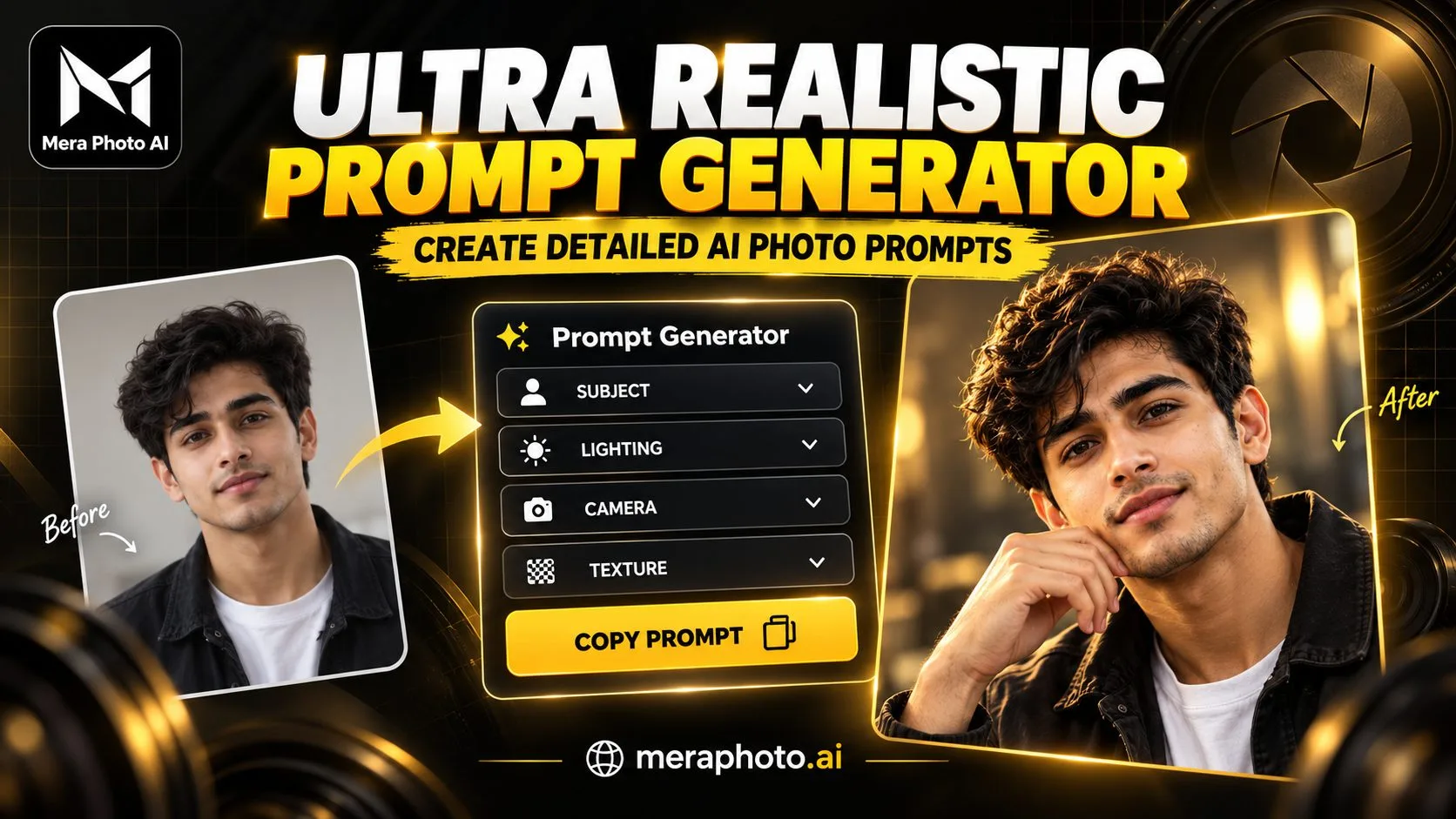
AI tools can create professional portraits, product photographs, lifestyle images, food visuals, travel scenes, wedding concepts, and social media content. However, realistic output does not depend only on adding words such as “8K,” “HD,” or “ultra realistic” to a short instruction.
A believable AI photograph requires a clear subject, logical lighting, realistic materials, natural skin texture, accurate proportions, suitable camera composition, and a consistent environment.
An ultra realistic prompt generator helps organize these details into one structured instruction. Instead of writing every photography requirement manually, users can select or describe their visual idea and receive a detailed prompt that can be customized for a compatible AI image-generation tool.
In this guide, you will learn what an ultra realistic prompt generator is, how it works, what details it should include, and how to write effective prompts for different photography categories.
What Is an Ultra Realistic Prompt Generator?
An ultra realistic prompt generator is a tool, template, or structured system that converts a simple visual idea into a detailed AI image prompt.
For example, a user may enter:
A professional portrait of an Indian man.
A structured prompt generator can expand this idea by adding:
Subject description
Outfit and accessories
Pose and expression
Background and location
Lighting direction
Camera view
Lens characteristics
Depth of field
Natural textures
Colour grading
Aspect ratio
Negative instructions
The expanded prompt gives an AI image tool more information about the intended result.
An ultra realistic prompt generator does not guarantee a perfect or genuinely photographic result. Its purpose is to create a clearer and more complete starting point.
How Does an Ultra Realistic Prompt Generator Work?
A prompt generator generally collects important visual details from the user and arranges them into a logical sequence.
The process may include the following stages:
The user selects an image category.
The user describes the main subject.
The generator asks for an outfit or product design.
The user selects a pose and expression.
A background or location is added.
Lighting and mood are selected.
Camera framing and orientation are defined.
Realistic textures and environmental details are included.
Important negative instructions are added.
The generator creates a complete prompt.
The generated prompt can then be copied, customized, and used with a compatible AI image-generation or editing platform.
Why Use an Ultra Realistic Prompt Generator?
Saves Time
A structured generator can produce a detailed starting point without requiring you to write every visual instruction manually.
Makes Prompt Writing Easier
Beginners may not know which photography details should be included. A structured generator works like a practical checklist.
Reduces Missing Information
A complete prompt is less likely to forget important elements such as:
Identity preservation
Lighting direction
Camera view
Background details
Natural textures
Aspect ratio
Negative instructions
Supports Consistent Results
When the same prompt structure is used across multiple images, it becomes easier to maintain a consistent photography direction.
Supports Multiple Categories
An ultra realistic prompt generator can help create instructions for:
Professional portraits
Social media photographs
Business headshots
Wedding concepts
Couple portraits
Product photographs
Fashion editorials
Food photography
Travel visuals
Real-estate images
Blog banners
Marketing creatives
Photo restoration
Lifestyle photography
Helps Users Customize Existing Ideas
Users can begin with a ready-made visual concept and then change the outfit, background, pose, lighting, colour palette, or composition.
Important Elements of an Ultra Realistic Prompt
A realistic prompt should focus on visual logic instead of using random quality-related words.
Subject
Clearly explain who or what should appear in the image.
The subject may be:
A man or woman
A boy or girl
A couple
A family
A professional
A product
A vehicle
A building
A food item
A natural landscape
Identity
If a personal reference photograph is being used, mention which facial characteristics must remain recognizable.
Identity instructions may cover:
Facial structure
Natural skin tone
Approximate age
Eyes and eyebrows
Nose and lips
Jawline
Hairstyle
Distinctive facial characteristics
Outfit and Accessories
Describe the type, colour, fabric, fit, and overall style of the clothing.
Include accessories only when they support the visual concept. Too many accessories can hide important facial details or create visual errors.
Pose and Expression
Explain the position of the body, head, arms, and hands.
Choose an expression that matches the purpose:
Friendly for personal profiles
Confident for professional portraits
Calm for premium editorials
Energetic for creator profiles
Joyful for festival photographs
Natural and relaxed for lifestyle images
Background and Location
A realistic subject needs a believable environment.
The location may be:
Professional studio
Modern office
Luxury hotel
Outdoor street
Heritage property
Mountain landscape
Beach
Café
Garden
Wedding venue
Product studio
Home interior
Lighting
Lighting should match the environment and time of day.
Useful lighting descriptions include:
Soft natural window light
Diffused morning sunlight
Warm golden-hour lighting
Balanced studio lighting
Cinematic side lighting
Soft overcast daylight
Warm indoor ambient lighting
Controlled product lighting
Camera View
Specify how much of the subject should appear.
Common options include:
Extreme close-up
Close-up portrait
Headshot
Head-and-shoulders portrait
Half-body photograph
Three-quarter-body composition
Full-body photograph
Wide environmental portrait
Overhead product shot
Low-angle composition
Photography Style
Use one primary photography style.
Examples include:
Professional portrait photography
Cinematic photography
Fashion editorial photography
Lifestyle photography
Documentary-style photography
Product photography
Food photography
Architectural photography
Wedding photography
Realistic Details
Small imperfections can make an image appear more believable.
Request details such as:
Natural skin pores
Minor facial lines
Fine hair strands
Flyaway hair
Realistic fabric creases
Surface variation
Natural shadows
Accurate reflections
Environmental depth
Believable material texture
Minimal retouching
Aspect Ratio
Select the ratio according to the final use.
| Intended use | Recommended ratio |
|---|---|
| Profile picture | 1:1 |
| Instagram portrait | 4:5 |
| Story, Reel or Status | 9:16 |
| YouTube thumbnail | 16:9 |
| Blog banner | 16:9 |
| Product listing | 1:1 or 4:5 |
| Landscape photograph | 3:2 or 16:9 |
| Mobile wallpaper | 9:16 |
| Desktop wallpaper | 16:9 |
Negative Instructions
Mention the most important unwanted elements.
Useful negative instructions may include:
No distorted hands
No extra fingers
No duplicate objects
No plastic skin
No excessive beauty retouching
No incorrect reflections
No unrealistic body proportions
No random text
No unwanted logos
No excessive background clutter
An extremely long list of negative instructions can make the prompt difficult to interpret. Keep only the restrictions that matter to the scene.
Ultra Realistic Prompt Formula
You can use this simple structure:
Create a photorealistic [type of photograph] featuring [subject]. Dress or design the subject with [outfit or product details]. Show [pose and expression] in [location]. Use [lighting], [camera angle], [composition], [photography style], [textures], [colour grading], and [aspect ratio]. Preserve [important details]. Avoid [major unwanted elements].
This formula can be customized for portraits, products, food, weddings, travel, fashion, and business photography.
Ultra Realistic Prompt Generator Examples
1. Professional Male Headshot
Create an ultra-realistic professional headshot of a young Indian man wearing a tailored navy-blue suit over a crisp white shirt. Show him facing the camera with a confident but approachable expression. Place him against a clean light-grey studio background.
Use soft and balanced studio lighting, sharp focus on the eyes, natural skin pores, realistic facial shadows, fine hair texture, subtle colour correction, and minimal retouching. Keep sufficient space around the head and shoulders for circular cropping.
Use an eye-level camera angle, head-and-shoulders composition, professional corporate photography, and a vertical 4:5 aspect ratio. Avoid plastic skin, distorted facial features, excessive accessories, random text, and visible logos.
2. Professional Female Headshot
Create an ultra-realistic professional profile portrait of a young Indian woman wearing a tailored beige blazer over a simple white top. Show a friendly and confident expression with natural eye contact.
Use a clean neutral studio background, diffused facial lighting, sharp eyes, realistic skin texture, fine hair strands, natural facial proportions, detailed clothing fabric, and subtle professional colour grading.
Use an eye-level camera angle, head-and-shoulders framing, shallow depth of field, and a vertical 4:5 aspect ratio. Leave sufficient space for circular cropping. Avoid excessive makeup, artificial skin smoothing, distorted facial features, text, and logos.
3. Cinematic Male Portrait
Create an ultra-realistic cinematic portrait of a stylish young Indian man standing beside a dark textured wall. Dress him in a fitted black shirt, tailored charcoal trousers, and a minimal wristwatch.
Show him standing confidently with one hand inside his trouser pocket while looking calmly toward the camera. Keep the complete face bright and clearly visible.
Use dramatic but logical side lighting, a soft warm rim light, natural skin pores, detailed hair, realistic fabric folds, deep environmental shadows, shallow depth of field, and premium black-and-gold colour grading.
Use a three-quarter-body composition, slightly low camera angle, editorial photography, and a vertical 4:5 aspect ratio. Avoid crushed facial shadows, distorted hands, extra fingers, heavy skin smoothing, text, and logos.
4. Traditional Indian Woman Portrait
Create an ultra-realistic traditional portrait of a young Indian woman wearing an elegant deep-red saree with refined golden embroidery and balanced traditional jewellery.
Place her inside a beautifully decorated heritage courtyard with warm lamps, flowers, and traditional architectural details. Show her standing gracefully while gently holding the saree drape with one hand.
Use warm evening lighting, balanced facial exposure, natural skin texture, realistic jewellery reflections, detailed embroidery, soft background blur, and premium cultural photography.
Use an eye-level camera angle, three-quarter-body composition, and a vertical 4:5 aspect ratio. Avoid excessive jewellery, distorted fingers, plastic skin, duplicated decorations, random text, and logos.
5. Indian Couple Portrait
Create an ultra-realistic portrait of a young Indian couple standing together inside a softly illuminated heritage courtyard.
Preserve both identities separately if reference photographs are supplied. Do not merge, swap, or redesign their facial features.
Dress the man in an ivory embroidered kurta with a matching jacket. Dress the woman in a deep-green traditional outfit with subtle golden details and refined jewellery.
Show them standing beside each other with natural smiles and relaxed body language. Keep both faces equally prominent and all hands clearly visible.
Use warm string lights, soft facial lighting, natural skin texture, detailed fabric, realistic shadows, and cinematic depth of field. Use a three-quarter-body composition and vertical 4:5 aspect ratio. Avoid merged faces, distorted fingers, excessive jewellery, artificial skin, and text.
6. Fashion Street Photograph
Create an ultra-realistic street-fashion photograph of a young Indian man walking through a clean modern city street.
Dress him in an oversized olive jacket, plain black T-shirt, relaxed-fit trousers, and clean white sneakers. Capture a natural walking pose with confident body language.
Use soft daylight, realistic environmental depth, subtle motion, natural skin tone, detailed street surfaces, realistic fabric texture, and modern editorial colour grading.
Use a full-body composition, slightly low camera angle, shallow depth of field, and a vertical 4:5 ratio. Avoid crowded backgrounds, distorted legs, extra fingers, visible brand logos, and excessive blur.
7. Luxury Product Photograph
Create an ultra-realistic studio product photograph of a premium black wristwatch placed on a dark textured stone surface.
Position the watch at a three-quarter angle so that the dial, crown, strap, and material details remain clearly visible. Add a subtle reflection beneath the product.
Use controlled softbox lighting, a narrow warm rim light, realistic metal reflections, accurate glass transparency, detailed leather texture, balanced shadows, and premium commercial colour grading.
Use a close-up composition and square 1:1 aspect ratio. Avoid incorrect numbers, distorted watch hands, duplicate parts, dust overload, random text, brand logos, and unrealistic reflections.
8. Realistic Food Photograph
Create an ultra-realistic overhead food photograph of freshly prepared Indian biryani served in an elegant copper handi.
Include detailed rice grains, natural saffron tones, visible spices, fresh herbs, fried onions, and realistic steam. Add a small bowl of raita and a simple salad beside the main dish.
Use warm restaurant lighting, realistic food texture, controlled highlights, natural shadows, balanced colours, and premium editorial food photography.
Use a top-down composition and square 1:1 aspect ratio. Avoid oversaturated colours, artificial shine, duplicate utensils, messy arrangement, random text, and logos.
9. Travel Photograph
Create an ultra-realistic travel photograph of a young Indian woman standing beside a calm mountain lake during early morning.
Dress her in a comfortable beige jacket, dark trousers, and practical travel shoes. Show her looking naturally toward the mountains with relaxed body language.
Use soft morning sunlight, realistic mountain reflections, light atmospheric mist, natural fabric movement, detailed ground texture, balanced skin tones, and cinematic travel colour grading.
Use a wide environmental composition and vertical 4:5 aspect ratio. Avoid artificial mountains, incorrect reflections, distorted hands, excessive fog, text, and logos.
10. Luxury Car Portrait
Create an ultra-realistic lifestyle portrait of a fashionable young Indian man standing beside a premium black luxury SUV in a modern urban environment during golden hour.
Dress him in a clean cream overshirt over a white T-shirt, tailored black trousers, and minimal accessories. Show him leaning lightly against the vehicle while looking confidently toward the camera.
Use warm sunset light, balanced illumination on the face, realistic vehicle reflections, accurate wheel proportions, natural skin texture, detailed clothing fabric, shallow depth of field, and premium automotive colour grading.
Use a three-quarter-body composition and vertical 4:5 aspect ratio. Avoid distorted wheels, incorrect reflections, extra fingers, random text, watermarks, and unauthorized brand marks.
11. Modern Home Interior
Create an ultra-realistic photograph of a modern premium living room featuring neutral furniture, warm wooden surfaces, large windows, and subtle indoor plants.
Arrange the sofa, chairs, coffee table, lighting fixtures, and decorative items with believable proportions and sufficient walking space.
Use soft daylight entering through the windows, realistic material textures, accurate glass reflections, natural shadows, balanced white tones, and professional interior photography.
Use a wide eye-level composition and horizontal 16:9 aspect ratio. Avoid distorted furniture, impossible architecture, duplicate objects, extreme wide-angle warping, text, and logos.
12. Wedding Couple Portrait
Create an ultra-realistic Indian wedding portrait of a young bride and groom standing inside a royal wedding venue.
Dress the groom in an ivory sherwani featuring subtle golden embroidery. Dress the bride in a deep-red bridal lehenga with refined golden details, a coordinated dupatta, and tasteful traditional jewellery.
Show them standing close together with natural smiles. Keep both faces equally visible and clearly describe the position of each hand.
Use warm wedding lights, floral decorations, realistic clothing embroidery, natural skin texture, detailed jewellery, soft background blur, and premium wedding colour grading.
Use a full-body vertical 4:5 composition. Avoid merged faces, extra fingers, incorrect jewellery, excessive skin smoothing, crowded decorations, text, and logos.
How to Create Your Own Ultra Realistic Prompt
Step 1: Select the Image Purpose
First decide where the image will be used.
Possible purposes include:
Profile picture
Social media post
Product listing
Marketing campaign
Blog banner
Business presentation
Wedding concept
Mobile wallpaper
Creative portfolio
Step 2: Describe the Main Subject
Identify the person, product, location, or object that should receive the most attention.
Step 3: Choose One Visual Style
Select a realistic photography direction instead of combining many unrelated styles.
Step 4: Add a Believable Environment
The background, weather, time, and location should support the subject.
Step 5: Define the Lighting
Explain where the light comes from and how it affects the face, object, and environment.
Step 6: Select the Camera View
Choose a suitable composition based on how much of the subject needs to appear.
Step 7: Add Natural Details
Include realistic textures, small imperfections, and material characteristics.
Step 8: Add the Aspect Ratio
Select the ratio according to the intended platform.
Step 9: Add Important Restrictions
Mention only the most relevant unwanted elements.
Step 10: Review and Simplify
Remove repeated, conflicting, or unnecessary instructions before using the prompt.
How to Preserve Identity in Realistic Portraits
If you want to preserve your identity, provide a clear and well-lit reference photograph where supported.
A suitable reference image should have:
Clearly visible facial details
Sharp eyes
Natural skin tone
Balanced lighting
Minimal filters
No large sunglasses
No hair covering the face
A simple background
Sufficient resolution
You can add the following instruction:
Preserve the subject’s recognizable facial identity, facial structure, natural skin tone, age, hairstyle, eyes, eyebrows, nose, lips, jawline, and distinctive facial characteristics. Do not replace, reshape, whiten, merge, or excessively beautify the face.
Reference photographs and detailed instructions may improve consistency, but an identical result is not guaranteed.
Tips for More Realistic AI Images
Use Photography Language Carefully
Terms such as close-up, eye-level, shallow depth of field, softbox lighting, and golden hour are useful when they accurately describe the scene.
Avoid Random Technical Words
Adding multiple camera names, lenses, resolutions, and quality terms does not automatically make an image realistic.
Keep the Lighting Logical
Do not request bright midday sunlight and dark indoor studio lighting in the same scene unless their relationship is clearly explained.
Request Natural Skin
Useful details include:
Natural pores
Fine facial lines
Realistic shadows
Fine hair strands
Balanced skin colour
Minimal retouching
Describe Materials
Mention whether a surface is made of metal, wood, glass, silk, cotton, leather, stone, or another material.
Explain Hand Placement
For portraits and couple photographs, clearly state what each hand should be doing.
Generate Multiple Versions
Random variation is part of AI generation. Create several results and select the one that best matches your requirements.
Review the Complete Image
Inspect:
Facial identity
Eyes and teeth
Hands and fingers
Body proportions
Clothing details
Product geometry
Background objects
Reflections and shadows
Text and spelling
Unwanted logos
Privacy concerns
Common Mistakes to Avoid
Providing too little information: A generator cannot produce a precise prompt if the visual goal is unclear.
Adding conflicting requirements: Inconsistent lighting, locations, or styles can create a confusing result.
Forgetting identity preservation: Personal portraits require clear instructions about recognizable features.
Using an overly long prompt: More words do not always improve the output.
Repeating the same instruction: Repetition can make the prompt harder to interpret.
Using too many negative instructions: Keep only the restrictions that materially affect the image.
Depending only on “8K” or “HD”: Resolution-related terms cannot replace clear visual direction.
Expecting identical results: AI-generated outputs can vary between tools and attempts.
Trusting the output without review: A detailed prompt does not guarantee an error-free image.
Limitations of Ultra Realistic Prompt Generators
Prompt generators can improve structure, but they have limitations:
They cannot guarantee photographic accuracy.
They may add unnecessary details.
They may misunderstand cultural requirements.
They cannot guarantee facial identity preservation.
They may generate conflicting instructions.
Results vary across AI models.
Complex hands and reflections may remain incorrect.
Text inside generated images may contain errors.
Commercial-use conditions vary across platforms.
A realistic image may still represent something that never happened.
Human review remains essential.
Ethical Use of Realistic AI Images
Ultra-realistic images can sometimes be mistaken for actual photographs. Use them responsibly.
Follow these practices:
Do not create misleading images of real people.
Obtain permission before uploading someone else’s photograph.
Do not impersonate professionals, public figures, or private individuals.
Do not present fictional events as documentary evidence.
Avoid deceptive product images.
Respect privacy, copyright, and trademarks.
Review platform terms before commercial use.
Disclose AI involvement when context requires transparency.
Do not create harmful, defamatory, or fraudulent visuals.
Find Ultra Realistic Prompts on Mera Photo AI
Mera Photo AI is an AI photography prompt discovery platform where users can explore inspiring AI-generated images, view the prompts behind them, and copy customizable prompts.
The platform provides a practical starting point for users who do not want to write every photography instruction from scratch.
You can:
Browse visual concepts.
Select an image style.
View its detailed prompt.
Copy the prompt.
Customize the subject, outfit, pose, and background.
Use it with a compatible AI image-generation tool.
Review the result before publishing.
Mera Photo AI does not directly generate images. It helps users discover visual concepts and copy detailed prompts for compatible third-party AI tools.
Frequently Asked Questions
Q. What is an ultra realistic prompt generator?
A. An ultra realistic prompt generator converts a simple visual idea into a detailed AI image instruction covering the subject, pose, background, lighting, camera view, photography style, textures, aspect ratio, and important negative instructions.
Q. Can a prompt generator make an image?
A. A prompt generator normally creates written instructions. The generated prompt must be used with a compatible AI image-generation or editing tool.
Q. What makes an AI prompt realistic?
A. A realistic prompt uses a clear subject, believable environment, logical lighting, accurate proportions, natural materials, suitable camera composition, and small real-world details.
Q. Does adding “8K” make an image realistic?
A. No. Quality terms may communicate the desired finish, but they cannot replace clear instructions about the subject, lighting, composition, textures, and environment.
Q. How long should an ultra realistic prompt be?
A. The prompt should be long enough to explain the important visual requirements but short enough to avoid repetition and conflicting details.
Q. Can I use my photograph as a reference?
A. Yes, where the selected AI platform supports reference images. Upload only photographs that belong to you or that you have permission to use.
Q. How can I preserve my face?
A. Use a clear reference photograph and ask the AI tool to preserve your facial structure, natural skin tone, age, hairstyle, eyes, eyebrows, nose, lips, and jawline.
Q. Will the AI image look exactly like my reference photograph?
A. Identical results are not guaranteed. A clear reference image and detailed instructions may improve consistency, but the output can still vary.
Q. Which aspect ratio is best for portraits?
A. Use 4:5 for social media portraits, 1:1 for profile pictures, and 9:16 for Stories, Reels, Status, or mobile wallpapers.
Q. Can an ultra realistic prompt generator create product prompts?
A. Yes. A product prompt can describe the product design, material, surface, position, lighting, reflections, background, camera angle, and intended commercial style.
Q. Can generated images be used commercially?
A. Commercial-use conditions depend on the AI platform, subscription plan, reference materials, generated content, and applicable laws. Review the relevant terms before commercial use.
Q. Is Mera Photo AI an ultra realistic prompt generator?
A. Mera Photo AI primarily works as an AI photography prompt discovery platform. Users can explore example images and copy detailed, customizable prompts for different visual concepts.
Q. Is Mera Photo AI an image generator?
A. No. Mera Photo AI does not directly generate images. It provides visual inspiration and customizable prompt text for use with compatible third-party AI tools.
Conclusion
An ultra realistic prompt generator helps transform a simple idea into a structured AI photography instruction. It can save time, make prompt writing easier, reduce missing details, and support a consistent visual direction.
Realism does not come from adding random words such as “8K,” “HD,” or “masterpiece.” A believable result requires a clear subject, suitable pose, logical lighting, realistic textures, correct camera composition, and a consistent background.
Before using a generated prompt, review it for repeated, conflicting, or unnecessary instructions. After creating the image, inspect the face, hands, proportions, reflections, materials, background objects, and text.
Visit Mera Photo AI to explore visual concepts and copy detailed AI photography prompts. Choose an idea, customize the prompt, use it with a compatible AI tool, and carefully review the final image before publishing.