7

Mera Photo AI @meraphotoai
30 views
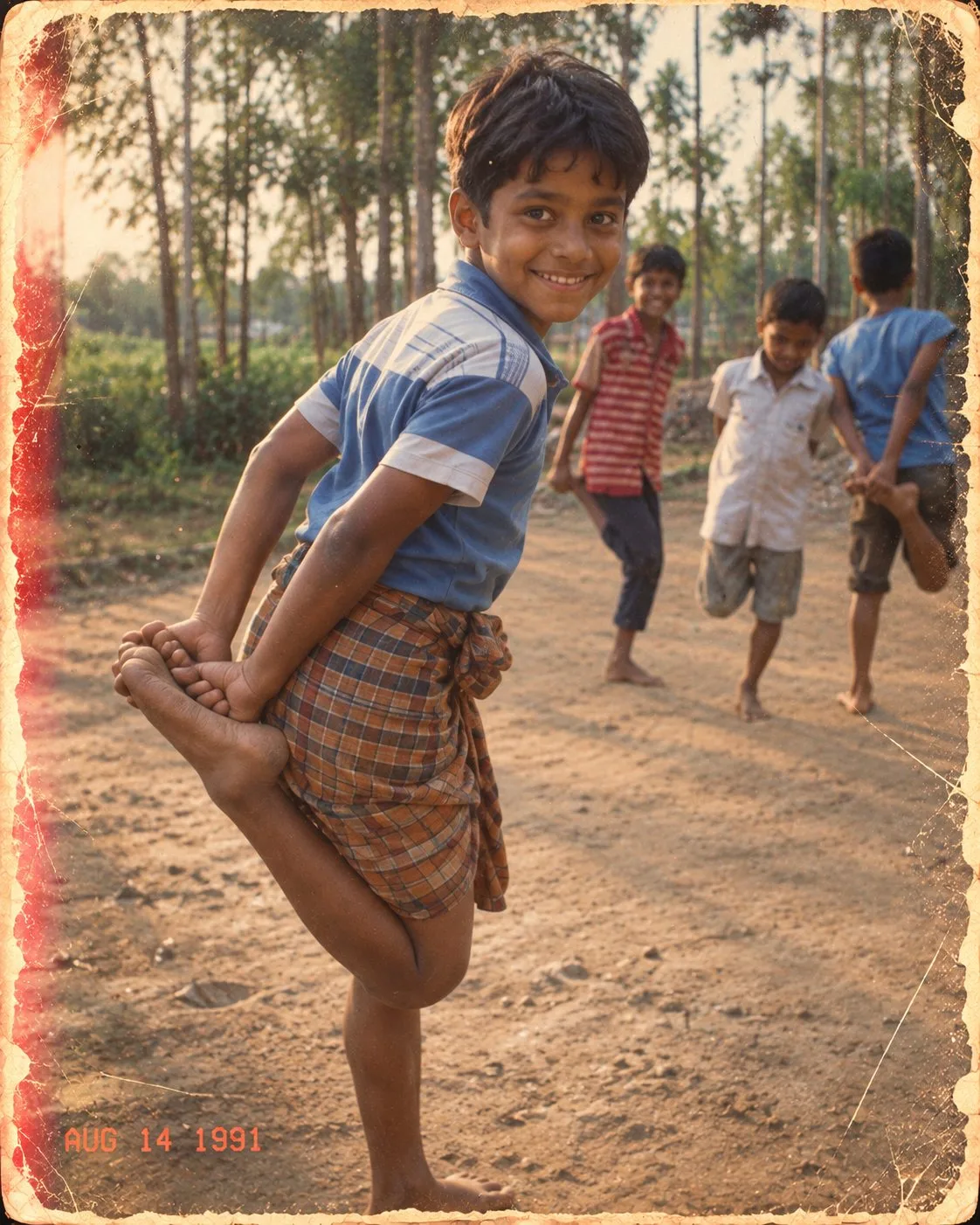
1990s Indian Boy Playing Balance Game Photo
Create an ultra-realistic vertical 4:5 nostalgic early-1990s Indian childhood photograph showing EXACTLY ONE fictional Indian boy playing an old childhood balance game on a dusty rural village ground.
STRICT SUBJECT RULE:
There must be ONLY ONE human being in the entire photograph.
No second child.
No friends.
No adults.
No people in the background.
No distant silhouettes.
IDENTITY:
Create a completely fresh fictional Indian boy around 10–12 years old.
His identity must be clearly different from the reference child, previously generated faces, celebrities, public figures and known people.
FACE — HIGHEST PRIORITY:
Bring the boy relatively CLOSE TO THE CAMERA.
His face must be clearly visible toward the camera.
He should:
- turn his upper body naturally toward the photographer
- look directly into the camera
- have both eyes clearly visible
- show a cheerful natural childhood smile
- have warm medium-brown Indian skin
- have a fresh youthful Indian facial structure
- have expressive dark-brown eyes
- have short slightly messy black hair
- have natural eyebrows
- have realistic teeth
- have natural skin texture
- have slight outdoor perspiration and dust
No sunglasses.
No makeup.
No beauty filter.
POSE:
The boy is balancing barefoot on ONE leg while performing a playful standing quad-stretch pose.
His supporting leg remains straight and naturally balanced on the dusty ground.
The opposite leg bends backward at the knee.
He holds the raised bare foot behind him with BOTH hands.
His shoulders and face rotate toward the camera so that his smiling face is clearly visible.
Make the pose feel playful, spontaneous and slightly imperfect, like a child having fun rather than performing a professional exercise.
CLOSE CAMERA COMPOSITION:
Use a closer vertical portrait than a wide environmental shot.
The boy should occupy approximately 65–75% of the frame height.
Camera should be around the child's chest/eye level.
Keep:
- face prominent
- upper body clearly visible
- both hands visible
- bent leg and held foot visible
- supporting bare foot visible
Do not make the boy tiny in the frame.
CLOTHING:
Dress him in authentic inexpensive early-1990s Indian childhood clothing.
Use:
- faded dusty-blue short-sleeve collared shirt
- cream/off-white horizontal shoulder and sleeve stripes
- slightly loose period-correct fit
- naturally faded cotton fabric
- brown, rust and muted-blue checked cotton wrap/short lungi-style garment
- barefoot
Clothing should look:
- slightly worn
- repeatedly washed
- mildly dusty
- inexpensive
- practical for rural childhood
For future variations, subtly change the shirt shade, stripe pattern and checked fabric colours while maintaining authentic early-1990s styling.
No modern logos.
No modern sportswear.
No sneakers.
No smartwatch.
ENVIRONMENT:
A peaceful early-1990s rural Indian open ground.
Include:
- wide dusty earth
- scattered tiny stones
- patches of dry grass
- tall slender trees
- dense natural greenery
- distant simple village structures
- small soil/hay mound
- warm late-afternoon countryside atmosphere
Keep the background naturally soft but still recognisable.
ABSOLUTELY NO OTHER PEOPLE:
The entire background must remain EMPTY of humans.
No children copying the pose.
No boys standing behind.
No girl at the edge.
No adults.
No villagers.
No distant pedestrians.
Only ONE fictional Indian boy exists in the photograph.
LIGHTING:
Warm golden-hour Indian sunlight coming from the left/rear side.
Create:
- soft rim light around hair
- warm highlights on face
- natural skin illumination
- long subtle ground shadow
- slight authentic lens flare
- gentle golden atmosphere
Avoid modern studio lighting.
1991 ANALOG FILM LOOK — CRITICAL:
The final photograph must genuinely look like it was captured in India in August 1991.
Do NOT simply apply a modern vintage filter.
Simulate an inexpensive early-1990s consumer 35mm colour-negative camera.
Use:
- naturally faded colours
- warm amber cast
- restrained saturation
- organic medium 35mm grain
- slightly muted blacks
- creamy highlights
- mild optical softness
- imperfect exposure
- gentle film halation
- subtle colour bleeding
- tiny black speckles
- film dust
- fine random scratches
- slight processing imperfections
FACE QUALITY:
Despite the analog treatment, the boy's FACE must remain clearly readable and naturally detailed.
Preserve:
- sharp expressive eyes
- natural smile
- realistic teeth
- individual hair strands
- natural Indian skin texture
- realistic ears
- natural skin-tone variation
Do not over-sharpen.
OLD INDIAN FAMILY-ALBUM EFFECT:
Make the final result resemble an original physical photograph discovered inside an Indian family album after more than 30 years.
Add:
- aged cream/off-white photographic border
- irregular distressed edges
- worn rounded corners
- small edge tears
- cracked photo emulsion
- subtle yellowing
- random dust particles
- tiny brown stains
- fine scratches
- slight crease marks
- naturally faded areas
Add a noticeable reddish-orange film burn/light leak mainly along the LEFT border.
Keep major scratches away from the boy's eyes and face.
DATE STAMP:
Add an authentic faded orange-red analog date stamp at the bottom-left:
“AUG 14 1991”
Make it look naturally exposed into the old photograph with:
- imperfect spacing
- soft character edges
- slight fading
- mild colour bleed
- subtle misalignment
CAMERA CHARACTER:
Early-1990s consumer 35mm colour-film camera,
approximately 50mm vintage lens,
ISO 200,
f/4,
1/500 sec,
natural golden-hour daylight.
QUALITY:
High-resolution restored scan while preserving genuine analog imperfections.
Ensure:
- anatomically correct body
- realistic hands
- five natural fingers
- correct bent leg
- realistic bare foot being held
- correct supporting foot
- believable balance
- detailed fabric
- natural hair
- realistic skin
NEGATIVE PROMPT:
multiple children, second child, background children, adults, crowd, spectators, people, silhouettes, group photo, hidden face, back-facing boy, face turned away, looking downward, blurred face, copied identity, celebrity resemblance, modern fashion, modern sneakers, smartphone, smartwatch, tattoos, branded clothing, plastic skin, beauty filter, excessive HDR, extreme bokeh, studio lighting, modern cinematic grading, CGI, 3D render, cartoon, illustration, malformed hands, extra fingers, extra arms, duplicate legs, extra feet, impossible body pose, watermark, stock watermark, social-media UI, modern text overlay.
FINAL RESULT:
A believable August 1991 Indian childhood photograph featuring ONE fictional Indian boy alone on a dusty rural ground.
He is brought relatively close to the camera, balancing barefoot on one leg while holding his other foot behind him with both hands. His upper body turns toward the photographer and his cheerful smiling face looks directly into the camera.
Tall trees, rural greenery and warm sunset light establish the countryside environment, but NO OTHER PEOPLE are visible anywhere.
Authentic faded 35mm colours, organic grain, scratches, distressed cream edges, reddish left-side light leak and an “AUG 14 1991” date stamp make it look like a genuine photograph recovered from an old Indian family album.
STRICT SUBJECT RULE:
There must be ONLY ONE human being in the entire photograph.
No second child.
No friends.
No adults.
No people in the background.
No distant silhouettes.
IDENTITY:
Create a completely fresh fictional Indian boy around 10–12 years old.
His identity must be clearly different from the reference child, previously generated faces, celebrities, public figures and known people.
FACE — HIGHEST PRIORITY:
Bring the boy relatively CLOSE TO THE CAMERA.
His face must be clearly visible toward the camera.
He should:
- turn his upper body naturally toward the photographer
- look directly into the camera
- have both eyes clearly visible
- show a cheerful natural childhood smile
- have warm medium-brown Indian skin
- have a fresh youthful Indian facial structure
- have expressive dark-brown eyes
- have short slightly messy black hair
- have natural eyebrows
- have realistic teeth
- have natural skin texture
- have slight outdoor perspiration and dust
No sunglasses.
No makeup.
No beauty filter.
POSE:
The boy is balancing barefoot on ONE leg while performing a playful standing quad-stretch pose.
His supporting leg remains straight and naturally balanced on the dusty ground.
The opposite leg bends backward at the knee.
He holds the raised bare foot behind him with BOTH hands.
His shoulders and face rotate toward the camera so that his smiling face is clearly visible.
Make the pose feel playful, spontaneous and slightly imperfect, like a child having fun rather than performing a professional exercise.
CLOSE CAMERA COMPOSITION:
Use a closer vertical portrait than a wide environmental shot.
The boy should occupy approximately 65–75% of the frame height.
Camera should be around the child's chest/eye level.
Keep:
- face prominent
- upper body clearly visible
- both hands visible
- bent leg and held foot visible
- supporting bare foot visible
Do not make the boy tiny in the frame.
CLOTHING:
Dress him in authentic inexpensive early-1990s Indian childhood clothing.
Use:
- faded dusty-blue short-sleeve collared shirt
- cream/off-white horizontal shoulder and sleeve stripes
- slightly loose period-correct fit
- naturally faded cotton fabric
- brown, rust and muted-blue checked cotton wrap/short lungi-style garment
- barefoot
Clothing should look:
- slightly worn
- repeatedly washed
- mildly dusty
- inexpensive
- practical for rural childhood
For future variations, subtly change the shirt shade, stripe pattern and checked fabric colours while maintaining authentic early-1990s styling.
No modern logos.
No modern sportswear.
No sneakers.
No smartwatch.
ENVIRONMENT:
A peaceful early-1990s rural Indian open ground.
Include:
- wide dusty earth
- scattered tiny stones
- patches of dry grass
- tall slender trees
- dense natural greenery
- distant simple village structures
- small soil/hay mound
- warm late-afternoon countryside atmosphere
Keep the background naturally soft but still recognisable.
ABSOLUTELY NO OTHER PEOPLE:
The entire background must remain EMPTY of humans.
No children copying the pose.
No boys standing behind.
No girl at the edge.
No adults.
No villagers.
No distant pedestrians.
Only ONE fictional Indian boy exists in the photograph.
LIGHTING:
Warm golden-hour Indian sunlight coming from the left/rear side.
Create:
- soft rim light around hair
- warm highlights on face
- natural skin illumination
- long subtle ground shadow
- slight authentic lens flare
- gentle golden atmosphere
Avoid modern studio lighting.
1991 ANALOG FILM LOOK — CRITICAL:
The final photograph must genuinely look like it was captured in India in August 1991.
Do NOT simply apply a modern vintage filter.
Simulate an inexpensive early-1990s consumer 35mm colour-negative camera.
Use:
- naturally faded colours
- warm amber cast
- restrained saturation
- organic medium 35mm grain
- slightly muted blacks
- creamy highlights
- mild optical softness
- imperfect exposure
- gentle film halation
- subtle colour bleeding
- tiny black speckles
- film dust
- fine random scratches
- slight processing imperfections
FACE QUALITY:
Despite the analog treatment, the boy's FACE must remain clearly readable and naturally detailed.
Preserve:
- sharp expressive eyes
- natural smile
- realistic teeth
- individual hair strands
- natural Indian skin texture
- realistic ears
- natural skin-tone variation
Do not over-sharpen.
OLD INDIAN FAMILY-ALBUM EFFECT:
Make the final result resemble an original physical photograph discovered inside an Indian family album after more than 30 years.
Add:
- aged cream/off-white photographic border
- irregular distressed edges
- worn rounded corners
- small edge tears
- cracked photo emulsion
- subtle yellowing
- random dust particles
- tiny brown stains
- fine scratches
- slight crease marks
- naturally faded areas
Add a noticeable reddish-orange film burn/light leak mainly along the LEFT border.
Keep major scratches away from the boy's eyes and face.
DATE STAMP:
Add an authentic faded orange-red analog date stamp at the bottom-left:
“AUG 14 1991”
Make it look naturally exposed into the old photograph with:
- imperfect spacing
- soft character edges
- slight fading
- mild colour bleed
- subtle misalignment
CAMERA CHARACTER:
Early-1990s consumer 35mm colour-film camera,
approximately 50mm vintage lens,
ISO 200,
f/4,
1/500 sec,
natural golden-hour daylight.
QUALITY:
High-resolution restored scan while preserving genuine analog imperfections.
Ensure:
- anatomically correct body
- realistic hands
- five natural fingers
- correct bent leg
- realistic bare foot being held
- correct supporting foot
- believable balance
- detailed fabric
- natural hair
- realistic skin
NEGATIVE PROMPT:
multiple children, second child, background children, adults, crowd, spectators, people, silhouettes, group photo, hidden face, back-facing boy, face turned away, looking downward, blurred face, copied identity, celebrity resemblance, modern fashion, modern sneakers, smartphone, smartwatch, tattoos, branded clothing, plastic skin, beauty filter, excessive HDR, extreme bokeh, studio lighting, modern cinematic grading, CGI, 3D render, cartoon, illustration, malformed hands, extra fingers, extra arms, duplicate legs, extra feet, impossible body pose, watermark, stock watermark, social-media UI, modern text overlay.
FINAL RESULT:
A believable August 1991 Indian childhood photograph featuring ONE fictional Indian boy alone on a dusty rural ground.
He is brought relatively close to the camera, balancing barefoot on one leg while holding his other foot behind him with both hands. His upper body turns toward the photographer and his cheerful smiling face looks directly into the camera.
Tall trees, rural greenery and warm sunset light establish the countryside environment, but NO OTHER PEOPLE are visible anywhere.
Authentic faded 35mm colours, organic grain, scratches, distressed cream edges, reddish left-side light leak and an “AUG 14 1991” date stamp make it look like a genuine photograph recovered from an old Indian family album.