2096

Mera Photo AI @meraphotoai
4,794 views
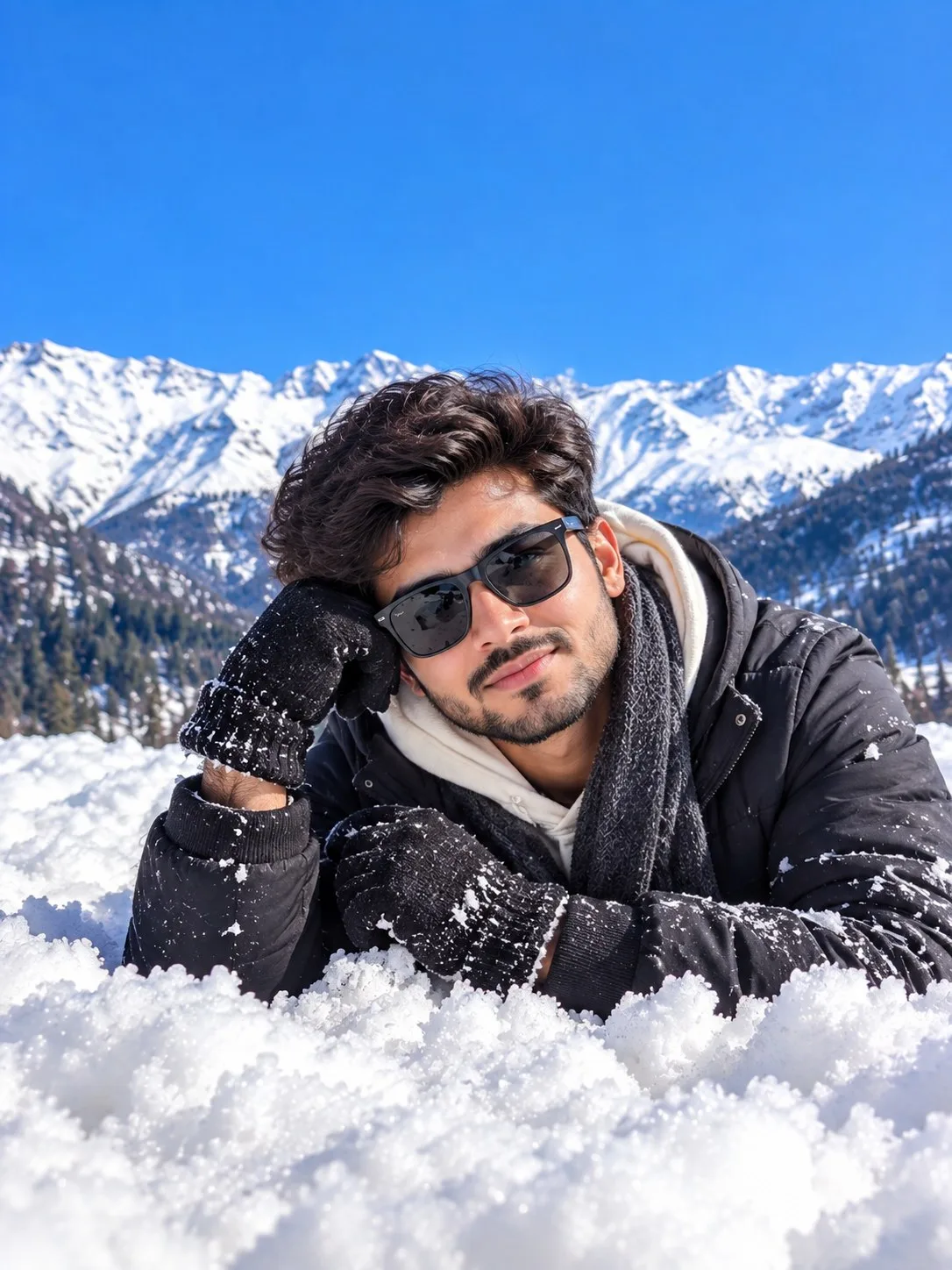
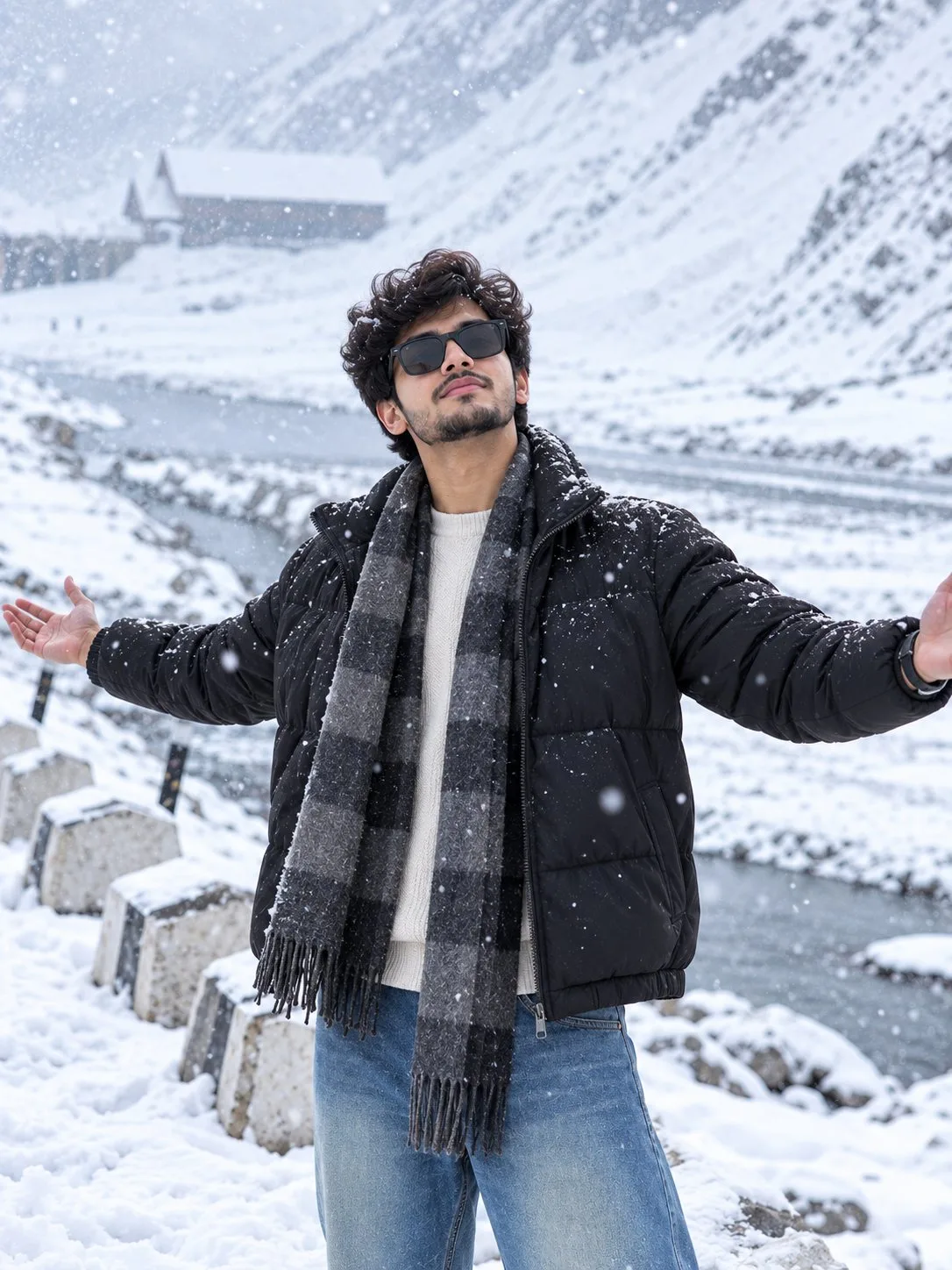
Cinematic Snowfall Boy Close-Up Photo
Use the uploaded person’s photo as the identity reference. Preserve the uploaded person’s facial identity accurately while recreating the hairstyle, winter clothing, open-arm pose, close 3:4 framing, active snowfall, snow-covered Himalayan valley, winding mountain road/stream, distant building, natural overcast daylight and professional cinematic winter-photography style described below.
Create an ultra-photorealistic, high-resolution VERTICAL 3:4 CINEMATIC CLOSE-UP WINTER PORTRAIT of one young adult Indian man enjoying fresh snowfall in a dramatic Himalayan mountain valley.
SUBJECT & IDENTITY:
Show ONLY ONE young adult Indian man.
If the user uploads his own photo, preserve his facial identity accurately, including:
• face shape
• forehead
• eyebrows
• eye region
• nose
• lips
• cheeks
• jawline
• chin
• ears
• natural Indian complexion
• distinctive facial proportions
Maintain natural facial asymmetry and authentic human characteristics.
FACE & EXPRESSION:
Keep his face clearly visible.
Tilt his head slightly upward toward the falling snow while keeping enough of his face directed toward the camera for clear identity recognition.
Give him a peaceful, confident expression.
Keep:
• relaxed forehead
• naturally raised chin
• relaxed lips
• defined jawline
• subtle sense of happiness
• calm winter-travel mood
Do not use an exaggerated smile.
HAIRSTYLE:
Give him thick, voluminous, medium-length naturally curly/wavy dark brown-black hair.
Use:
• loose irregular curls
• naturally messy volume
• textured front
• realistic hairline
• individual strands
• tiny flyaway hairs
• subtle wind movement
• small naturally accumulated snowflakes
The hair must look genuinely wet/cold-weather affected rather than perfectly styled.
FACIAL HAIR:
Give him neat youthful facial hair with:
• light moustache
• short beard along jawline
• subtle cheek stubble
• defined chin beard
• individual beard follicles
• naturally uneven density
SUNGLASSES:
Give him stylish matte-black rectangular sunglasses with dark smoky lenses.
Render:
• contemporary thick frame
• realistic nose placement
• natural temple fit
• subtle snowy landscape reflections
• soft grey-sky reflections
• realistic highlights on the lenses
OUTFIT – BLACK PUFFER JACKET:
Dress him in a completely plain matte BLACK winter puffer jacket.
Use:
• thick insulated construction
• horizontal padded sections
• slightly oversized relaxed fit
• raised open collar
• full sleeves
• elasticated cuffs
• front zipper
• realistic stitching
• natural fabric compression
• subtle wrinkles
• realistic matte synthetic texture
Allow individual snowflakes to naturally collect on the shoulders, chest, sleeves and collar.
Keep the jacket completely plain and unbranded.
INNER SWEATER:
Under the jacket, dress him in a completely plain warm CREAM / OFF-WHITE knitted sweater.
Use:
• medium-weight winter knit
• crew neckline
• visible knit fibres
• ribbed neckline
• subtle warm ivory tone
• natural folds
• realistic fabric thickness
Keep it plain without text, graphics or logos.
CHARCOAL PLAID SCARF:
Wrap a long CHARCOAL-GREY winter scarf loosely around his neck.
The scarf should hang naturally down the front of his body.
Use:
• dark charcoal base
• subtle grey plaid/check pattern
• soft woven wool texture
• naturally uneven drape
• long hanging ends
• realistic folds
• visible woven fibres
• fringed lower edges
Allow small snowflakes to settle naturally on the scarf.
BLUE JEANS:
Dress him in relaxed LIGHT-TO-MEDIUM BLUE jeans.
Use:
• loose contemporary fit
• authentic denim texture
• subtle faded areas
• realistic seams
• natural hip folds
• visible stitching
• believable fabric weight
Keep them completely plain and unbranded.
WATCH:
Add a simple dark wristwatch on one wrist.
Keep it understated and realistic.
OPEN-ARM SNOWFALL POSE:
Create a joyful but natural open-arm pose.
Extend BOTH ARMS outward to either side of his body.
Keep the arms slightly below shoulder level.
Turn both palms naturally upward/open as though he is feeling the falling snow.
Use:
• naturally bent elbows
• relaxed shoulders
• realistic wrists
• anatomically correct hands
• properly formed fingers
• slight backward lean
• chest naturally open
• head gently tilted upward
The pose should communicate freedom and enjoyment without looking theatrical.
3:4 CINEMATIC CLOSE-UP COMPOSITION:
Use a VERTICAL 3:4 aspect ratio.
Bring the camera significantly closer than a normal full-body travel photo.
Frame approximately from the COMPLETE TOP OF HIS HAIR down to the upper thighs.
Keep both extended arms visible within the composition as much as naturally possible.
Do not crop the top of his hair.
Make the subject large and dominant in the frame.
Keep his face, curly hair, sunglasses, scarf and jacket as the primary visual focus.
Retain enough of the snowy valley behind him to clearly establish the Himalayan winter location.
ACTIVE SNOWFALL:
Show genuine active snowfall throughout the scene.
Use snowflakes at several optical distances:
• tiny sharp flakes around the subject
• medium flakes near his jacket and hair
• a few large softly blurred flakes close to the lens
• fine distant snowfall across the valley
Snowflakes should vary naturally in:
• size
• sharpness
• brightness
• direction
• distance
Do not create identical artificial snow particles.
Some snow should naturally settle on:
• curly hair
• jacket shoulders
• jacket sleeves
• scarf
• nearby surfaces
SNOW-COVERED HIMALAYAN VALLEY:
Preserve the broad snow-covered mountain valley behind the man.
Show:
• deep white snow
• steep mountain slopes
• irregular rocky areas
• naturally accumulated snow
• soft atmospheric haze
• realistic winter depth
• subtle distant details
The environment should feel cold, expansive and genuinely Himalayan.
MOUNTAIN SLOPES:
Keep the steep snow-covered mountains rising behind him.
Use:
• irregular rocky surfaces
• exposed dark-grey rock
• deep snow channels
• natural ridgelines
• patches of accumulated snow
• atmospheric softness with distance
Avoid fantasy mountains or exaggerated peaks.
WINDING ROAD / STREAM:
Preserve the existing dark winding road or narrow water channel cutting naturally through the snowy valley.
It should curve through the middle background and provide natural visual depth.
Keep its edges irregular and surrounded by accumulated snow.
ROAD BARRIERS:
Preserve the existing concrete roadside barriers visible along the snowy foreground/valley edge.
Render:
• rough concrete texture
• uneven weathering
• accumulated snow on top
• realistic grey-white tones
• believable perspective
Do not introduce additional barriers.
DISTANT BUILDING:
Preserve the existing simple distant mountain building with its peaked roof.
Keep it softly visible through the snowy atmosphere.
It should remain a minor environmental element and must not compete with the subject.
Do not add any extra buildings.
OVERCAST WINTER SKY:
Use a naturally pale grey-white Himalayan winter sky.
Keep it softly diffused because of active snowfall and cloud cover.
Avoid dramatic artificial blue skies.
The sky should merge naturally with the snowy mountain atmosphere.
LIGHTING:
Use soft diffused natural winter daylight.
Snow should act as a natural reflector and gently illuminate the face from multiple directions.
Create subtle realistic highlights on:
• hair
• sunglasses
• nose
• cheekbones
• lips
• jacket
• scarf fibres
• cream sweater
• snowflakes
Avoid harsh artificial studio lighting.
Keep facial exposure balanced against the bright snow.
SKIN REALISM:
Because this is a close portrait, prioritise genuine Indian skin texture.
Render:
• visible pores
• forehead texture
• cheek texture
• realistic nose texture
• subtle under-eye details
• natural lips
• eyebrow hairs
• beard follicles
• moustache hairs
• fine facial hairs
• natural complexion variation
• subtle cold-weather redness
• tiny real-world imperfections
Do not use plastic skin, excessive smoothing or beauty filters.
HAIR DETAIL:
Clearly resolve:
• individual curly strands
• overlapping curls
• root density
• natural dark-brown highlights
• tiny flyaway hairs
• subtle moisture
• individual snowflakes caught between strands
PUFFER JACKET DETAIL:
Clearly render:
• individual padded sections
• stitching
• zipper
• matte synthetic fibres
• natural compression
• wrinkles around elbows
• realistic snow accumulation
• tiny wet areas from melting flakes
SCARF DETAIL:
Clearly render:
• wool fibres
• subtle plaid pattern
• fringed edges
• realistic overlapping fabric
• folds
• snowflakes resting on the surface
SWEATER DETAIL:
Clearly show:
• knitted fibres
• ribbed neckline
• subtle cream tonal variation
• natural fabric folds
SNOW DETAIL:
Render snow with realistic:
• crystalline texture
• uneven accumulation
• compressed sections
• blue-grey shadow areas
• bright diffused highlights
• footprints/disturbed areas where appropriate
• soft powder on concrete surfaces
DEPTH OF FIELD:
Use professional optical depth.
Keep:
FACE — extremely sharp
HAIR — extremely sharp
SUNGLASSES — sharp
PUFFER JACKET — highly detailed
SCARF — highly detailed
CREAM SWEATER — detailed
NEARBY SNOWFLAKES — mixed sharp and blurred
CONCRETE BARRIERS — moderately detailed
WINDING ROAD / STREAM — clearly recognisable
DISTANT BUILDING — softly rendered
MOUNTAINS — naturally softened by snowfall and atmospheric depth
Do not completely blur the environment.
CAMERA & OPTICS:
Simulate a premium full-frame mirrorless camera.
Use approximately:
• 70–85mm environmental portrait lens
• vertical 3:4 composition
• eye-level/slightly lower camera position
• close camera-to-subject distance
• f/3.2–f/4
• ISO 200
• 1/800–1/1250 sec shutter
• continuous face autofocus
• cloudy/daylight white balance
• high dynamic range
• realistic lens compression
• natural optical sharpness
Use a sufficiently fast shutter speed to freeze many snowflakes while allowing a few close flakes to appear naturally soft.
COLOR GRADING:
Use premium cinematic Himalayan winter photography grading.
Maintain:
• naturally warm Indian skin
• dark brown-black curly hair
• matte-black sunglasses
• deep black puffer jacket
• warm cream sweater
• charcoal-grey plaid scarf
• natural blue denim
• clean white snow
• subtle blue-grey snow shadows
• dark winding road/water
• neutral grey rocks
• pale atmospheric winter sky
Create gentle warm-versus-cool separation between the subject’s skin and the snowy environment.
Keep colours realistic rather than heavily saturated.
PHOTOREALISM:
Prioritise genuine real-camera realism.
Clearly resolve:
• authentic skin pores
• facial asymmetry
• beard follicles
• individual hair strands
• realistic sunglasses reflections
• puffer stitching
• sweater knit
• scarf fibres
• denim weave
• anatomically correct hands
• individual snowflakes
• wet/melting snow
• concrete texture
• mountain geology
• atmospheric snowfall
Include subtle real-world photographic imperfections.
SCENE PRESERVATION:
Preserve only the natural and existing elements of this snowy mountain scene.
Do not add any extra text, logo, board, signboard, placard, watermark, advertisement, artificial landmark, decorative object or unrelated scene element.
FINAL RESULT:
Create an ultra-photorealistic high-resolution VERTICAL 3:4 CINEMATIC CLOSE-UP winter travel portrait of one young adult Indian man standing in active Himalayan snowfall.
Keep his face clearly visible with thick naturally curly dark hair, youthful facial hair and matte-black rectangular sunglasses.
Dress him in a plain matte-black puffer jacket over a warm cream knitted sweater, a long charcoal-grey plaid wool scarf and relaxed blue jeans.
Capture him with both arms extended naturally outward, palms open, chest relaxed and head gently tilted upward as he enjoys the falling snow.
Make the subject large in the frame from head to upper thighs while preserving the snow-covered Himalayan valley, winding dark road/stream, concrete barriers, steep snowy mountain slopes and the existing distant peaked-roof building.
Use genuine multi-layer snowfall, soft overcast winter daylight, authentic Indian skin texture, realistic snow accumulation, highly detailed winter clothing and premium full-frame-camera realism.
The final result must look like a genuine professionally captured photograph during real Himalayan snowfall, not an AI-generated image.
Create an ultra-photorealistic, high-resolution VERTICAL 3:4 CINEMATIC CLOSE-UP WINTER PORTRAIT of one young adult Indian man enjoying fresh snowfall in a dramatic Himalayan mountain valley.
SUBJECT & IDENTITY:
Show ONLY ONE young adult Indian man.
If the user uploads his own photo, preserve his facial identity accurately, including:
• face shape
• forehead
• eyebrows
• eye region
• nose
• lips
• cheeks
• jawline
• chin
• ears
• natural Indian complexion
• distinctive facial proportions
Maintain natural facial asymmetry and authentic human characteristics.
FACE & EXPRESSION:
Keep his face clearly visible.
Tilt his head slightly upward toward the falling snow while keeping enough of his face directed toward the camera for clear identity recognition.
Give him a peaceful, confident expression.
Keep:
• relaxed forehead
• naturally raised chin
• relaxed lips
• defined jawline
• subtle sense of happiness
• calm winter-travel mood
Do not use an exaggerated smile.
HAIRSTYLE:
Give him thick, voluminous, medium-length naturally curly/wavy dark brown-black hair.
Use:
• loose irregular curls
• naturally messy volume
• textured front
• realistic hairline
• individual strands
• tiny flyaway hairs
• subtle wind movement
• small naturally accumulated snowflakes
The hair must look genuinely wet/cold-weather affected rather than perfectly styled.
FACIAL HAIR:
Give him neat youthful facial hair with:
• light moustache
• short beard along jawline
• subtle cheek stubble
• defined chin beard
• individual beard follicles
• naturally uneven density
SUNGLASSES:
Give him stylish matte-black rectangular sunglasses with dark smoky lenses.
Render:
• contemporary thick frame
• realistic nose placement
• natural temple fit
• subtle snowy landscape reflections
• soft grey-sky reflections
• realistic highlights on the lenses
OUTFIT – BLACK PUFFER JACKET:
Dress him in a completely plain matte BLACK winter puffer jacket.
Use:
• thick insulated construction
• horizontal padded sections
• slightly oversized relaxed fit
• raised open collar
• full sleeves
• elasticated cuffs
• front zipper
• realistic stitching
• natural fabric compression
• subtle wrinkles
• realistic matte synthetic texture
Allow individual snowflakes to naturally collect on the shoulders, chest, sleeves and collar.
Keep the jacket completely plain and unbranded.
INNER SWEATER:
Under the jacket, dress him in a completely plain warm CREAM / OFF-WHITE knitted sweater.
Use:
• medium-weight winter knit
• crew neckline
• visible knit fibres
• ribbed neckline
• subtle warm ivory tone
• natural folds
• realistic fabric thickness
Keep it plain without text, graphics or logos.
CHARCOAL PLAID SCARF:
Wrap a long CHARCOAL-GREY winter scarf loosely around his neck.
The scarf should hang naturally down the front of his body.
Use:
• dark charcoal base
• subtle grey plaid/check pattern
• soft woven wool texture
• naturally uneven drape
• long hanging ends
• realistic folds
• visible woven fibres
• fringed lower edges
Allow small snowflakes to settle naturally on the scarf.
BLUE JEANS:
Dress him in relaxed LIGHT-TO-MEDIUM BLUE jeans.
Use:
• loose contemporary fit
• authentic denim texture
• subtle faded areas
• realistic seams
• natural hip folds
• visible stitching
• believable fabric weight
Keep them completely plain and unbranded.
WATCH:
Add a simple dark wristwatch on one wrist.
Keep it understated and realistic.
OPEN-ARM SNOWFALL POSE:
Create a joyful but natural open-arm pose.
Extend BOTH ARMS outward to either side of his body.
Keep the arms slightly below shoulder level.
Turn both palms naturally upward/open as though he is feeling the falling snow.
Use:
• naturally bent elbows
• relaxed shoulders
• realistic wrists
• anatomically correct hands
• properly formed fingers
• slight backward lean
• chest naturally open
• head gently tilted upward
The pose should communicate freedom and enjoyment without looking theatrical.
3:4 CINEMATIC CLOSE-UP COMPOSITION:
Use a VERTICAL 3:4 aspect ratio.
Bring the camera significantly closer than a normal full-body travel photo.
Frame approximately from the COMPLETE TOP OF HIS HAIR down to the upper thighs.
Keep both extended arms visible within the composition as much as naturally possible.
Do not crop the top of his hair.
Make the subject large and dominant in the frame.
Keep his face, curly hair, sunglasses, scarf and jacket as the primary visual focus.
Retain enough of the snowy valley behind him to clearly establish the Himalayan winter location.
ACTIVE SNOWFALL:
Show genuine active snowfall throughout the scene.
Use snowflakes at several optical distances:
• tiny sharp flakes around the subject
• medium flakes near his jacket and hair
• a few large softly blurred flakes close to the lens
• fine distant snowfall across the valley
Snowflakes should vary naturally in:
• size
• sharpness
• brightness
• direction
• distance
Do not create identical artificial snow particles.
Some snow should naturally settle on:
• curly hair
• jacket shoulders
• jacket sleeves
• scarf
• nearby surfaces
SNOW-COVERED HIMALAYAN VALLEY:
Preserve the broad snow-covered mountain valley behind the man.
Show:
• deep white snow
• steep mountain slopes
• irregular rocky areas
• naturally accumulated snow
• soft atmospheric haze
• realistic winter depth
• subtle distant details
The environment should feel cold, expansive and genuinely Himalayan.
MOUNTAIN SLOPES:
Keep the steep snow-covered mountains rising behind him.
Use:
• irregular rocky surfaces
• exposed dark-grey rock
• deep snow channels
• natural ridgelines
• patches of accumulated snow
• atmospheric softness with distance
Avoid fantasy mountains or exaggerated peaks.
WINDING ROAD / STREAM:
Preserve the existing dark winding road or narrow water channel cutting naturally through the snowy valley.
It should curve through the middle background and provide natural visual depth.
Keep its edges irregular and surrounded by accumulated snow.
ROAD BARRIERS:
Preserve the existing concrete roadside barriers visible along the snowy foreground/valley edge.
Render:
• rough concrete texture
• uneven weathering
• accumulated snow on top
• realistic grey-white tones
• believable perspective
Do not introduce additional barriers.
DISTANT BUILDING:
Preserve the existing simple distant mountain building with its peaked roof.
Keep it softly visible through the snowy atmosphere.
It should remain a minor environmental element and must not compete with the subject.
Do not add any extra buildings.
OVERCAST WINTER SKY:
Use a naturally pale grey-white Himalayan winter sky.
Keep it softly diffused because of active snowfall and cloud cover.
Avoid dramatic artificial blue skies.
The sky should merge naturally with the snowy mountain atmosphere.
LIGHTING:
Use soft diffused natural winter daylight.
Snow should act as a natural reflector and gently illuminate the face from multiple directions.
Create subtle realistic highlights on:
• hair
• sunglasses
• nose
• cheekbones
• lips
• jacket
• scarf fibres
• cream sweater
• snowflakes
Avoid harsh artificial studio lighting.
Keep facial exposure balanced against the bright snow.
SKIN REALISM:
Because this is a close portrait, prioritise genuine Indian skin texture.
Render:
• visible pores
• forehead texture
• cheek texture
• realistic nose texture
• subtle under-eye details
• natural lips
• eyebrow hairs
• beard follicles
• moustache hairs
• fine facial hairs
• natural complexion variation
• subtle cold-weather redness
• tiny real-world imperfections
Do not use plastic skin, excessive smoothing or beauty filters.
HAIR DETAIL:
Clearly resolve:
• individual curly strands
• overlapping curls
• root density
• natural dark-brown highlights
• tiny flyaway hairs
• subtle moisture
• individual snowflakes caught between strands
PUFFER JACKET DETAIL:
Clearly render:
• individual padded sections
• stitching
• zipper
• matte synthetic fibres
• natural compression
• wrinkles around elbows
• realistic snow accumulation
• tiny wet areas from melting flakes
SCARF DETAIL:
Clearly render:
• wool fibres
• subtle plaid pattern
• fringed edges
• realistic overlapping fabric
• folds
• snowflakes resting on the surface
SWEATER DETAIL:
Clearly show:
• knitted fibres
• ribbed neckline
• subtle cream tonal variation
• natural fabric folds
SNOW DETAIL:
Render snow with realistic:
• crystalline texture
• uneven accumulation
• compressed sections
• blue-grey shadow areas
• bright diffused highlights
• footprints/disturbed areas where appropriate
• soft powder on concrete surfaces
DEPTH OF FIELD:
Use professional optical depth.
Keep:
FACE — extremely sharp
HAIR — extremely sharp
SUNGLASSES — sharp
PUFFER JACKET — highly detailed
SCARF — highly detailed
CREAM SWEATER — detailed
NEARBY SNOWFLAKES — mixed sharp and blurred
CONCRETE BARRIERS — moderately detailed
WINDING ROAD / STREAM — clearly recognisable
DISTANT BUILDING — softly rendered
MOUNTAINS — naturally softened by snowfall and atmospheric depth
Do not completely blur the environment.
CAMERA & OPTICS:
Simulate a premium full-frame mirrorless camera.
Use approximately:
• 70–85mm environmental portrait lens
• vertical 3:4 composition
• eye-level/slightly lower camera position
• close camera-to-subject distance
• f/3.2–f/4
• ISO 200
• 1/800–1/1250 sec shutter
• continuous face autofocus
• cloudy/daylight white balance
• high dynamic range
• realistic lens compression
• natural optical sharpness
Use a sufficiently fast shutter speed to freeze many snowflakes while allowing a few close flakes to appear naturally soft.
COLOR GRADING:
Use premium cinematic Himalayan winter photography grading.
Maintain:
• naturally warm Indian skin
• dark brown-black curly hair
• matte-black sunglasses
• deep black puffer jacket
• warm cream sweater
• charcoal-grey plaid scarf
• natural blue denim
• clean white snow
• subtle blue-grey snow shadows
• dark winding road/water
• neutral grey rocks
• pale atmospheric winter sky
Create gentle warm-versus-cool separation between the subject’s skin and the snowy environment.
Keep colours realistic rather than heavily saturated.
PHOTOREALISM:
Prioritise genuine real-camera realism.
Clearly resolve:
• authentic skin pores
• facial asymmetry
• beard follicles
• individual hair strands
• realistic sunglasses reflections
• puffer stitching
• sweater knit
• scarf fibres
• denim weave
• anatomically correct hands
• individual snowflakes
• wet/melting snow
• concrete texture
• mountain geology
• atmospheric snowfall
Include subtle real-world photographic imperfections.
SCENE PRESERVATION:
Preserve only the natural and existing elements of this snowy mountain scene.
Do not add any extra text, logo, board, signboard, placard, watermark, advertisement, artificial landmark, decorative object or unrelated scene element.
FINAL RESULT:
Create an ultra-photorealistic high-resolution VERTICAL 3:4 CINEMATIC CLOSE-UP winter travel portrait of one young adult Indian man standing in active Himalayan snowfall.
Keep his face clearly visible with thick naturally curly dark hair, youthful facial hair and matte-black rectangular sunglasses.
Dress him in a plain matte-black puffer jacket over a warm cream knitted sweater, a long charcoal-grey plaid wool scarf and relaxed blue jeans.
Capture him with both arms extended naturally outward, palms open, chest relaxed and head gently tilted upward as he enjoys the falling snow.
Make the subject large in the frame from head to upper thighs while preserving the snow-covered Himalayan valley, winding dark road/stream, concrete barriers, steep snowy mountain slopes and the existing distant peaked-roof building.
Use genuine multi-layer snowfall, soft overcast winter daylight, authentic Indian skin texture, realistic snow accumulation, highly detailed winter clothing and premium full-frame-camera realism.
The final result must look like a genuine professionally captured photograph during real Himalayan snowfall, not an AI-generated image.