92

Mera Photo AI @meraphotoai
246 views
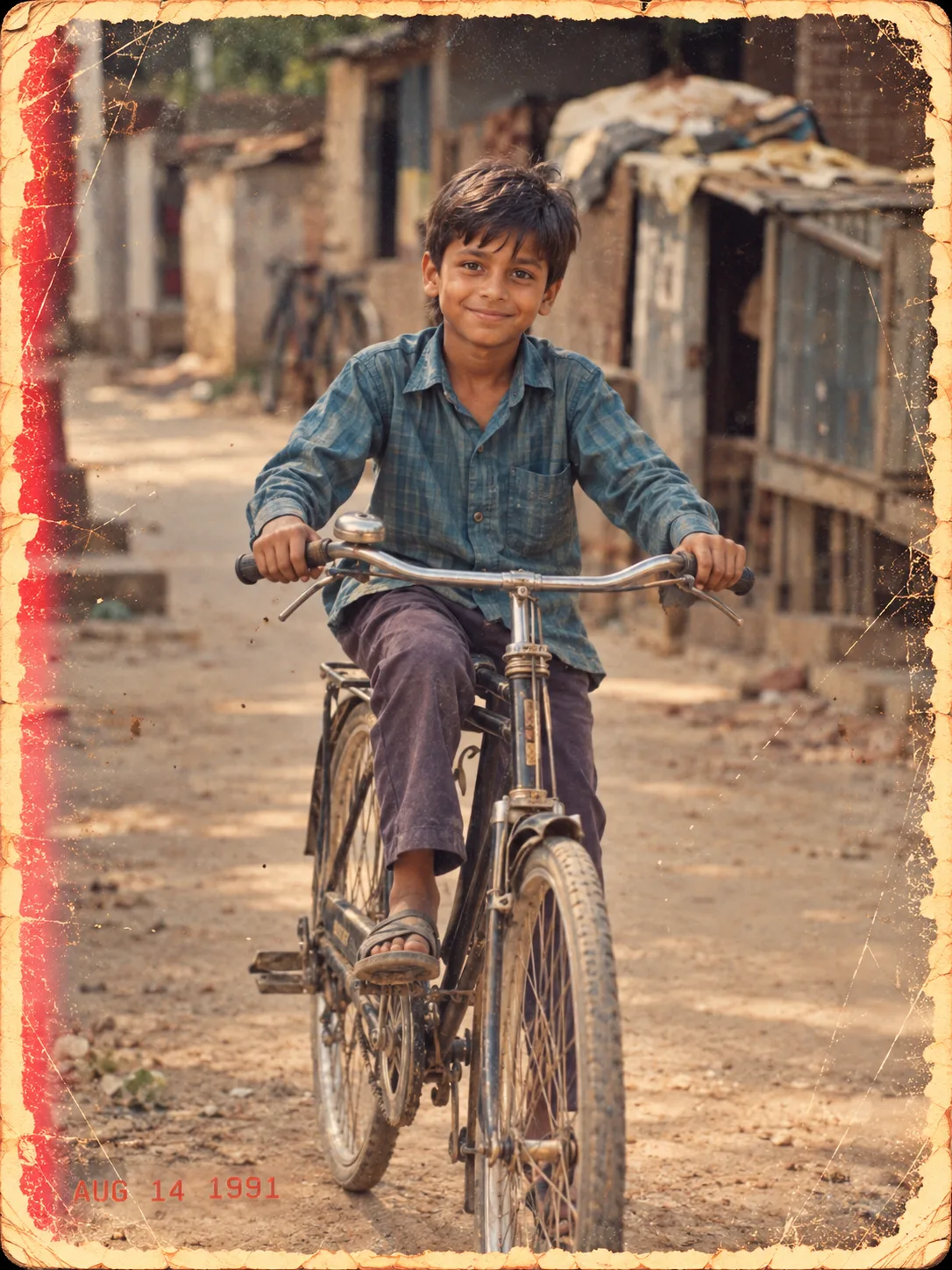
1990s Indian Boy Riding Old Bicycle Photo
Create an ultra-realistic vertical 4:5 nostalgic early-1990s Indian childhood photograph showing EXACTLY ONE fictional Indian village boy, approximately 9–11 years old, riding an old black road bicycle directly toward the camera on a dusty rural lane.
MAIN SUBJECT:
Create a completely fresh fictional Indian boy with a unique identity.
He must NOT resemble the reference child, any previously generated person, celebrity, public figure or known individual.
APPEARANCE:
- 9–11-year-old Indian boy
- warm medium-brown Indian skin
- age-appropriate youthful facial structure
- expressive dark-brown eyes
- short naturally messy black hair
- natural eyebrows
- slim childhood build
- realistic skin texture
- subtle outdoor dust
- innocent village-child appearance
FACE — HIGHEST PRIORITY:
The boy's face must be DIRECTLY TOWARD THE CAMERA.
Both eyes must be completely visible and looking straight into the lens.
Give him a gentle natural CLOSED-MOUTH smile.
No visible teeth.
No open-mouth laugh.
No sunglasses.
No face turned sideways.
No looking down.
Keep the eyes and facial details naturally sharp.
ACTION:
The boy is actively riding the bicycle slowly toward the photographer.
He sits naturally on the bicycle seat and holds the curved chrome handlebar correctly with BOTH hands.
His body faces forward.
One foot presses naturally on a pedal while the opposite pedal sits at a different height.
Create believable cycling posture and balance.
The front bicycle wheel should point almost directly toward the camera, creating subtle perspective and depth.
The scene should feel like a spontaneous childhood photograph rather than a fashion shoot.
BICYCLE:
Use an authentic old Indian roadster bicycle appropriate for the late 1980s / early 1990s.
Include:
- old black steel frame
- large thin wheels
- dusty tyres
- chrome curved handlebar
- small traditional metal bell
- metal mudguards
- old chain guard
- rear carrier
- slightly rusty nuts and bolts
- naturally worn paint
- dust and minor scratches
- simple old pedals
No modern mountain bike.
No gears.
No disc brakes.
No modern branding.
No plastic sports accessories.
CLOTHING:
Dress the boy in simple inexpensive early-1990s Indian clothing.
Use:
- faded dusty teal / blue-green long-sleeve cotton button-up shirt
- subtle muted check pattern
- slightly oversized relaxed fit
- naturally rolled/wrinkled sleeves
- small chest pocket
- faded dark purple-brown loose cotton trousers
- old grey/brown open sandals
The clothing should look:
- repeatedly washed
- naturally faded
- slightly dusty
- inexpensive
- practical
- period-correct
No modern logos or branded fashion.
STRICT SINGLE-SUBJECT RULE:
Show EXACTLY ONE human in the entire image.
No passenger on bicycle.
No second child.
No girl.
No adults.
No villagers.
No people standing in shops.
No background silhouettes.
No partial bodies.
The boy must be the ONLY person visible anywhere in the photograph.
RURAL / OLD NEIGHBOURHOOD SETTING:
Create a modest early-1990s Indian village or semi-rural neighbourhood lane.
Include:
- dusty unpaved earth road
- old weathered brick and plaster houses
- small rustic corrugated-metal shed
- aged wooden doors
- weathered tin sheets
- old sacks or folded fabric on a shed roof
- scattered small stones
- subtle dry vegetation
- another old bicycle leaning against a distant wall
- simple household structures
- naturally worn surroundings
Background should look genuinely lived-in, old and inexpensive.
Remove all:
- watermarks
- stock-photo marks
- signs
- readable advertisements
- modern vehicles
- modern buildings
- social-media UI
COMPOSITION:
Vertical 4:5 old family-album photograph.
Bring the boy CLOSE TO THE CAMERA.
He should occupy roughly 70–80% of the image height.
Place him centrally.
The bicycle's front wheel should appear prominent in the lower foreground and naturally lead the viewer's eye toward the boy's face.
Show:
- complete face
- both eyes
- both hands
- handlebar
- torso
- legs
- pedals
- front wheel
- most of the bicycle
Use a child-height or slightly low camera position.
FACE must be the strongest focal point.
DEPTH OF FIELD:
Use moderate period-believable shallow depth of field.
Boy's face and upper body = sharp.
Handlebar and bicycle = detailed.
Immediate road = reasonably detailed.
Old sheds and houses = softly blurred.
Do NOT use extreme smartphone portrait-mode blur.
AUTHENTIC 1991 FILM LOOK — CRITICAL:
The photograph must genuinely look like it was captured in India on AUGUST 14, 1991.
Do NOT create a modern digital photograph with a vintage filter.
Simulate an inexpensive early-1990s consumer 35mm colour-negative camera.
Use:
- warm faded colours
- restrained saturation
- organic medium film grain
- subtle amber/cream cast
- muted blacks
- creamy warm highlights
- moderate contrast
- mild optical softness
- imperfect exposure
- subtle colour bleeding
- gentle highlight halation
- tiny black film speckles
- dust particles
- random fine scratches
- minor film-processing imperfections
Keep the boy's eyes and face naturally clear.
OLD INDIAN FAMILY-ALBUM PRINT:
Make the result resemble a real physical photograph preserved for more than 30 years.
Add:
- thick aged cream/off-white photographic border
- irregular heavily worn edges
- distressed rounded corners
- cracked photo emulsion
- peeling border areas
- tiny edge tears
- fine scratches
- dust particles
- subtle brown age stains
- faint crease marks
- naturally yellowed photographic paper
- faded patches
Add a noticeable RED-ORANGE LIGHT LEAK / FILM BURN running vertically along the LEFT EDGE.
Keep major scratches away from the boy's eyes and face.
DATE STAMP:
Add a faded orange-red analog date imprint at the bottom-left:
“AUG 14 1991”
Make it look genuinely exposed into the original photograph:
- slightly uneven spacing
- imperfect alignment
- soft character edges
- subtle colour bleed
- mild fading
LIGHTING:
Use warm natural Indian afternoon daylight.
Create:
- soft warm light across the boy's face
- natural highlights on messy hair
- realistic warm Indian skin
- soft reflections on the chrome bicycle handlebar
- natural shadows beneath the bicycle
- gentle golden atmosphere
No studio lighting.
No flash-heavy appearance.
No modern cinematic lighting.
CAMERA CHARACTER:
Early-1990s consumer 35mm colour-film camera,
approximately 45–50mm vintage lens,
ISO 200,
f/4,
1/500 sec,
natural afternoon daylight.
QUALITY:
Create a high-resolution restored scan while retaining genuine analog character.
Preserve:
- expressive dark eyes
- closed-mouth smile
- realistic Indian skin
- individual hair strands
- anatomically correct hands
- five natural fingers
- correct child proportions
- realistic bicycle geometry
- correctly positioned pedals
- natural legs and feet
- realistic cotton fabric
- old steel and chrome textures
- believable dust and rust
NEGATIVE PROMPT:
multiple children, second child, bicycle passenger, adults, background people, crowd, pedestrians, duplicate boy, copied identity, celebrity resemblance, side-facing face, looking away, looking downward, hidden eyes, blurred face, open mouth, visible teeth, exaggerated laugh, sunglasses, modern fashion, modern bicycle, mountain bike, sports bicycle, gears, disc brakes, helmet, smartphone, smartwatch, tattoos, branded clothing, modern road, cars, motorcycles, modern shops, plastic skin, beauty filter, excessive HDR, extreme bokeh, studio lighting, teal-orange cinematic grading, CGI, 3D render, cartoon, illustration, malformed hands, extra fingers, duplicate arms, extra legs, broken bicycle geometry, warped wheels, watermark, 123RF watermark, stock-photo text, logos, social-media UI.
FINAL RESULT:
A believable August 14, 1991 Indian childhood photograph showing ONE fictional 9–11-year-old Indian boy riding an old black roadster bicycle directly toward the camera along a dusty village lane.
The boy looks straight into the lens with expressive eyes and a gentle closed-mouth smile. He wears a faded teal checked shirt, dark loose trousers and old sandals.
Weathered village houses, rustic metal sheds and the dusty road create an authentic early-1990s Indian childhood environment.
Warm faded 35mm colours, organic film grain, dust, scratches, heavily distressed cream borders, a red-orange left-edge film burn and an “AUG 14 1991” date stamp make the result look like a genuine photograph rediscovered in an old Indian family album.
MAIN SUBJECT:
Create a completely fresh fictional Indian boy with a unique identity.
He must NOT resemble the reference child, any previously generated person, celebrity, public figure or known individual.
APPEARANCE:
- 9–11-year-old Indian boy
- warm medium-brown Indian skin
- age-appropriate youthful facial structure
- expressive dark-brown eyes
- short naturally messy black hair
- natural eyebrows
- slim childhood build
- realistic skin texture
- subtle outdoor dust
- innocent village-child appearance
FACE — HIGHEST PRIORITY:
The boy's face must be DIRECTLY TOWARD THE CAMERA.
Both eyes must be completely visible and looking straight into the lens.
Give him a gentle natural CLOSED-MOUTH smile.
No visible teeth.
No open-mouth laugh.
No sunglasses.
No face turned sideways.
No looking down.
Keep the eyes and facial details naturally sharp.
ACTION:
The boy is actively riding the bicycle slowly toward the photographer.
He sits naturally on the bicycle seat and holds the curved chrome handlebar correctly with BOTH hands.
His body faces forward.
One foot presses naturally on a pedal while the opposite pedal sits at a different height.
Create believable cycling posture and balance.
The front bicycle wheel should point almost directly toward the camera, creating subtle perspective and depth.
The scene should feel like a spontaneous childhood photograph rather than a fashion shoot.
BICYCLE:
Use an authentic old Indian roadster bicycle appropriate for the late 1980s / early 1990s.
Include:
- old black steel frame
- large thin wheels
- dusty tyres
- chrome curved handlebar
- small traditional metal bell
- metal mudguards
- old chain guard
- rear carrier
- slightly rusty nuts and bolts
- naturally worn paint
- dust and minor scratches
- simple old pedals
No modern mountain bike.
No gears.
No disc brakes.
No modern branding.
No plastic sports accessories.
CLOTHING:
Dress the boy in simple inexpensive early-1990s Indian clothing.
Use:
- faded dusty teal / blue-green long-sleeve cotton button-up shirt
- subtle muted check pattern
- slightly oversized relaxed fit
- naturally rolled/wrinkled sleeves
- small chest pocket
- faded dark purple-brown loose cotton trousers
- old grey/brown open sandals
The clothing should look:
- repeatedly washed
- naturally faded
- slightly dusty
- inexpensive
- practical
- period-correct
No modern logos or branded fashion.
STRICT SINGLE-SUBJECT RULE:
Show EXACTLY ONE human in the entire image.
No passenger on bicycle.
No second child.
No girl.
No adults.
No villagers.
No people standing in shops.
No background silhouettes.
No partial bodies.
The boy must be the ONLY person visible anywhere in the photograph.
RURAL / OLD NEIGHBOURHOOD SETTING:
Create a modest early-1990s Indian village or semi-rural neighbourhood lane.
Include:
- dusty unpaved earth road
- old weathered brick and plaster houses
- small rustic corrugated-metal shed
- aged wooden doors
- weathered tin sheets
- old sacks or folded fabric on a shed roof
- scattered small stones
- subtle dry vegetation
- another old bicycle leaning against a distant wall
- simple household structures
- naturally worn surroundings
Background should look genuinely lived-in, old and inexpensive.
Remove all:
- watermarks
- stock-photo marks
- signs
- readable advertisements
- modern vehicles
- modern buildings
- social-media UI
COMPOSITION:
Vertical 4:5 old family-album photograph.
Bring the boy CLOSE TO THE CAMERA.
He should occupy roughly 70–80% of the image height.
Place him centrally.
The bicycle's front wheel should appear prominent in the lower foreground and naturally lead the viewer's eye toward the boy's face.
Show:
- complete face
- both eyes
- both hands
- handlebar
- torso
- legs
- pedals
- front wheel
- most of the bicycle
Use a child-height or slightly low camera position.
FACE must be the strongest focal point.
DEPTH OF FIELD:
Use moderate period-believable shallow depth of field.
Boy's face and upper body = sharp.
Handlebar and bicycle = detailed.
Immediate road = reasonably detailed.
Old sheds and houses = softly blurred.
Do NOT use extreme smartphone portrait-mode blur.
AUTHENTIC 1991 FILM LOOK — CRITICAL:
The photograph must genuinely look like it was captured in India on AUGUST 14, 1991.
Do NOT create a modern digital photograph with a vintage filter.
Simulate an inexpensive early-1990s consumer 35mm colour-negative camera.
Use:
- warm faded colours
- restrained saturation
- organic medium film grain
- subtle amber/cream cast
- muted blacks
- creamy warm highlights
- moderate contrast
- mild optical softness
- imperfect exposure
- subtle colour bleeding
- gentle highlight halation
- tiny black film speckles
- dust particles
- random fine scratches
- minor film-processing imperfections
Keep the boy's eyes and face naturally clear.
OLD INDIAN FAMILY-ALBUM PRINT:
Make the result resemble a real physical photograph preserved for more than 30 years.
Add:
- thick aged cream/off-white photographic border
- irregular heavily worn edges
- distressed rounded corners
- cracked photo emulsion
- peeling border areas
- tiny edge tears
- fine scratches
- dust particles
- subtle brown age stains
- faint crease marks
- naturally yellowed photographic paper
- faded patches
Add a noticeable RED-ORANGE LIGHT LEAK / FILM BURN running vertically along the LEFT EDGE.
Keep major scratches away from the boy's eyes and face.
DATE STAMP:
Add a faded orange-red analog date imprint at the bottom-left:
“AUG 14 1991”
Make it look genuinely exposed into the original photograph:
- slightly uneven spacing
- imperfect alignment
- soft character edges
- subtle colour bleed
- mild fading
LIGHTING:
Use warm natural Indian afternoon daylight.
Create:
- soft warm light across the boy's face
- natural highlights on messy hair
- realistic warm Indian skin
- soft reflections on the chrome bicycle handlebar
- natural shadows beneath the bicycle
- gentle golden atmosphere
No studio lighting.
No flash-heavy appearance.
No modern cinematic lighting.
CAMERA CHARACTER:
Early-1990s consumer 35mm colour-film camera,
approximately 45–50mm vintage lens,
ISO 200,
f/4,
1/500 sec,
natural afternoon daylight.
QUALITY:
Create a high-resolution restored scan while retaining genuine analog character.
Preserve:
- expressive dark eyes
- closed-mouth smile
- realistic Indian skin
- individual hair strands
- anatomically correct hands
- five natural fingers
- correct child proportions
- realistic bicycle geometry
- correctly positioned pedals
- natural legs and feet
- realistic cotton fabric
- old steel and chrome textures
- believable dust and rust
NEGATIVE PROMPT:
multiple children, second child, bicycle passenger, adults, background people, crowd, pedestrians, duplicate boy, copied identity, celebrity resemblance, side-facing face, looking away, looking downward, hidden eyes, blurred face, open mouth, visible teeth, exaggerated laugh, sunglasses, modern fashion, modern bicycle, mountain bike, sports bicycle, gears, disc brakes, helmet, smartphone, smartwatch, tattoos, branded clothing, modern road, cars, motorcycles, modern shops, plastic skin, beauty filter, excessive HDR, extreme bokeh, studio lighting, teal-orange cinematic grading, CGI, 3D render, cartoon, illustration, malformed hands, extra fingers, duplicate arms, extra legs, broken bicycle geometry, warped wheels, watermark, 123RF watermark, stock-photo text, logos, social-media UI.
FINAL RESULT:
A believable August 14, 1991 Indian childhood photograph showing ONE fictional 9–11-year-old Indian boy riding an old black roadster bicycle directly toward the camera along a dusty village lane.
The boy looks straight into the lens with expressive eyes and a gentle closed-mouth smile. He wears a faded teal checked shirt, dark loose trousers and old sandals.
Weathered village houses, rustic metal sheds and the dusty road create an authentic early-1990s Indian childhood environment.
Warm faded 35mm colours, organic film grain, dust, scratches, heavily distressed cream borders, a red-orange left-edge film burn and an “AUG 14 1991” date stamp make the result look like a genuine photograph rediscovered in an old Indian family album.