34

Mera Photo AI @meraphotoai
82 views
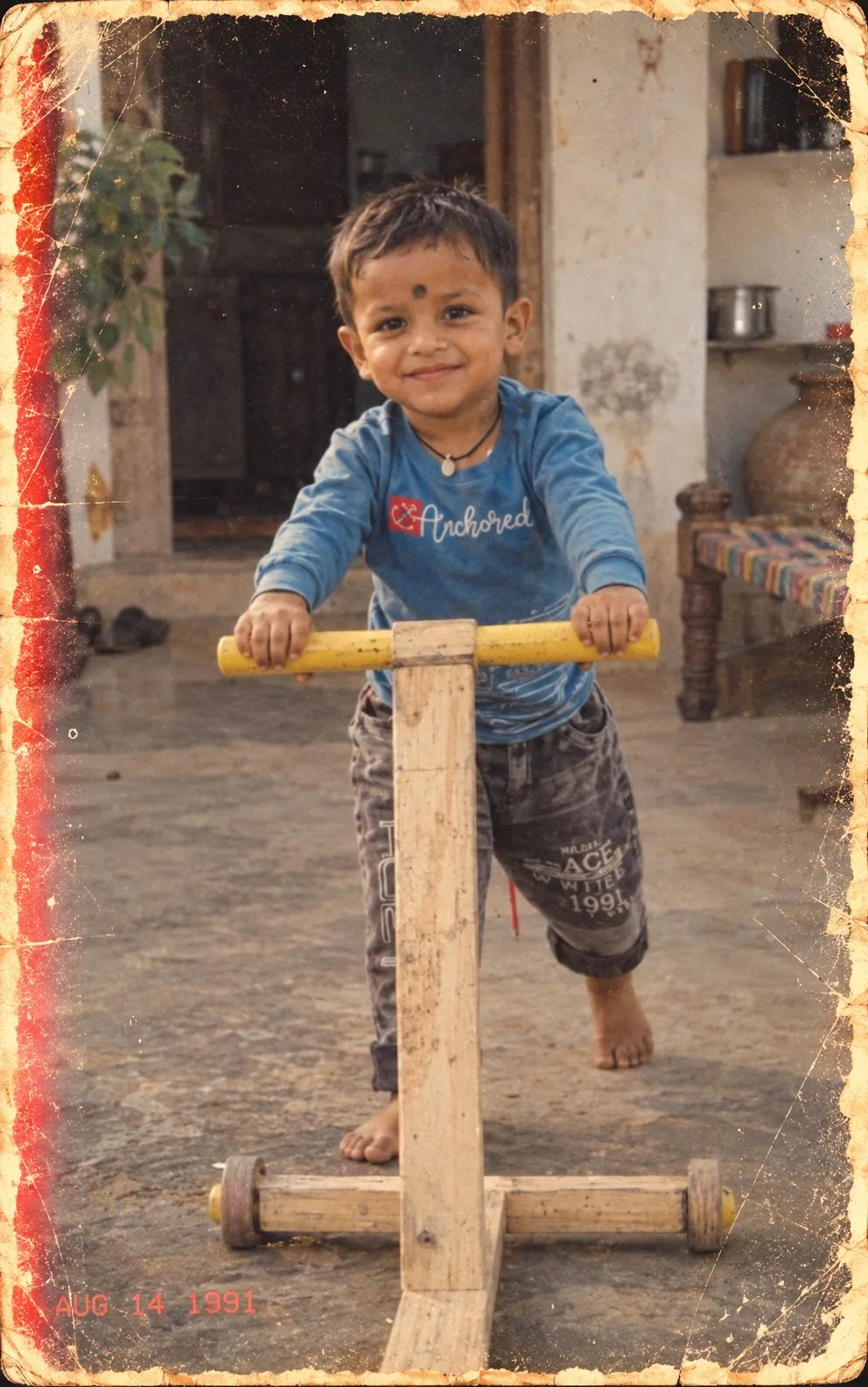
1990s Indian Boy with Wooden Push Toy Photo
Create an ultra-realistic vertical 4:5 nostalgic early-1990s Indian childhood photograph showing EXACTLY ONE fictional Indian boy, approximately 4–5 years old, playing with a simple handmade wooden push toy in the courtyard of a modest Indian home.
IDENTITY:
Create a completely fresh fictional Indian child.
He must have:
- warm medium-brown Indian complexion
- cute natural age-appropriate Indian facial structure
- expressive dark-brown eyes
- short slightly messy black hair
- natural eyebrows
- small traditional black kajal/bindi dot on the forehead
- realistic skin texture
- innocent childhood appearance
His identity must NOT resemble the reference child, a celebrity, public figure, known person, or previously generated face.
FACE — HIGHEST PRIORITY:
The boy must FACE DIRECTLY TOWARD THE CAMERA.
Both eyes must be clearly visible and looking into the lens.
Give him a gentle, happy CLOSED-MOUTH SMILE.
IMPORTANT:
- lips completely closed
- no open mouth
- no visible teeth
- no exaggerated laughing expression
- face naturally sharp
- no beauty filter
- no plastic skin
AGE:
Make him visibly a little older than a toddler, approximately 4–5 years old.
He should have believable child proportions for this age, while still looking small and innocent.
ACTION:
The boy is barefoot and standing/walking behind a traditional handmade wooden push toy.
He grips the horizontal yellow wooden handle naturally with BOTH hands.
One bare foot is planted on the courtyard floor while the other leg is slightly lifted naturally, suggesting that he is slowly pushing the toy toward the photographer.
His upper body and FACE remain directed toward the camera.
WOODEN PUSH TOY:
Create a primitive homemade early-1990s wooden walking/push toy.
Construction:
- pale unfinished natural wood
- tall central wooden plank
- horizontal mustard-yellow wooden handlebar
- simple wooden crossbar near ground level
- small basic wooden wheels
- visible wood grain
- scratches
- dust
- slightly uneven handmade construction
- naturally worn edges
The toy should look locally handmade, inexpensive and old.
NO plastic modern baby walker.
NO modern branding.
NO polished commercial toy.
CLOTHING:
Dress him in simple early-1990s Indian childhood clothing.
Use:
- faded dusty-blue long-sleeve cotton T-shirt
- subtle muted cream/rust retro detailing
- slightly loose and worn fit
- dark charcoal-grey loose cotton trousers
- faded period-style printed detailing
- trousers rolled slightly above the ankles
- simple thin black thread necklace with a tiny light-coloured pendant
- barefoot
Clothes should look:
- inexpensive
- repeatedly washed
- naturally faded
- slightly dusty
- comfortable for playing at home
For future variations, subtly change the shirt shade, small pattern and trouser details while maintaining authentic early-1990s styling.
HOME SETTING:
The photograph must be taken AT HOME, not on a road or playground.
Create a modest early-1990s Indian house courtyard.
Include:
- old weathered off-white/beige plaster walls
- dark open wooden doorway behind the child
- naturally worn cement courtyard floor
- old traditional woven charpai on one side
- large earthen/clay storage pot
- simple steel household utensils on wall shelves
- a few old slippers near the doorway
- small household plants
- naturally stained walls
- minor cracks and weathering
- simple lived-in rural/semi-rural atmosphere
Everything must look period-correct and naturally used.
STRICT PEOPLE RULE:
Show EXACTLY ONE child.
No second child.
No siblings.
No adults.
No people inside the doorway.
No distant people.
No silhouettes.
No partial bodies.
No crowd.
The boy must be the ONLY human in the entire photograph.
COMPOSITION:
Vertical 4:5 old family-album photograph.
Photograph the child relatively CLOSE.
The boy should occupy approximately 65–75% of the image height.
Place him centrally behind the wooden push toy.
The vertical wooden toy naturally leads the viewer's eye upward toward his FACE.
Keep:
- full face
- both eyes
- both hands
- complete wooden handle
- upper body
- legs
- bare feet
- most of the handmade push toy
Use a child-level camera position rather than photographing from high above.
FACE must remain the primary visual focus.
LIGHTING:
Use soft warm natural Indian afternoon daylight entering the courtyard.
Create:
- gentle highlights on the child's face
- warm natural skin tone
- subtle light on hair
- realistic soft shadows
- natural indoor/outdoor light transition around the doorway
No studio lights.
No flash-heavy appearance.
No modern cinematic lighting.
AUTHENTIC 1991 FILM LOOK:
The photograph must genuinely appear to have been captured in India in AUGUST 1991.
Do NOT create a modern DSLR image with a vintage preset.
Simulate an inexpensive early-1990s consumer 35mm colour-negative camera.
Include:
- organic medium 35mm film grain
- warm slightly faded colours
- restrained saturation
- subtle amber/cream cast
- muted blacks
- creamy highlights
- slightly imperfect exposure
- mild vintage optical softness
- subtle colour bleeding
- gentle highlight halation
- tiny black film speckles
- dust particles
- random fine scratches
- subtle chemical-processing marks
Keep the CHILD'S FACE naturally clear despite the vintage texture.
OLD INDIAN FAMILY-ALBUM PRINT:
Make the final photograph look like a genuine physical photo preserved in an Indian family album for more than 30 years.
Add:
- thick aged cream/off-white photographic border
- heavily distressed irregular edges
- worn rounded corners
- cracked photo emulsion
- peeling areas around outer borders
- tiny tears
- fine scratches
- dust particles
- small brown age stains
- faint crease marks
- faded areas
- naturally yellowed photographic paper
Add a strong but believable RED/ORANGE FILM LIGHT LEAK running vertically along the LEFT edge.
Do not cover the child's eyes or face with heavy scratches.
DATE STAMP:
Add an authentic faded orange-red analog date imprint at bottom-left:
“AUG 14 1991”
Make the date look physically processed into the photograph:
- imperfect character spacing
- slightly soft edges
- mild fading
- subtle colour bleed
- slightly uneven alignment
CAMERA CHARACTER:
Early-1990s consumer 35mm colour-film camera,
approximately 45–50mm vintage lens,
ISO 200,
f/4,
1/250–1/500 sec,
natural daylight.
DETAIL QUALITY:
Produce a high-resolution restored scan while preserving genuine analog imperfections.
Ensure:
- naturally detailed eyes
- closed lips
- realistic facial proportions
- individual hair strands
- realistic Indian skin texture
- anatomically correct hands
- five natural fingers
- correct child proportions
- realistic legs and bare feet
- detailed wooden grain
- believable wheels
- natural fabric wrinkles
- authentic courtyard textures
NEGATIVE PROMPT:
open mouth, visible teeth, laughing with mouth open, baby younger than requested, older child, multiple children, second child, adults, background people, people inside doorway, crowd, hidden face, side face, looking downward, back-facing child, blurred face, copied identity, celebrity resemblance, modern road, highway, playground, modern plastic walker, modern baby toy, modern sneakers, smartphone, smartwatch, tattoos, modern branded clothing, plastic skin, beauty filter, excessive HDR, extreme bokeh, studio lighting, teal-orange cinematic grading, CGI, cartoon, illustration, extra fingers, malformed hands, duplicate limbs, distorted feet, broken toy geometry, watermark, stock-photo text, social-media UI.
FINAL RESULT:
A believable August 1991 Indian childhood family photograph showing ONE fictional 4–5-year-old Indian boy alone in the courtyard of his modest home.
He stands barefoot behind a handmade wooden push toy, holding its yellow handle with both hands while looking DIRECTLY into the camera with a sweet CLOSED-MOUTH smile.
The weathered house, dark doorway, charpai, clay pot, steel utensils and old cement courtyard create an authentic home atmosphere.
Warm faded 35mm colours, organic film grain, scratches, heavily aged cream borders, red-orange left-edge film burn and an “AUG 14 1991” date stamp make the result feel like a genuine childhood photograph recovered from an old Indian family album.
IDENTITY:
Create a completely fresh fictional Indian child.
He must have:
- warm medium-brown Indian complexion
- cute natural age-appropriate Indian facial structure
- expressive dark-brown eyes
- short slightly messy black hair
- natural eyebrows
- small traditional black kajal/bindi dot on the forehead
- realistic skin texture
- innocent childhood appearance
His identity must NOT resemble the reference child, a celebrity, public figure, known person, or previously generated face.
FACE — HIGHEST PRIORITY:
The boy must FACE DIRECTLY TOWARD THE CAMERA.
Both eyes must be clearly visible and looking into the lens.
Give him a gentle, happy CLOSED-MOUTH SMILE.
IMPORTANT:
- lips completely closed
- no open mouth
- no visible teeth
- no exaggerated laughing expression
- face naturally sharp
- no beauty filter
- no plastic skin
AGE:
Make him visibly a little older than a toddler, approximately 4–5 years old.
He should have believable child proportions for this age, while still looking small and innocent.
ACTION:
The boy is barefoot and standing/walking behind a traditional handmade wooden push toy.
He grips the horizontal yellow wooden handle naturally with BOTH hands.
One bare foot is planted on the courtyard floor while the other leg is slightly lifted naturally, suggesting that he is slowly pushing the toy toward the photographer.
His upper body and FACE remain directed toward the camera.
WOODEN PUSH TOY:
Create a primitive homemade early-1990s wooden walking/push toy.
Construction:
- pale unfinished natural wood
- tall central wooden plank
- horizontal mustard-yellow wooden handlebar
- simple wooden crossbar near ground level
- small basic wooden wheels
- visible wood grain
- scratches
- dust
- slightly uneven handmade construction
- naturally worn edges
The toy should look locally handmade, inexpensive and old.
NO plastic modern baby walker.
NO modern branding.
NO polished commercial toy.
CLOTHING:
Dress him in simple early-1990s Indian childhood clothing.
Use:
- faded dusty-blue long-sleeve cotton T-shirt
- subtle muted cream/rust retro detailing
- slightly loose and worn fit
- dark charcoal-grey loose cotton trousers
- faded period-style printed detailing
- trousers rolled slightly above the ankles
- simple thin black thread necklace with a tiny light-coloured pendant
- barefoot
Clothes should look:
- inexpensive
- repeatedly washed
- naturally faded
- slightly dusty
- comfortable for playing at home
For future variations, subtly change the shirt shade, small pattern and trouser details while maintaining authentic early-1990s styling.
HOME SETTING:
The photograph must be taken AT HOME, not on a road or playground.
Create a modest early-1990s Indian house courtyard.
Include:
- old weathered off-white/beige plaster walls
- dark open wooden doorway behind the child
- naturally worn cement courtyard floor
- old traditional woven charpai on one side
- large earthen/clay storage pot
- simple steel household utensils on wall shelves
- a few old slippers near the doorway
- small household plants
- naturally stained walls
- minor cracks and weathering
- simple lived-in rural/semi-rural atmosphere
Everything must look period-correct and naturally used.
STRICT PEOPLE RULE:
Show EXACTLY ONE child.
No second child.
No siblings.
No adults.
No people inside the doorway.
No distant people.
No silhouettes.
No partial bodies.
No crowd.
The boy must be the ONLY human in the entire photograph.
COMPOSITION:
Vertical 4:5 old family-album photograph.
Photograph the child relatively CLOSE.
The boy should occupy approximately 65–75% of the image height.
Place him centrally behind the wooden push toy.
The vertical wooden toy naturally leads the viewer's eye upward toward his FACE.
Keep:
- full face
- both eyes
- both hands
- complete wooden handle
- upper body
- legs
- bare feet
- most of the handmade push toy
Use a child-level camera position rather than photographing from high above.
FACE must remain the primary visual focus.
LIGHTING:
Use soft warm natural Indian afternoon daylight entering the courtyard.
Create:
- gentle highlights on the child's face
- warm natural skin tone
- subtle light on hair
- realistic soft shadows
- natural indoor/outdoor light transition around the doorway
No studio lights.
No flash-heavy appearance.
No modern cinematic lighting.
AUTHENTIC 1991 FILM LOOK:
The photograph must genuinely appear to have been captured in India in AUGUST 1991.
Do NOT create a modern DSLR image with a vintage preset.
Simulate an inexpensive early-1990s consumer 35mm colour-negative camera.
Include:
- organic medium 35mm film grain
- warm slightly faded colours
- restrained saturation
- subtle amber/cream cast
- muted blacks
- creamy highlights
- slightly imperfect exposure
- mild vintage optical softness
- subtle colour bleeding
- gentle highlight halation
- tiny black film speckles
- dust particles
- random fine scratches
- subtle chemical-processing marks
Keep the CHILD'S FACE naturally clear despite the vintage texture.
OLD INDIAN FAMILY-ALBUM PRINT:
Make the final photograph look like a genuine physical photo preserved in an Indian family album for more than 30 years.
Add:
- thick aged cream/off-white photographic border
- heavily distressed irregular edges
- worn rounded corners
- cracked photo emulsion
- peeling areas around outer borders
- tiny tears
- fine scratches
- dust particles
- small brown age stains
- faint crease marks
- faded areas
- naturally yellowed photographic paper
Add a strong but believable RED/ORANGE FILM LIGHT LEAK running vertically along the LEFT edge.
Do not cover the child's eyes or face with heavy scratches.
DATE STAMP:
Add an authentic faded orange-red analog date imprint at bottom-left:
“AUG 14 1991”
Make the date look physically processed into the photograph:
- imperfect character spacing
- slightly soft edges
- mild fading
- subtle colour bleed
- slightly uneven alignment
CAMERA CHARACTER:
Early-1990s consumer 35mm colour-film camera,
approximately 45–50mm vintage lens,
ISO 200,
f/4,
1/250–1/500 sec,
natural daylight.
DETAIL QUALITY:
Produce a high-resolution restored scan while preserving genuine analog imperfections.
Ensure:
- naturally detailed eyes
- closed lips
- realistic facial proportions
- individual hair strands
- realistic Indian skin texture
- anatomically correct hands
- five natural fingers
- correct child proportions
- realistic legs and bare feet
- detailed wooden grain
- believable wheels
- natural fabric wrinkles
- authentic courtyard textures
NEGATIVE PROMPT:
open mouth, visible teeth, laughing with mouth open, baby younger than requested, older child, multiple children, second child, adults, background people, people inside doorway, crowd, hidden face, side face, looking downward, back-facing child, blurred face, copied identity, celebrity resemblance, modern road, highway, playground, modern plastic walker, modern baby toy, modern sneakers, smartphone, smartwatch, tattoos, modern branded clothing, plastic skin, beauty filter, excessive HDR, extreme bokeh, studio lighting, teal-orange cinematic grading, CGI, cartoon, illustration, extra fingers, malformed hands, duplicate limbs, distorted feet, broken toy geometry, watermark, stock-photo text, social-media UI.
FINAL RESULT:
A believable August 1991 Indian childhood family photograph showing ONE fictional 4–5-year-old Indian boy alone in the courtyard of his modest home.
He stands barefoot behind a handmade wooden push toy, holding its yellow handle with both hands while looking DIRECTLY into the camera with a sweet CLOSED-MOUTH smile.
The weathered house, dark doorway, charpai, clay pot, steel utensils and old cement courtyard create an authentic home atmosphere.
Warm faded 35mm colours, organic film grain, scratches, heavily aged cream borders, red-orange left-edge film burn and an “AUG 14 1991” date stamp make the result feel like a genuine childhood photograph recovered from an old Indian family album.