53

Mera Photo AI @meraphotoai
108 views
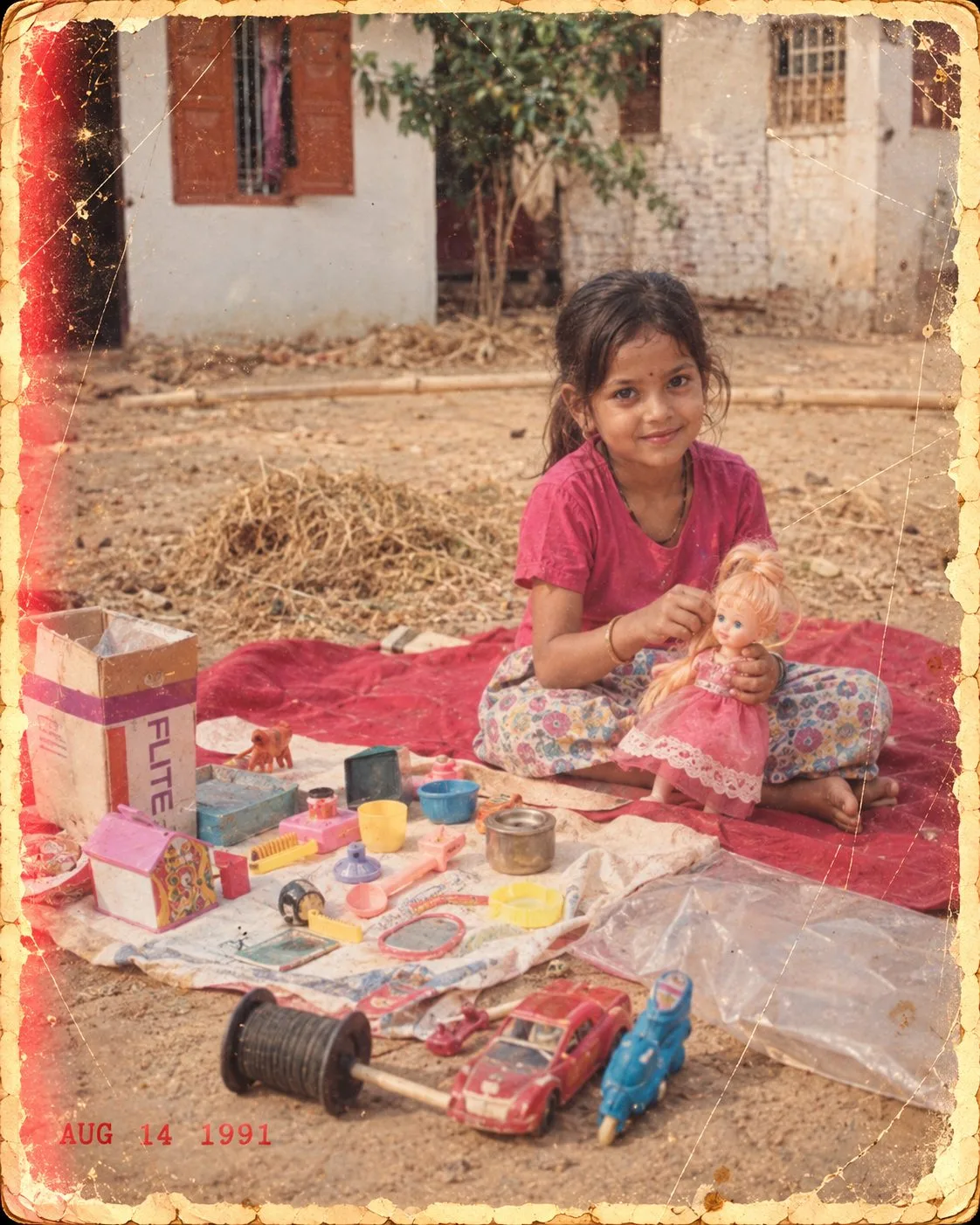
1990s Indian Girl Playing With Doll and Toys
Create an ultra-realistic vertical 4:5 nostalgic early-1990s Indian childhood family photograph featuring EXACTLY ONE fictional Indian village girl, approximately 7–9 years old, sitting cross-legged on a faded red cloth in the dusty courtyard of a modest rural Indian home.
MAIN SUBJECT:
Create a completely fresh fictional Indian girl with a unique identity.
She must NOT resemble any reference child, previously generated face, celebrity, public figure or known individual.
APPEARANCE:
- approximately 7–9 years old
- warm medium-brown Indian complexion
- soft age-appropriate Indian facial structure
- expressive dark-brown eyes
- natural eyebrows
- small traditional black bindi
- tiny simple earrings
- thin traditional bangles
- natural age-appropriate Indian skin texture
- slightly dusty outdoor appearance
- innocent childhood expression
HAIR:
Give her natural black hair tied into a simple low ponytail.
Keep a few messy loose strands around her forehead, temples and ears.
Hair should look naturally played-in, not professionally styled.
FACE — HIGHEST PRIORITY:
The girl's face must be DIRECTLY TOWARD THE CAMERA.
Both eyes must be completely visible and looking directly into the camera lens.
Give her a gentle natural CLOSED-MOUTH smile.
No visible teeth.
No exaggerated laugh.
No looking downward at the doll.
No side-facing face.
No sunglasses.
No makeup.
No beauty filter.
Even though she is playing with toys, her FACE and EYES must remain the strongest visual focus.
POSE:
The girl sits naturally CROSS-LEGGED on an old faded red cloth spread over the dusty ground.
Her torso faces mostly toward the camera.
She holds a small vintage-style doll upright in her lap.
One hand gently holds the doll's body while the other hand naturally adjusts or combs the doll's hair.
Her head remains raised and turned toward the photographer.
The pose must feel spontaneous, innocent and believable, like someone called her name while she was playing and she looked toward the family camera.
DOLL:
Give her one old-fashioned childhood doll appropriate for an early-1990s Indian household.
Use:
- small plastic doll
- light golden/blonde synthetic hair
- slightly messy doll hair
- simple pink fabric dress
- white lace trim
- small plastic shoes or bare doll feet
- naturally used condition
The doll should look like a genuinely played-with old toy rather than a brand-new collector doll.
CLOTHING:
Dress the girl in simple inexpensive early-1990s Indian childhood clothing.
Use:
- faded dusty-magenta / deep pink short-sleeve cotton T-shirt
- plain unbranded design
- slightly loose fit
- naturally wrinkled and repeatedly washed fabric
Bottom:
- loose cream cotton pyjama/trousers
- tiny faded pink, blue, green and mustard floral print
- comfortable relaxed fit
- slightly dusty fabric
She is BAREFOOT.
No modern sneakers.
No branded clothing.
No smartwatch.
No modern accessories.
TOYS & CHILDHOOD ITEMS:
Spread a believable collection of inexpensive old childhood toys and pretend-household items around her on a pale old cloth.
Include:
- tiny coloured plastic cups
- miniature bowls
- small toy plates
- little metal cooking pot
- toy spoon
- miniature plastic kitchen pieces
- small pink toy house/container
- old yellow comb
- small hand mirror
- tiny plastic animal
- small old red toy car
- small faded blue toy vehicle
- simple inexpensive trinkets
- old thread/string spool
Arrange everything naturally and imperfectly as if the child has been playing for a long time.
Do NOT make the scene look like a modern commercial toy collection.
Use muted, slightly faded toy colours appropriate for an old photograph.
STRICT SINGLE-PERSON RULE:
Show EXACTLY ONE HUMAN in the entire image.
Only the girl.
No second girl.
No boys.
No adults.
No parents.
No villagers.
No background children.
No people visible through windows or doors.
No distant silhouettes.
No partial bodies.
RURAL COURTYARD:
Create a modest early-1990s Indian village home environment.
Include:
- dusty uneven brown earth
- scattered dry straw
- small stones
- faded red cloth under the girl
- old white/off-white plastered house
- weathered exterior walls
- red/brown wooden window shutters
- old barred window
- small dark doorway
- old exposed brick section
- mature village tree
- sparse rural vegetation
- long simple bamboo pole lying in the background
The house should look naturally old, inexpensive and lived-in.
No modern buildings.
No modern vehicles.
No plastic outdoor furniture.
No advertisements.
No readable modern signs.
COMPOSITION:
Vertical 4:5 old family-album portrait.
Bring the girl relatively CLOSE TO THE CAMERA.
Position her slightly right of centre.
She should occupy approximately 55–65% of the image height while leaving enough foreground space to clearly show the toys.
Create three visual layers:
FOREGROUND:
Old toys, miniature utensils, toy cars and thread spool.
MIDDLE:
Main girl sitting cross-legged with the doll.
BACKGROUND:
Old village house, window, dusty courtyard and tree.
The viewer's eye must go FIRST to the girl's face, SECOND to the doll, THIRD to the nostalgic toys.
CAMERA POSITION:
Use a natural adult-standing or slightly lowered family-camera viewpoint.
Camera points gently downward toward the seated girl, but avoid an extreme overhead angle.
Her complete face must remain clearly visible.
DEPTH OF FIELD:
Girl's face and eyes = sharpest.
Doll = detailed.
Hands = detailed.
Nearest toys = reasonably detailed.
House and tree = softly blurred.
Use natural vintage optical depth rather than artificial smartphone portrait blur.
AUTHENTIC AUGUST 1991 FILM LOOK — CRITICAL:
The photograph must genuinely appear to have been captured in rural India on AUGUST 14, 1991.
Do NOT create a modern high-end digital image and simply apply a retro filter.
Simulate an inexpensive early-1990s consumer 35mm colour-negative camera.
Use:
- organic medium 35mm film grain
- warm faded colours
- restrained saturation
- slight amber/cream colour cast
- muted blacks
- creamy warm highlights
- moderate contrast
- mild vintage lens softness
- slightly imperfect exposure
- subtle colour bleeding
- gentle highlight halation
- tiny black film speckles
- natural dust particles
- fine random scratches
- slight chemical-processing imperfections
Keep the girl's eyes and facial features naturally clear.
OLD INDIAN FAMILY-ALBUM PRINT:
Make the final image look like a genuine physical photograph rediscovered after more than 30 years.
Add:
- thick aged cream/off-white photographic border
- heavily distressed irregular edges
- worn rounded corners
- cracked photo emulsion
- peeling outer border
- tiny edge tears
- naturally yellowed photographic paper
- scattered dust
- numerous fine scratches
- tiny brown age stains
- subtle crease lines
- faded patches
- minor corner damage
Add a prominent RED-ORANGE FILM BURN / LIGHT LEAK vertically along the LEFT EDGE and upper-left corner.
The light leak should partially affect the border and background but must NOT obscure the girl's face.
DATE STAMP:
Add a faded orange-red analog date imprint at bottom-left:
“AUG 14 1991”
Use:
- blocky old analog date characters
- slightly uneven spacing
- imperfect alignment
- soft printed edges
- subtle colour bleeding
- mild natural fading
The date must look physically exposed into the original photograph rather than digitally added.
LIGHTING:
Use warm natural Indian late-afternoon daylight.
Create:
- soft warm light across the girl's face
- gentle highlights in her dark hair
- realistic warm Indian skin
- subtle light across the doll
- soft highlights on faded toys
- natural shadows underneath the girl and objects
- slightly dusty golden rural atmosphere
No studio lighting.
No beauty lighting.
No modern cinematic lighting.
CAMERA CHARACTER:
Early-1990s consumer 35mm colour-negative camera,
45–50mm vintage lens,
ISO 200,
f/4,
1/250 sec,
natural Indian afternoon daylight.
QUALITY:
Create a high-resolution restored scan while retaining authentic analog imperfections.
Ensure:
- expressive naturally sharp eyes
- realistic closed-mouth smile
- age-appropriate Indian skin
- detailed natural hair strands
- anatomically correct hands
- five natural fingers
- realistic child body proportions
- natural cross-legged posture
- anatomically accurate bare feet
- realistic doll proportions
- believable old plastic toys
- natural cotton fabric texture
- realistic dust and ground detail
NEGATIVE PROMPT:
multiple children, second girl, boys, adults, crowd, villagers, background people, parents, duplicate child, copied identity, celebrity resemblance, side-facing main face, looking down at doll, hidden eyes, blurred main face, open-mouth laugh, visible teeth, makeup, sunglasses, modern hairstyle, modern branded clothing, sneakers, smartphone, tablet, smartwatch, modern electronic toys, expensive modern dolls, modern toy packaging, modern vehicles, modern architecture, plastic skin, beauty filter, excessive HDR, extreme artificial bokeh, studio lighting, cinematic teal-orange grading, CGI, 3D render, cartoon, illustration, malformed hands, extra fingers, duplicate arms, extra legs, distorted bare feet, watermark, stock-photo watermark, social-media text, Hindi text overlay, logo.
FINAL RESULT:
A believable August 14, 1991 Indian childhood family photograph showing ONE fictional 7–9-year-old Indian village girl sitting barefoot and cross-legged on a faded red cloth in a dusty rural courtyard.
She holds an old pink-dressed doll in her lap while playing with its hair, surrounded by miniature utensils, plastic cups, bowls, a comb, mirror, small toy house, old toy cars and other inexpensive childhood belongings.
Although she is playing, her head is raised and her complete face looks DIRECTLY into the camera with expressive dark eyes and a gentle closed-mouth smile.
A weathered village house, old window shutters, exposed brick, tree, dry straw and dusty earth establish an authentic early-1990s rural Indian environment.
Warm faded 35mm colours, organic grain, dust, scratches, heavily distressed cream borders, a strong red-orange left-edge film burn and an “AUG 14 1991” date stamp make the result look like a genuine childhood photograph rediscovered in an old Indian family album.
MAIN SUBJECT:
Create a completely fresh fictional Indian girl with a unique identity.
She must NOT resemble any reference child, previously generated face, celebrity, public figure or known individual.
APPEARANCE:
- approximately 7–9 years old
- warm medium-brown Indian complexion
- soft age-appropriate Indian facial structure
- expressive dark-brown eyes
- natural eyebrows
- small traditional black bindi
- tiny simple earrings
- thin traditional bangles
- natural age-appropriate Indian skin texture
- slightly dusty outdoor appearance
- innocent childhood expression
HAIR:
Give her natural black hair tied into a simple low ponytail.
Keep a few messy loose strands around her forehead, temples and ears.
Hair should look naturally played-in, not professionally styled.
FACE — HIGHEST PRIORITY:
The girl's face must be DIRECTLY TOWARD THE CAMERA.
Both eyes must be completely visible and looking directly into the camera lens.
Give her a gentle natural CLOSED-MOUTH smile.
No visible teeth.
No exaggerated laugh.
No looking downward at the doll.
No side-facing face.
No sunglasses.
No makeup.
No beauty filter.
Even though she is playing with toys, her FACE and EYES must remain the strongest visual focus.
POSE:
The girl sits naturally CROSS-LEGGED on an old faded red cloth spread over the dusty ground.
Her torso faces mostly toward the camera.
She holds a small vintage-style doll upright in her lap.
One hand gently holds the doll's body while the other hand naturally adjusts or combs the doll's hair.
Her head remains raised and turned toward the photographer.
The pose must feel spontaneous, innocent and believable, like someone called her name while she was playing and she looked toward the family camera.
DOLL:
Give her one old-fashioned childhood doll appropriate for an early-1990s Indian household.
Use:
- small plastic doll
- light golden/blonde synthetic hair
- slightly messy doll hair
- simple pink fabric dress
- white lace trim
- small plastic shoes or bare doll feet
- naturally used condition
The doll should look like a genuinely played-with old toy rather than a brand-new collector doll.
CLOTHING:
Dress the girl in simple inexpensive early-1990s Indian childhood clothing.
Use:
- faded dusty-magenta / deep pink short-sleeve cotton T-shirt
- plain unbranded design
- slightly loose fit
- naturally wrinkled and repeatedly washed fabric
Bottom:
- loose cream cotton pyjama/trousers
- tiny faded pink, blue, green and mustard floral print
- comfortable relaxed fit
- slightly dusty fabric
She is BAREFOOT.
No modern sneakers.
No branded clothing.
No smartwatch.
No modern accessories.
TOYS & CHILDHOOD ITEMS:
Spread a believable collection of inexpensive old childhood toys and pretend-household items around her on a pale old cloth.
Include:
- tiny coloured plastic cups
- miniature bowls
- small toy plates
- little metal cooking pot
- toy spoon
- miniature plastic kitchen pieces
- small pink toy house/container
- old yellow comb
- small hand mirror
- tiny plastic animal
- small old red toy car
- small faded blue toy vehicle
- simple inexpensive trinkets
- old thread/string spool
Arrange everything naturally and imperfectly as if the child has been playing for a long time.
Do NOT make the scene look like a modern commercial toy collection.
Use muted, slightly faded toy colours appropriate for an old photograph.
STRICT SINGLE-PERSON RULE:
Show EXACTLY ONE HUMAN in the entire image.
Only the girl.
No second girl.
No boys.
No adults.
No parents.
No villagers.
No background children.
No people visible through windows or doors.
No distant silhouettes.
No partial bodies.
RURAL COURTYARD:
Create a modest early-1990s Indian village home environment.
Include:
- dusty uneven brown earth
- scattered dry straw
- small stones
- faded red cloth under the girl
- old white/off-white plastered house
- weathered exterior walls
- red/brown wooden window shutters
- old barred window
- small dark doorway
- old exposed brick section
- mature village tree
- sparse rural vegetation
- long simple bamboo pole lying in the background
The house should look naturally old, inexpensive and lived-in.
No modern buildings.
No modern vehicles.
No plastic outdoor furniture.
No advertisements.
No readable modern signs.
COMPOSITION:
Vertical 4:5 old family-album portrait.
Bring the girl relatively CLOSE TO THE CAMERA.
Position her slightly right of centre.
She should occupy approximately 55–65% of the image height while leaving enough foreground space to clearly show the toys.
Create three visual layers:
FOREGROUND:
Old toys, miniature utensils, toy cars and thread spool.
MIDDLE:
Main girl sitting cross-legged with the doll.
BACKGROUND:
Old village house, window, dusty courtyard and tree.
The viewer's eye must go FIRST to the girl's face, SECOND to the doll, THIRD to the nostalgic toys.
CAMERA POSITION:
Use a natural adult-standing or slightly lowered family-camera viewpoint.
Camera points gently downward toward the seated girl, but avoid an extreme overhead angle.
Her complete face must remain clearly visible.
DEPTH OF FIELD:
Girl's face and eyes = sharpest.
Doll = detailed.
Hands = detailed.
Nearest toys = reasonably detailed.
House and tree = softly blurred.
Use natural vintage optical depth rather than artificial smartphone portrait blur.
AUTHENTIC AUGUST 1991 FILM LOOK — CRITICAL:
The photograph must genuinely appear to have been captured in rural India on AUGUST 14, 1991.
Do NOT create a modern high-end digital image and simply apply a retro filter.
Simulate an inexpensive early-1990s consumer 35mm colour-negative camera.
Use:
- organic medium 35mm film grain
- warm faded colours
- restrained saturation
- slight amber/cream colour cast
- muted blacks
- creamy warm highlights
- moderate contrast
- mild vintage lens softness
- slightly imperfect exposure
- subtle colour bleeding
- gentle highlight halation
- tiny black film speckles
- natural dust particles
- fine random scratches
- slight chemical-processing imperfections
Keep the girl's eyes and facial features naturally clear.
OLD INDIAN FAMILY-ALBUM PRINT:
Make the final image look like a genuine physical photograph rediscovered after more than 30 years.
Add:
- thick aged cream/off-white photographic border
- heavily distressed irregular edges
- worn rounded corners
- cracked photo emulsion
- peeling outer border
- tiny edge tears
- naturally yellowed photographic paper
- scattered dust
- numerous fine scratches
- tiny brown age stains
- subtle crease lines
- faded patches
- minor corner damage
Add a prominent RED-ORANGE FILM BURN / LIGHT LEAK vertically along the LEFT EDGE and upper-left corner.
The light leak should partially affect the border and background but must NOT obscure the girl's face.
DATE STAMP:
Add a faded orange-red analog date imprint at bottom-left:
“AUG 14 1991”
Use:
- blocky old analog date characters
- slightly uneven spacing
- imperfect alignment
- soft printed edges
- subtle colour bleeding
- mild natural fading
The date must look physically exposed into the original photograph rather than digitally added.
LIGHTING:
Use warm natural Indian late-afternoon daylight.
Create:
- soft warm light across the girl's face
- gentle highlights in her dark hair
- realistic warm Indian skin
- subtle light across the doll
- soft highlights on faded toys
- natural shadows underneath the girl and objects
- slightly dusty golden rural atmosphere
No studio lighting.
No beauty lighting.
No modern cinematic lighting.
CAMERA CHARACTER:
Early-1990s consumer 35mm colour-negative camera,
45–50mm vintage lens,
ISO 200,
f/4,
1/250 sec,
natural Indian afternoon daylight.
QUALITY:
Create a high-resolution restored scan while retaining authentic analog imperfections.
Ensure:
- expressive naturally sharp eyes
- realistic closed-mouth smile
- age-appropriate Indian skin
- detailed natural hair strands
- anatomically correct hands
- five natural fingers
- realistic child body proportions
- natural cross-legged posture
- anatomically accurate bare feet
- realistic doll proportions
- believable old plastic toys
- natural cotton fabric texture
- realistic dust and ground detail
NEGATIVE PROMPT:
multiple children, second girl, boys, adults, crowd, villagers, background people, parents, duplicate child, copied identity, celebrity resemblance, side-facing main face, looking down at doll, hidden eyes, blurred main face, open-mouth laugh, visible teeth, makeup, sunglasses, modern hairstyle, modern branded clothing, sneakers, smartphone, tablet, smartwatch, modern electronic toys, expensive modern dolls, modern toy packaging, modern vehicles, modern architecture, plastic skin, beauty filter, excessive HDR, extreme artificial bokeh, studio lighting, cinematic teal-orange grading, CGI, 3D render, cartoon, illustration, malformed hands, extra fingers, duplicate arms, extra legs, distorted bare feet, watermark, stock-photo watermark, social-media text, Hindi text overlay, logo.
FINAL RESULT:
A believable August 14, 1991 Indian childhood family photograph showing ONE fictional 7–9-year-old Indian village girl sitting barefoot and cross-legged on a faded red cloth in a dusty rural courtyard.
She holds an old pink-dressed doll in her lap while playing with its hair, surrounded by miniature utensils, plastic cups, bowls, a comb, mirror, small toy house, old toy cars and other inexpensive childhood belongings.
Although she is playing, her head is raised and her complete face looks DIRECTLY into the camera with expressive dark eyes and a gentle closed-mouth smile.
A weathered village house, old window shutters, exposed brick, tree, dry straw and dusty earth establish an authentic early-1990s rural Indian environment.
Warm faded 35mm colours, organic grain, dust, scratches, heavily distressed cream borders, a strong red-orange left-edge film burn and an “AUG 14 1991” date stamp make the result look like a genuine childhood photograph rediscovered in an old Indian family album.