1364

Mera Photo AI @meraphotoai
2,544 views
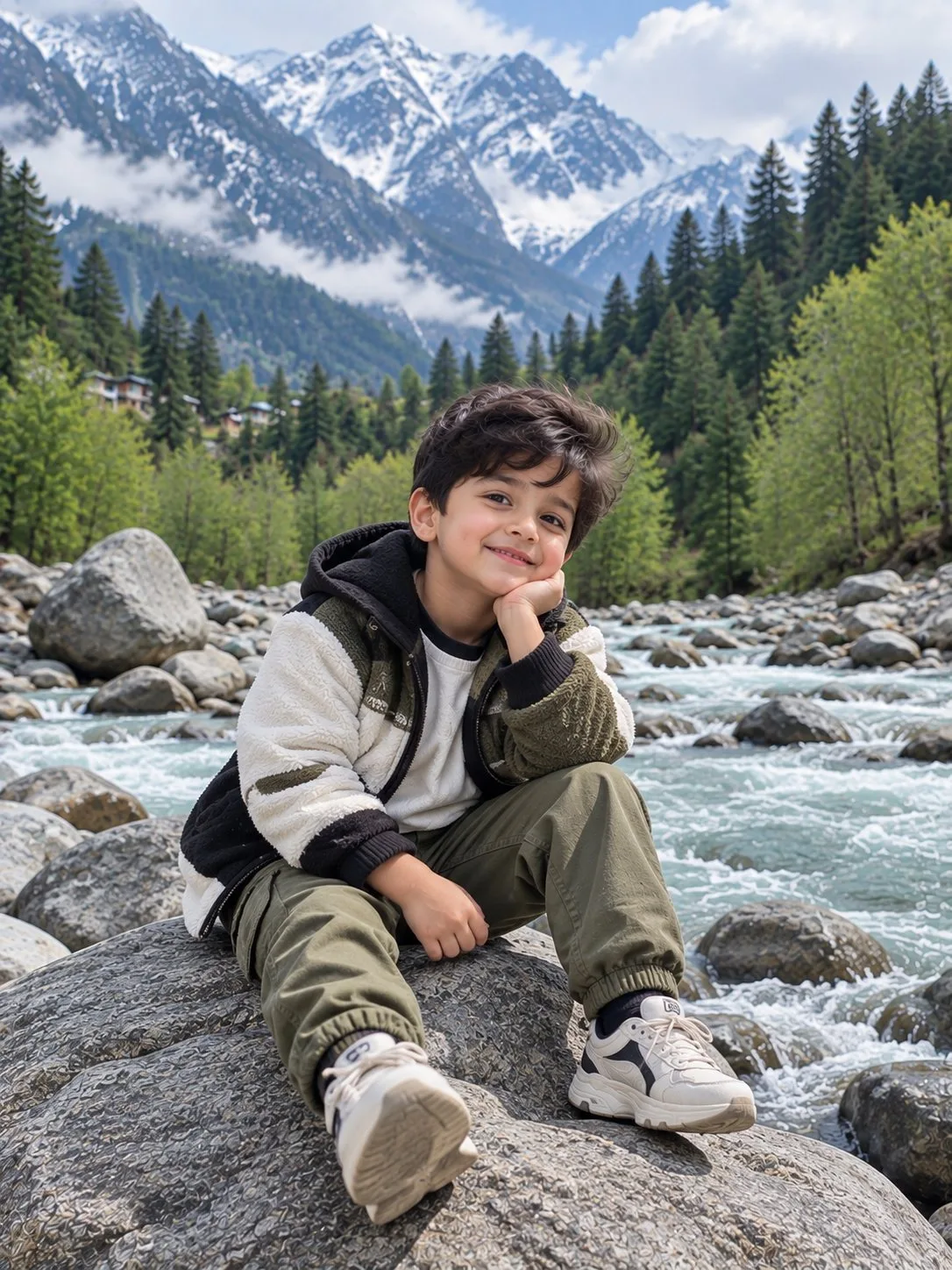
Manali Riverside Little Boy Photo
Use the uploaded child’s photo as the identity reference. Preserve the uploaded child’s facial identity accurately while recreating the hairstyle, winter outfit, seated pose, framing, rocky riverside environment, Himalayan mountains, natural lighting and realistic photography style described below.
Create an ultra-photorealistic, high-resolution VERTICAL 3:4 CINEMATIC TRAVEL PORTRAIT of one approximately 5-year-old Indian boy sitting naturally on a large grey boulder beside a fast-flowing turquoise Himalayan river in Manali, Himachal Pradesh.
The final result should look like a genuine high-quality outdoor photograph taken during a family trip to the Himalayas.
SUBJECT & IDENTITY:
Show ONLY ONE approximately 5-year-old Indian boy.
If an identity-reference photo is uploaded, accurately preserve his:
• face shape
• forehead
• eyebrows
• eyes
• nose
• lips
• cheeks
• chin
• ears
• natural Indian complexion
• distinctive facial proportions
Keep all facial proportions naturally CHILDLIKE and age-appropriate.
Do not make him look like a teenager or adult.
Keep his face soft, youthful and naturally expressive.
FACE & EXPRESSION:
Keep the boy’s face clearly visible and turned toward the camera.
Use:
• bright natural eyes
• gentle direct eye contact
• slightly tilted head
• naturally rounded cheeks
• relaxed eyebrows
• soft genuine smile
• cheerful and innocent expression
The smile should feel spontaneous, as though the photograph was captured during a happy family holiday.
HAIRSTYLE:
Give him thick, naturally wavy/curly dark brown-black hair.
Use:
• medium child-appropriate length
• soft loose curls
• naturally messy volume
• several curls falling gently across the forehead
• realistic hairline
• individual fine hair strands
• subtle flyaways
• slight movement from the mountain breeze
Keep the hairstyle natural rather than heavily styled.
SKIN REALISM:
Render natural age-appropriate Indian skin with:
• soft genuine skin texture
• natural cheek colour
• subtle pores appropriate for a young child
• realistic lips
• individual eyebrow hairs
• eyelashes
• natural under-eye contours
• tiny real-world imperfections
• slightly rosy cheeks from the cool mountain air
Avoid adult facial texture, facial hair or excessive skin smoothing.
WINTER JACKET:
Dress him in a stylish but practical COLOR-BLOCKED winter fleece jacket.
Use a combination of:
• warm off-white / cream fleece
• muted olive-green textured sections
• deep black panels
The jacket should have:
• soft sherpa/fleece texture
• relaxed child-sized fit
• full sleeves
• ribbed cuffs
• black hood
• open front
• realistic zipper construction
• natural fabric folds
• believable compression around elbows
• individual fleece fibres
Keep the jacket completely unbranded.
BLACK HOOD:
Add a plain black hood naturally resting behind and around his neck.
Use thick soft fabric with realistic folds.
CREAM INNER SWEATER:
Under the jacket, dress him in a plain CREAM / OFF-WHITE knitted sweater.
Show:
• subtle knitted texture
• round neckline
• soft warm fabric
• natural chest folds
• age-appropriate relaxed fit
Keep the sweater simple and completely unbranded.
OLIVE CARGO TROUSERS:
Dress him in muted OLIVE-GREEN cargo/jogger trousers.
Use:
• relaxed child-sized fit
• slightly loose legs
• practical outdoor fabric
• elasticated ankle cuffs
• realistic seams
• natural knee folds
• believable fabric bunching
• subtle pocket construction
Keep the trousers plain.
OFF-WHITE SNEAKERS:
Give him chunky OFF-WHITE / CREAM sneakers.
Use:
• child-appropriate proportions
• realistic laces
• layered shoe panels
• textured thick soles
• subtle grey details
• natural creases
• very light outdoor dust
• believable contact with the rock
Keep the shoes unbranded.
POSE:
Seat the boy safely and naturally on a broad, stable grey riverside boulder.
Use a noticeably different relaxed child pose.
Keep ONE leg extending diagonally toward the camera with the sneaker prominent in the lower foreground.
Keep the OTHER leg bent naturally with its foot securely resting on the rock.
Rest the elbow of ONE arm on the raised knee.
Let that hand gently support the side of his cheek/chin.
Keep the OTHER hand relaxed naturally near his lap or resting on the rock between his legs.
Use:
• relaxed shoulders
• slight natural body lean
• comfortable seated posture
• believable body weight
• natural childlike hand positioning
• anatomically correct fingers
The pose should feel playful, comfortable and spontaneous rather than like an adult fashion pose.
3:4 COMPOSITION:
Use a VERTICAL 3:4 aspect ratio.
Create a relatively close environmental portrait.
Frame the boy from the COMPLETE TOP OF HIS HAIR down through his shoes.
Make his face and upper body prominent while keeping the seated pose clearly understandable.
Place his face approximately around the upper-middle portion of the frame.
Allow the extended leg and sneaker to create natural foreground perspective.
Do not crop the top of his hair.
Keep enough surrounding landscape visible to clearly establish the Himalayan riverside location.
FOREGROUND BOULDER:
Seat him on a large dark-grey naturally rounded river boulder.
Render highly realistic:
• coarse granite texture
• irregular mineral markings
• tiny cracks
• wet darker areas
• rough weathered surface
• natural highlights
• contact shadows beneath his body
The rock should look physically solid and naturally shaped by river erosion.
SURROUNDING ROCKS:
Fill the foreground and middle ground with naturally scattered Himalayan river stones.
Include:
• large grey boulders
• charcoal rocks
• occasional warm brown stones
• smaller rounded pebbles
• wet rocks near the water
• irregular shapes and sizes
Avoid symmetrical or artificially arranged rocks.
TURQUOISE HIMALAYAN RIVER:
Preserve a beautiful fast-flowing turquoise Himalayan river immediately behind and around the rocks.
Show realistic:
• pale turquoise water
• rushing currents
• white-water foam
• small rapids
• water flowing around boulders
• irregular surface movement
• subtle transparency
• deeper blue-green channels
• natural reflections
• realistic splashes
The water must look genuinely moving.
GREEN FOREST:
Fill the middle background with dense Himalayan forest.
Use a realistic mixture of:
• tall dark-green pine/deodar trees
• fresh light-green deciduous trees
• irregular tree heights
• visible trunks
• naturally overlapping branches
• varied foliage density
• realistic gaps between trees
Allow the forest to climb naturally across the lower mountain slopes.
DISTANT HOUSES:
Retain only a few tiny existing hillside houses partially visible between the trees.
Keep them distant, subtle and secondary.
Do not introduce additional buildings.
SNOW-COVERED HIMALAYAN MOUNTAINS:
Fill the upper background with enormous dramatic snow-covered Himalayan peaks.
Show:
• rugged jagged mountain formations
• huge irregular ridges
• clean white snow
• exposed dark-grey rock
• deep snowy gullies
• overlapping mountain layers
• forested lower slopes
• realistic geological detail
• believable enormous scale
The mountains should tower dramatically behind the boy and forest.
Do not make the peaks perfectly symmetrical or fantasy-like.
MOUNTAIN MIST:
Add natural soft mist and low cloud around portions of the distant mountains.
Use:
• thin white cloud bands
• valley haze
• partially softened mountain faces
• natural atmospheric perspective
• gradual reduction of contrast with distance
Keep the main snowy peaks clearly visible.
SKY:
Use a naturally bright partly cloudy Himalayan sky.
Include soft white and pale-grey clouds with gentle blue areas.
Keep the atmosphere fresh and realistic.
LIGHTING:
Use crisp but soft NATURAL DAYLIGHT.
Illuminate the child’s face evenly.
Use subtle natural highlights on:
• forehead
• cheeks
• eyes
• nose
• lips
• curly hair
• fleece fibres
• cream sweater
• olive trousers
• sneakers
• nearby wet rocks
• moving river
Keep facial shadows gentle.
Do not use dramatic artificial studio lighting.
FACE PRIORITY:
The boy’s face should remain the sharpest and most emotionally important part of the image.
Clearly resolve:
• pupils
• irises
• eyelashes
• eyebrow hairs
• natural lips
• soft cheek texture
• individual curls
• tiny flyaway hairs
Keep facial detail age-appropriate and natural.
HAND REALISM:
Render both hands carefully.
Each visible hand should have:
• five natural fingers
• age-appropriate proportions
• realistic small fingernails
• natural knuckles
• believable wrist anatomy
• relaxed finger positions
The hand supporting his cheek should make gentle, believable contact with the face.
DEPTH OF FIELD:
Use realistic professional-camera depth.
Keep:
BOY’S FACE — extremely sharp
HAIR — extremely sharp
OUTFIT — highly detailed
FOREGROUND ROCK — detailed
NEARBY RIVER — clearly detailed
MIDGROUND FOREST — moderately softened
DISTANT HIMALAYAN PEAKS — naturally softer through atmospheric distance
Do not completely blur the background.
The river, forest and snowy mountains should remain clearly recognisable.
CAMERA & OPTICS:
Simulate a premium full-frame mirrorless camera.
Use approximately:
• 50–70mm environmental portrait lens
• vertical 3:4 framing
• camera near the child’s eye level
• relatively close camera distance
• f/4
• ISO 100–160
• 1/800 sec
• continuous eye autofocus
• daylight/cloudy white balance
• high dynamic range
• natural lens compression
• realistic optical sharpness
The camera angle should feel friendly and child-level rather than looking strongly downward at him.
COLOR GRADING:
Use clean premium Himalayan family-travel photography grading.
Maintain:
• naturally warm Indian skin
• dark brown-black curly hair
• cream/olive/black fleece jacket
• warm cream inner sweater
• muted olive trousers
• off-white sneakers
• realistic grey rocks
• fresh turquoise river
• vibrant but natural green forest
• cool blue-grey mountain rock
• clean white snow
• soft blue and white cloudy sky
Keep colours fresh and photographic without excessive saturation.
PHOTOREALISM:
Prioritise genuine real-camera realism.
Clearly render:
• natural child facial proportions
• realistic skin texture
• eyelashes
• eyebrow hairs
• individual curly hair strands
• fleece fibres
• knitted sweater texture
• trouser stitching
• sneaker materials
• anatomically correct child hands
• coarse granite
• wet stones
• turbulent river water
• individual trees
• mountain geology
• snow texture
• atmospheric mist
Keep subtle real-world photographic imperfections.
SCENE PRESERVATION:
Preserve only the natural elements belonging to this Himalayan riverside scene.
Do not add any extra:
• board
• signboard
• placard
• logo
• watermark
• written text
• advertisement
• artificial landmark
• decorative installation
• unnecessary prop
• invented scene element
FINAL RESULT:
Create an ultra-photorealistic high-resolution VERTICAL 3:4 environmental portrait of one approximately 5-year-old Indian boy sitting happily on a large grey boulder beside a rushing turquoise Himalayan river in Manali.
Keep his face clearly visible toward the camera with a sweet natural smile, soft childlike features, rosy cheeks and thick naturally curly dark hair.
Dress him in a completely unbranded cream, muted-olive and black color-blocked fleece winter jacket over a plain cream knitted sweater, muted olive cargo joggers and chunky off-white sneakers.
Use a relaxed childlike seated pose with one leg extending naturally toward the camera, the other knee bent, one elbow resting on the raised knee and that hand gently supporting his cheek. Keep the other hand naturally relaxed near his lap.
Behind him, preserve the fast-flowing turquoise river, naturally scattered grey boulders, dense green pine and deciduous forest, a few tiny distant hillside houses already belonging to the landscape, enormous rugged snow-covered Himalayan mountains and soft mountain mist.
Use crisp natural daylight, realistic child skin texture, detailed winter fabrics, physically believable water movement and genuine professional-camera depth.
The final result must look like a real family travel photograph captured beside a Himalayan river in Manali.
Create an ultra-photorealistic, high-resolution VERTICAL 3:4 CINEMATIC TRAVEL PORTRAIT of one approximately 5-year-old Indian boy sitting naturally on a large grey boulder beside a fast-flowing turquoise Himalayan river in Manali, Himachal Pradesh.
The final result should look like a genuine high-quality outdoor photograph taken during a family trip to the Himalayas.
SUBJECT & IDENTITY:
Show ONLY ONE approximately 5-year-old Indian boy.
If an identity-reference photo is uploaded, accurately preserve his:
• face shape
• forehead
• eyebrows
• eyes
• nose
• lips
• cheeks
• chin
• ears
• natural Indian complexion
• distinctive facial proportions
Keep all facial proportions naturally CHILDLIKE and age-appropriate.
Do not make him look like a teenager or adult.
Keep his face soft, youthful and naturally expressive.
FACE & EXPRESSION:
Keep the boy’s face clearly visible and turned toward the camera.
Use:
• bright natural eyes
• gentle direct eye contact
• slightly tilted head
• naturally rounded cheeks
• relaxed eyebrows
• soft genuine smile
• cheerful and innocent expression
The smile should feel spontaneous, as though the photograph was captured during a happy family holiday.
HAIRSTYLE:
Give him thick, naturally wavy/curly dark brown-black hair.
Use:
• medium child-appropriate length
• soft loose curls
• naturally messy volume
• several curls falling gently across the forehead
• realistic hairline
• individual fine hair strands
• subtle flyaways
• slight movement from the mountain breeze
Keep the hairstyle natural rather than heavily styled.
SKIN REALISM:
Render natural age-appropriate Indian skin with:
• soft genuine skin texture
• natural cheek colour
• subtle pores appropriate for a young child
• realistic lips
• individual eyebrow hairs
• eyelashes
• natural under-eye contours
• tiny real-world imperfections
• slightly rosy cheeks from the cool mountain air
Avoid adult facial texture, facial hair or excessive skin smoothing.
WINTER JACKET:
Dress him in a stylish but practical COLOR-BLOCKED winter fleece jacket.
Use a combination of:
• warm off-white / cream fleece
• muted olive-green textured sections
• deep black panels
The jacket should have:
• soft sherpa/fleece texture
• relaxed child-sized fit
• full sleeves
• ribbed cuffs
• black hood
• open front
• realistic zipper construction
• natural fabric folds
• believable compression around elbows
• individual fleece fibres
Keep the jacket completely unbranded.
BLACK HOOD:
Add a plain black hood naturally resting behind and around his neck.
Use thick soft fabric with realistic folds.
CREAM INNER SWEATER:
Under the jacket, dress him in a plain CREAM / OFF-WHITE knitted sweater.
Show:
• subtle knitted texture
• round neckline
• soft warm fabric
• natural chest folds
• age-appropriate relaxed fit
Keep the sweater simple and completely unbranded.
OLIVE CARGO TROUSERS:
Dress him in muted OLIVE-GREEN cargo/jogger trousers.
Use:
• relaxed child-sized fit
• slightly loose legs
• practical outdoor fabric
• elasticated ankle cuffs
• realistic seams
• natural knee folds
• believable fabric bunching
• subtle pocket construction
Keep the trousers plain.
OFF-WHITE SNEAKERS:
Give him chunky OFF-WHITE / CREAM sneakers.
Use:
• child-appropriate proportions
• realistic laces
• layered shoe panels
• textured thick soles
• subtle grey details
• natural creases
• very light outdoor dust
• believable contact with the rock
Keep the shoes unbranded.
POSE:
Seat the boy safely and naturally on a broad, stable grey riverside boulder.
Use a noticeably different relaxed child pose.
Keep ONE leg extending diagonally toward the camera with the sneaker prominent in the lower foreground.
Keep the OTHER leg bent naturally with its foot securely resting on the rock.
Rest the elbow of ONE arm on the raised knee.
Let that hand gently support the side of his cheek/chin.
Keep the OTHER hand relaxed naturally near his lap or resting on the rock between his legs.
Use:
• relaxed shoulders
• slight natural body lean
• comfortable seated posture
• believable body weight
• natural childlike hand positioning
• anatomically correct fingers
The pose should feel playful, comfortable and spontaneous rather than like an adult fashion pose.
3:4 COMPOSITION:
Use a VERTICAL 3:4 aspect ratio.
Create a relatively close environmental portrait.
Frame the boy from the COMPLETE TOP OF HIS HAIR down through his shoes.
Make his face and upper body prominent while keeping the seated pose clearly understandable.
Place his face approximately around the upper-middle portion of the frame.
Allow the extended leg and sneaker to create natural foreground perspective.
Do not crop the top of his hair.
Keep enough surrounding landscape visible to clearly establish the Himalayan riverside location.
FOREGROUND BOULDER:
Seat him on a large dark-grey naturally rounded river boulder.
Render highly realistic:
• coarse granite texture
• irregular mineral markings
• tiny cracks
• wet darker areas
• rough weathered surface
• natural highlights
• contact shadows beneath his body
The rock should look physically solid and naturally shaped by river erosion.
SURROUNDING ROCKS:
Fill the foreground and middle ground with naturally scattered Himalayan river stones.
Include:
• large grey boulders
• charcoal rocks
• occasional warm brown stones
• smaller rounded pebbles
• wet rocks near the water
• irregular shapes and sizes
Avoid symmetrical or artificially arranged rocks.
TURQUOISE HIMALAYAN RIVER:
Preserve a beautiful fast-flowing turquoise Himalayan river immediately behind and around the rocks.
Show realistic:
• pale turquoise water
• rushing currents
• white-water foam
• small rapids
• water flowing around boulders
• irregular surface movement
• subtle transparency
• deeper blue-green channels
• natural reflections
• realistic splashes
The water must look genuinely moving.
GREEN FOREST:
Fill the middle background with dense Himalayan forest.
Use a realistic mixture of:
• tall dark-green pine/deodar trees
• fresh light-green deciduous trees
• irregular tree heights
• visible trunks
• naturally overlapping branches
• varied foliage density
• realistic gaps between trees
Allow the forest to climb naturally across the lower mountain slopes.
DISTANT HOUSES:
Retain only a few tiny existing hillside houses partially visible between the trees.
Keep them distant, subtle and secondary.
Do not introduce additional buildings.
SNOW-COVERED HIMALAYAN MOUNTAINS:
Fill the upper background with enormous dramatic snow-covered Himalayan peaks.
Show:
• rugged jagged mountain formations
• huge irregular ridges
• clean white snow
• exposed dark-grey rock
• deep snowy gullies
• overlapping mountain layers
• forested lower slopes
• realistic geological detail
• believable enormous scale
The mountains should tower dramatically behind the boy and forest.
Do not make the peaks perfectly symmetrical or fantasy-like.
MOUNTAIN MIST:
Add natural soft mist and low cloud around portions of the distant mountains.
Use:
• thin white cloud bands
• valley haze
• partially softened mountain faces
• natural atmospheric perspective
• gradual reduction of contrast with distance
Keep the main snowy peaks clearly visible.
SKY:
Use a naturally bright partly cloudy Himalayan sky.
Include soft white and pale-grey clouds with gentle blue areas.
Keep the atmosphere fresh and realistic.
LIGHTING:
Use crisp but soft NATURAL DAYLIGHT.
Illuminate the child’s face evenly.
Use subtle natural highlights on:
• forehead
• cheeks
• eyes
• nose
• lips
• curly hair
• fleece fibres
• cream sweater
• olive trousers
• sneakers
• nearby wet rocks
• moving river
Keep facial shadows gentle.
Do not use dramatic artificial studio lighting.
FACE PRIORITY:
The boy’s face should remain the sharpest and most emotionally important part of the image.
Clearly resolve:
• pupils
• irises
• eyelashes
• eyebrow hairs
• natural lips
• soft cheek texture
• individual curls
• tiny flyaway hairs
Keep facial detail age-appropriate and natural.
HAND REALISM:
Render both hands carefully.
Each visible hand should have:
• five natural fingers
• age-appropriate proportions
• realistic small fingernails
• natural knuckles
• believable wrist anatomy
• relaxed finger positions
The hand supporting his cheek should make gentle, believable contact with the face.
DEPTH OF FIELD:
Use realistic professional-camera depth.
Keep:
BOY’S FACE — extremely sharp
HAIR — extremely sharp
OUTFIT — highly detailed
FOREGROUND ROCK — detailed
NEARBY RIVER — clearly detailed
MIDGROUND FOREST — moderately softened
DISTANT HIMALAYAN PEAKS — naturally softer through atmospheric distance
Do not completely blur the background.
The river, forest and snowy mountains should remain clearly recognisable.
CAMERA & OPTICS:
Simulate a premium full-frame mirrorless camera.
Use approximately:
• 50–70mm environmental portrait lens
• vertical 3:4 framing
• camera near the child’s eye level
• relatively close camera distance
• f/4
• ISO 100–160
• 1/800 sec
• continuous eye autofocus
• daylight/cloudy white balance
• high dynamic range
• natural lens compression
• realistic optical sharpness
The camera angle should feel friendly and child-level rather than looking strongly downward at him.
COLOR GRADING:
Use clean premium Himalayan family-travel photography grading.
Maintain:
• naturally warm Indian skin
• dark brown-black curly hair
• cream/olive/black fleece jacket
• warm cream inner sweater
• muted olive trousers
• off-white sneakers
• realistic grey rocks
• fresh turquoise river
• vibrant but natural green forest
• cool blue-grey mountain rock
• clean white snow
• soft blue and white cloudy sky
Keep colours fresh and photographic without excessive saturation.
PHOTOREALISM:
Prioritise genuine real-camera realism.
Clearly render:
• natural child facial proportions
• realistic skin texture
• eyelashes
• eyebrow hairs
• individual curly hair strands
• fleece fibres
• knitted sweater texture
• trouser stitching
• sneaker materials
• anatomically correct child hands
• coarse granite
• wet stones
• turbulent river water
• individual trees
• mountain geology
• snow texture
• atmospheric mist
Keep subtle real-world photographic imperfections.
SCENE PRESERVATION:
Preserve only the natural elements belonging to this Himalayan riverside scene.
Do not add any extra:
• board
• signboard
• placard
• logo
• watermark
• written text
• advertisement
• artificial landmark
• decorative installation
• unnecessary prop
• invented scene element
FINAL RESULT:
Create an ultra-photorealistic high-resolution VERTICAL 3:4 environmental portrait of one approximately 5-year-old Indian boy sitting happily on a large grey boulder beside a rushing turquoise Himalayan river in Manali.
Keep his face clearly visible toward the camera with a sweet natural smile, soft childlike features, rosy cheeks and thick naturally curly dark hair.
Dress him in a completely unbranded cream, muted-olive and black color-blocked fleece winter jacket over a plain cream knitted sweater, muted olive cargo joggers and chunky off-white sneakers.
Use a relaxed childlike seated pose with one leg extending naturally toward the camera, the other knee bent, one elbow resting on the raised knee and that hand gently supporting his cheek. Keep the other hand naturally relaxed near his lap.
Behind him, preserve the fast-flowing turquoise river, naturally scattered grey boulders, dense green pine and deciduous forest, a few tiny distant hillside houses already belonging to the landscape, enormous rugged snow-covered Himalayan mountains and soft mountain mist.
Use crisp natural daylight, realistic child skin texture, detailed winter fabrics, physically believable water movement and genuine professional-camera depth.
The final result must look like a real family travel photograph captured beside a Himalayan river in Manali.