100

Mera Photo AI @meraphotoai
251 views
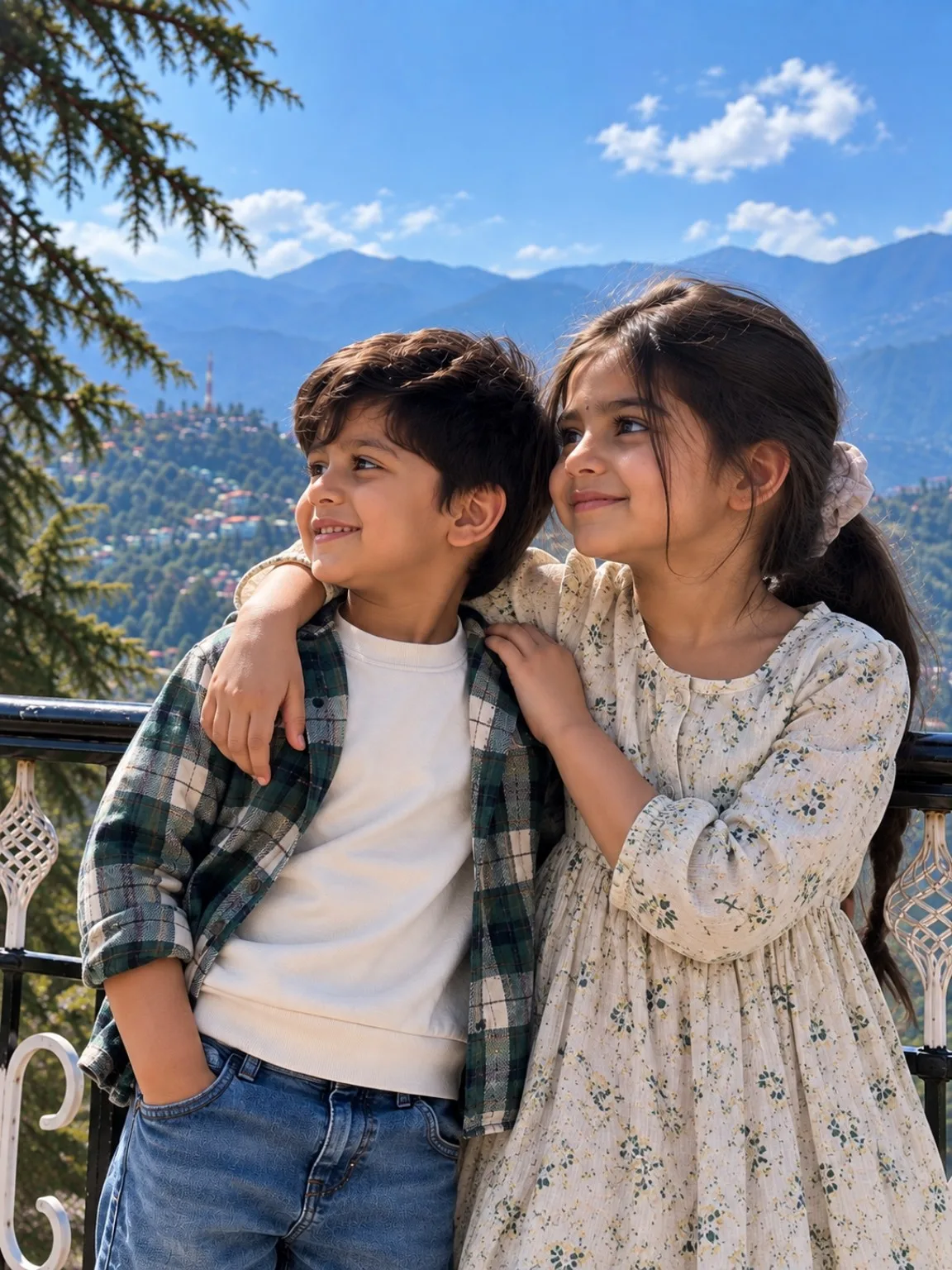
Cute Brother and Sister Photo in Shimla Mountains
Use the uploaded photos of the two children as identity references. Preserve each child's facial identity accurately while recreating the complete scene, pose, clothing, hairstyle, composition, lighting and photographic style described below.
Create an ultra-photorealistic, high-resolution vertical 3:4 cinematic travel portrait of two approximately 5–7-year-old Indian children — one little boy and one little girl — standing together at a scenic mountain viewpoint in Shimla, Himachal Pradesh.
The image should look like a genuine sibling/family travel photograph captured naturally on a beautiful bright sunny day.
COMPOSITION & FRAMING:
Create a close vertical portrait framed approximately from the children's upper thighs upward.
Place the little boy on the left and the little girl on the right.
Bring both children close to the camera so their faces, expressions, upper bodies and interaction become the main focus.
Their heads should appear close together while still maintaining natural spacing.
Keep enough background visible above and around them to clearly show the blue Himalayan mountains, forest-covered Shimla hillside, scattered houses and blue sky.
Photograph them approximately at their eye level using a natural portrait perspective.
Both faces must be extremely sharp.
LITTLE BOY — FACE:
The boy should appear approximately 5–7 years old.
Accurately preserve the uploaded boy's facial identity.
Maintain his natural:
• youthful face shape
• forehead
• eyebrows
• expressive dark eyes
• small nose
• lips
• rounded cheeks
• chin
• ears
• natural Indian skin tone
Keep completely age-appropriate proportions and natural child skin texture.
Give him a cheerful, spontaneous smile with a small amount of teeth naturally visible.
His face is turned toward the LEFT side of the frame.
He is looking happily toward something in the distance rather than directly at the camera.
LITTLE BOY — HAIR:
Give him thick, naturally dark brown-to-black hair.
Use a soft, slightly messy and naturally wavy children's haircut.
Keep more volume across the top and forehead with shorter sides.
Show individual hair strands and subtle sunlight highlights.
LITTLE BOY — CLOTHING:
Dress him in a simple cream/off-white crew-neck sweatshirt or lightweight top.
Over it, add an OPEN casual plaid overshirt.
Use a dark forest-green, muted teal, cream and subtle grey check pattern.
The overshirt should look like lightweight everyday cotton clothing, NOT a heavy jacket.
Push or roll the sleeves casually toward the forearms.
Pair it with medium-blue denim jeans.
Show realistic cotton fibres, plaid weave, buttons, seams, wrinkles, sleeve folds and denim texture.
Keep the outfit casual, comfortable and appropriate for a child visiting Shimla.
LITTLE BOY — POSE:
The boy stands comfortably beside the viewpoint railing.
Keep one hand naturally inside his jeans pocket.
His other arm remains relaxed around his side/body.
His torso faces mostly toward the camera while his head turns toward the left.
Keep his shoulders relaxed.
LITTLE GIRL — FACE:
The girl should appear approximately 5–7 years old.
Accurately preserve the uploaded girl's facial identity.
Maintain her natural:
• youthful face shape
• forehead
• eyebrows
• large expressive dark eyes
• nose
• lips
• soft cheeks
• chin
• ears
• natural Indian skin tone
Keep age-appropriate facial proportions.
Show realistic child skin texture with soft natural cheeks.
Give her a gentle, innocent closed-mouth smile.
Her head is also turned slightly toward the LEFT side of the frame.
She looks upward and into the distance with a happy, dreamy expression.
LITTLE GIRL — HAIR:
Give her long dark brown-to-black Indian hair.
Style it into a simple low ponytail.
Secure the ponytail with a large soft cream/off-white fabric scrunchie.
Use a natural centre-to-soft-side part.
Allow several thin loose strands to fall around her forehead, temples and cheeks.
Show realistic individual hairs and subtle flyaways illuminated by sunlight.
LITTLE GIRL — CLOTHING:
Dress her in a beautiful cream/off-white cotton floral dress.
Cover the fabric with tiny scattered botanical prints in muted forest-green, soft blue-green and subtle yellow tones.
Use:
• gently rounded neckline
• soft gathering around the upper bodice
• three-quarter loose sleeves
• lightly gathered cuffs
• gathered waist
• naturally flowing skirt
The dress should look lightweight, modest, comfortable and completely age-appropriate.
Render individual cotton fibres, floral printing, seams, stitching, gathered fabric and natural wrinkles.
LITTLE GIRL — POSE:
Create a warm sibling/friend interaction.
The girl stands immediately beside the boy.
Place her LEFT arm naturally across and around the boy's shoulders.
Her forearm should rest comfortably behind/across his upper shoulders.
Let her hand hang naturally near his upper arm/shoulder area.
Use her other hand to gently hold or touch the boy's upper shoulder/chest area.
Keep every finger anatomically correct and naturally positioned.
Their interaction should feel spontaneous, affectionate and innocent — like two children enjoying a family holiday together.
Do not make their pose stiff or overly staged.
RAILING:
Place both children directly in front of a distinctive Shimla viewpoint railing.
Use a black painted metal railing with decorative white ornamental inserts.
Include:
• glossy black horizontal top rail
• black vertical supports
• white curved motifs
• white twisted/lattice ornaments
• subtle paint wear
• realistic daylight reflections
The railing should remain visible behind and around their lower bodies.
SHIMLA LANDSCAPE:
Behind the children, create a beautiful panoramic Shimla mountain environment.
Show a prominent densely forested hill toward the left-middle background.
Cover it with Himalayan pine/deodar trees.
Scatter numerous tiny colourful houses naturally across its slopes.
Place a thin communication/telecom tower near the top of the hill.
Behind the nearer hill, show several large layers of Himalayan mountain ridges extending across the horizon.
Use realistic atmospheric perspective:
nearest hills = rich forest green
middle hills = blue-green
distant mountains = soft blue
farthest ridges = slightly hazy blue-grey
The mountains should remain recognisable while naturally softer than the children.
DEODAR TREE:
Allow large natural deodar/pine branches to enter from the upper-left corner.
Use irregular branch shapes with detailed dark-green needles.
The branches should create natural photographic framing without covering either child's face.
SKY:
Use a beautiful clear Himalayan blue sky occupying much of the upper background.
Include scattered fluffy white clouds.
Maintain a realistic atmospheric blue gradient.
LIGHTING:
Use bright natural mountain daylight.
The sunlight should illuminate both children's faces beautifully.
Create soft warm highlights across their:
• foreheads
• cheeks
• noses
• hair
• ears
• clothing
• hands and arms
Allow subtle rim lighting around loose hair strands, especially around the girl's ponytail and facial flyaways.
Maintain gentle natural shadows under the hair, nose, chin, arms and clothing folds.
Preserve authentic Indian skin tones.
Do not use artificial studio lighting.
DEPTH OF FIELD:
Keep both children's faces equally sharp.
Clearly resolve:
• eyes
• eyelashes
• hair
• skin texture
• clothing
• hands
• fabric patterns
Keep the nearby railing reasonably detailed.
Use moderate natural background separation.
The forested hill, houses and communication tower should remain recognisable.
Let distant Himalayan ridges gradually soften through natural atmospheric haze rather than excessive artificial portrait blur.
CAMERA & OPTICS:
Simulate a premium full-frame mirrorless camera.
Use approximately:
• 50–70mm focal length
• f/3.2–f/4
• ISO 100
• fast daylight shutter speed
• child eye-level camera position
• natural daylight white balance
• high dynamic range
• realistic optical sharpness
PHOTOREALISM:
Prioritise maximum real-camera realism.
Render:
• authentic child skin texture
• natural facial asymmetry
• soft youthful cheeks
• realistic eyes and eyelashes
• individual eyebrow hairs
• individual scalp and flyaway hairs
• natural hairlines
• realistic ponytail and scrunchie
• cotton sweatshirt fibres
• woven plaid overshirt texture
• floral dress fibres and tiny prints
• denim weave
• realistic clothing folds
• anatomically accurate small hands and fingers
• weathered metal railing
• individual deodar needles
• tiny hillside houses
• realistic forest texture
• atmospheric mountain haze
• natural clouds
• realistic sunlight
Keep the anatomy, body size, clothing and facial characteristics completely age-appropriate.
FINAL RESULT:
Ultra-photorealistic high-resolution vertical 3:4 cinematic sibling-style travel portrait of a cheerful young Indian boy and girl standing closely together at a scenic Shimla mountain viewpoint. The boy stands on the left wearing a cream crew-neck top, an open forest-green and cream plaid overshirt and blue jeans, with one hand casually inside his pocket. The girl stands on the right wearing a flowing cream cotton dress covered with tiny green and muted floral prints, with her long dark hair tied into a low ponytail using a cream scrunchie. She affectionately places one arm around the boy's shoulders while gently holding his shoulder with her other hand. Both children smile naturally while looking toward the left and slightly upward into the distance. Behind them are an ornate black-and-white railing, forest-covered Shimla hills filled with tiny houses, a distant communication tower, layered blue Himalayan mountains, deodar branches and a vivid blue sky with fluffy white clouds. Bright natural daylight, authentic child proportions, genuine sibling warmth, realistic skin and fabric textures and premium family travel photography.
Create an ultra-photorealistic, high-resolution vertical 3:4 cinematic travel portrait of two approximately 5–7-year-old Indian children — one little boy and one little girl — standing together at a scenic mountain viewpoint in Shimla, Himachal Pradesh.
The image should look like a genuine sibling/family travel photograph captured naturally on a beautiful bright sunny day.
COMPOSITION & FRAMING:
Create a close vertical portrait framed approximately from the children's upper thighs upward.
Place the little boy on the left and the little girl on the right.
Bring both children close to the camera so their faces, expressions, upper bodies and interaction become the main focus.
Their heads should appear close together while still maintaining natural spacing.
Keep enough background visible above and around them to clearly show the blue Himalayan mountains, forest-covered Shimla hillside, scattered houses and blue sky.
Photograph them approximately at their eye level using a natural portrait perspective.
Both faces must be extremely sharp.
LITTLE BOY — FACE:
The boy should appear approximately 5–7 years old.
Accurately preserve the uploaded boy's facial identity.
Maintain his natural:
• youthful face shape
• forehead
• eyebrows
• expressive dark eyes
• small nose
• lips
• rounded cheeks
• chin
• ears
• natural Indian skin tone
Keep completely age-appropriate proportions and natural child skin texture.
Give him a cheerful, spontaneous smile with a small amount of teeth naturally visible.
His face is turned toward the LEFT side of the frame.
He is looking happily toward something in the distance rather than directly at the camera.
LITTLE BOY — HAIR:
Give him thick, naturally dark brown-to-black hair.
Use a soft, slightly messy and naturally wavy children's haircut.
Keep more volume across the top and forehead with shorter sides.
Show individual hair strands and subtle sunlight highlights.
LITTLE BOY — CLOTHING:
Dress him in a simple cream/off-white crew-neck sweatshirt or lightweight top.
Over it, add an OPEN casual plaid overshirt.
Use a dark forest-green, muted teal, cream and subtle grey check pattern.
The overshirt should look like lightweight everyday cotton clothing, NOT a heavy jacket.
Push or roll the sleeves casually toward the forearms.
Pair it with medium-blue denim jeans.
Show realistic cotton fibres, plaid weave, buttons, seams, wrinkles, sleeve folds and denim texture.
Keep the outfit casual, comfortable and appropriate for a child visiting Shimla.
LITTLE BOY — POSE:
The boy stands comfortably beside the viewpoint railing.
Keep one hand naturally inside his jeans pocket.
His other arm remains relaxed around his side/body.
His torso faces mostly toward the camera while his head turns toward the left.
Keep his shoulders relaxed.
LITTLE GIRL — FACE:
The girl should appear approximately 5–7 years old.
Accurately preserve the uploaded girl's facial identity.
Maintain her natural:
• youthful face shape
• forehead
• eyebrows
• large expressive dark eyes
• nose
• lips
• soft cheeks
• chin
• ears
• natural Indian skin tone
Keep age-appropriate facial proportions.
Show realistic child skin texture with soft natural cheeks.
Give her a gentle, innocent closed-mouth smile.
Her head is also turned slightly toward the LEFT side of the frame.
She looks upward and into the distance with a happy, dreamy expression.
LITTLE GIRL — HAIR:
Give her long dark brown-to-black Indian hair.
Style it into a simple low ponytail.
Secure the ponytail with a large soft cream/off-white fabric scrunchie.
Use a natural centre-to-soft-side part.
Allow several thin loose strands to fall around her forehead, temples and cheeks.
Show realistic individual hairs and subtle flyaways illuminated by sunlight.
LITTLE GIRL — CLOTHING:
Dress her in a beautiful cream/off-white cotton floral dress.
Cover the fabric with tiny scattered botanical prints in muted forest-green, soft blue-green and subtle yellow tones.
Use:
• gently rounded neckline
• soft gathering around the upper bodice
• three-quarter loose sleeves
• lightly gathered cuffs
• gathered waist
• naturally flowing skirt
The dress should look lightweight, modest, comfortable and completely age-appropriate.
Render individual cotton fibres, floral printing, seams, stitching, gathered fabric and natural wrinkles.
LITTLE GIRL — POSE:
Create a warm sibling/friend interaction.
The girl stands immediately beside the boy.
Place her LEFT arm naturally across and around the boy's shoulders.
Her forearm should rest comfortably behind/across his upper shoulders.
Let her hand hang naturally near his upper arm/shoulder area.
Use her other hand to gently hold or touch the boy's upper shoulder/chest area.
Keep every finger anatomically correct and naturally positioned.
Their interaction should feel spontaneous, affectionate and innocent — like two children enjoying a family holiday together.
Do not make their pose stiff or overly staged.
RAILING:
Place both children directly in front of a distinctive Shimla viewpoint railing.
Use a black painted metal railing with decorative white ornamental inserts.
Include:
• glossy black horizontal top rail
• black vertical supports
• white curved motifs
• white twisted/lattice ornaments
• subtle paint wear
• realistic daylight reflections
The railing should remain visible behind and around their lower bodies.
SHIMLA LANDSCAPE:
Behind the children, create a beautiful panoramic Shimla mountain environment.
Show a prominent densely forested hill toward the left-middle background.
Cover it with Himalayan pine/deodar trees.
Scatter numerous tiny colourful houses naturally across its slopes.
Place a thin communication/telecom tower near the top of the hill.
Behind the nearer hill, show several large layers of Himalayan mountain ridges extending across the horizon.
Use realistic atmospheric perspective:
nearest hills = rich forest green
middle hills = blue-green
distant mountains = soft blue
farthest ridges = slightly hazy blue-grey
The mountains should remain recognisable while naturally softer than the children.
DEODAR TREE:
Allow large natural deodar/pine branches to enter from the upper-left corner.
Use irregular branch shapes with detailed dark-green needles.
The branches should create natural photographic framing without covering either child's face.
SKY:
Use a beautiful clear Himalayan blue sky occupying much of the upper background.
Include scattered fluffy white clouds.
Maintain a realistic atmospheric blue gradient.
LIGHTING:
Use bright natural mountain daylight.
The sunlight should illuminate both children's faces beautifully.
Create soft warm highlights across their:
• foreheads
• cheeks
• noses
• hair
• ears
• clothing
• hands and arms
Allow subtle rim lighting around loose hair strands, especially around the girl's ponytail and facial flyaways.
Maintain gentle natural shadows under the hair, nose, chin, arms and clothing folds.
Preserve authentic Indian skin tones.
Do not use artificial studio lighting.
DEPTH OF FIELD:
Keep both children's faces equally sharp.
Clearly resolve:
• eyes
• eyelashes
• hair
• skin texture
• clothing
• hands
• fabric patterns
Keep the nearby railing reasonably detailed.
Use moderate natural background separation.
The forested hill, houses and communication tower should remain recognisable.
Let distant Himalayan ridges gradually soften through natural atmospheric haze rather than excessive artificial portrait blur.
CAMERA & OPTICS:
Simulate a premium full-frame mirrorless camera.
Use approximately:
• 50–70mm focal length
• f/3.2–f/4
• ISO 100
• fast daylight shutter speed
• child eye-level camera position
• natural daylight white balance
• high dynamic range
• realistic optical sharpness
PHOTOREALISM:
Prioritise maximum real-camera realism.
Render:
• authentic child skin texture
• natural facial asymmetry
• soft youthful cheeks
• realistic eyes and eyelashes
• individual eyebrow hairs
• individual scalp and flyaway hairs
• natural hairlines
• realistic ponytail and scrunchie
• cotton sweatshirt fibres
• woven plaid overshirt texture
• floral dress fibres and tiny prints
• denim weave
• realistic clothing folds
• anatomically accurate small hands and fingers
• weathered metal railing
• individual deodar needles
• tiny hillside houses
• realistic forest texture
• atmospheric mountain haze
• natural clouds
• realistic sunlight
Keep the anatomy, body size, clothing and facial characteristics completely age-appropriate.
FINAL RESULT:
Ultra-photorealistic high-resolution vertical 3:4 cinematic sibling-style travel portrait of a cheerful young Indian boy and girl standing closely together at a scenic Shimla mountain viewpoint. The boy stands on the left wearing a cream crew-neck top, an open forest-green and cream plaid overshirt and blue jeans, with one hand casually inside his pocket. The girl stands on the right wearing a flowing cream cotton dress covered with tiny green and muted floral prints, with her long dark hair tied into a low ponytail using a cream scrunchie. She affectionately places one arm around the boy's shoulders while gently holding his shoulder with her other hand. Both children smile naturally while looking toward the left and slightly upward into the distance. Behind them are an ornate black-and-white railing, forest-covered Shimla hills filled with tiny houses, a distant communication tower, layered blue Himalayan mountains, deodar branches and a vivid blue sky with fluffy white clouds. Bright natural daylight, authentic child proportions, genuine sibling warmth, realistic skin and fabric textures and premium family travel photography.