70

Mera Photo AI @meraphotoai
180 views
Local Village Girl Portrait in Shimla Mountains
Use the uploaded girl's photo only as the identity reference. Preserve her facial identity accurately while recreating the complete location, traditional clothing, hairstyle, pose, composition, lighting and photographic style described below.
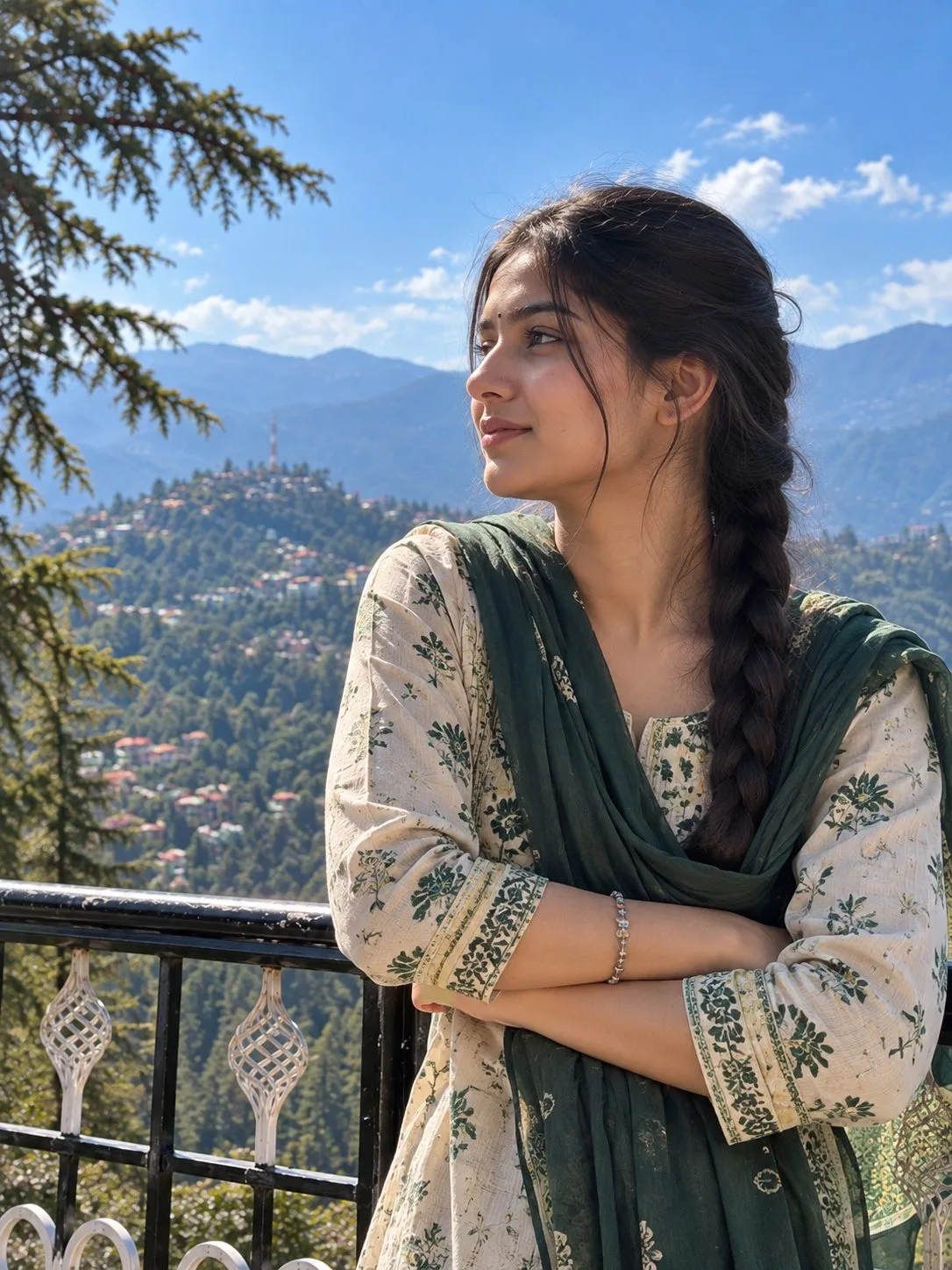
Create an ultra-photorealistic, high-resolution vertical 3:4 cinematic close-up travel portrait of a young Indian woman at a scenic mountain viewpoint in Shimla, Himachal Pradesh.
The overall appearance should feel simple, graceful and authentically inspired by a local Himachali village girl rather than a glamorous fashion photoshoot.
COMPOSITION & FRAMING:
Create a close portrait framed approximately from the waist upward.
Position the woman slightly toward the right side of the frame.
Keep enough background visible on the left to show the beautiful forest-covered Shimla hills, scattered hillside houses, blue Himalayan mountain layers and natural deodar branches.
Photograph her from approximately chest-to-eye level with a subtle natural upward perspective.
Keep her face, braid and traditional clothing extremely sharp while maintaining enough background detail to clearly establish the Shimla mountain environment.
FACE & IDENTITY:
Preserve the uploaded woman's facial identity accurately.
Maintain her natural:
• face shape
• forehead
• eyebrows
• eyes
• nose
• lips
• cheeks
• jawline
• ears
• Indian skin tone
Keep the face naturally beautiful rather than heavily retouched.
Show genuine skin pores, tiny facial imperfections, subtle cheek texture, realistic under-eye details and natural facial asymmetry.
Use little to no visible heavy makeup.
Keep the eyebrows natural and the lips in a soft natural shade.
EXPRESSION:
Give her a peaceful, gentle and slightly happy expression.
Her lips should form a very subtle natural smile.
Turn her head toward the left side of the frame.
She should calmly look across the distant mountains rather than directly at the camera.
Her expression should feel candid, as though she is quietly enjoying the Himalayan landscape.
HAIRSTYLE:
Give her long, naturally dark black-brown Indian hair.
Style most of the hair into one thick traditional loose braid falling over her right shoulder and continuing down across her chest.
Keep the braid detailed with individually visible hair strands.
Allow several soft loose strands around her forehead, temples and cheeks.
Create subtle natural flyaways caused by the mountain breeze.
Keep the hairstyle simple and suitable for a young village woman rather than a salon-styled fashion hairstyle.
CLOTHING:
Dress her in a beautiful but simple cream/off-white traditional cotton salwar-kameez/kurta outfit.
The kurta should feature small dark forest-green traditional floral block-print motifs distributed naturally across the fabric.
Use three-quarter sleeves.
Add slightly denser traditional green printed borders around the sleeve cuffs.
Keep the fabric lightweight with a subtle handwoven cotton appearance.
Show realistic:
• cotton fibres
• stitching
• natural creases
• sleeve folds
• printed floral imperfections
• fabric thickness
• soft sunlight interaction
DUPATTA:
Add a deep forest-green traditional dupatta.
Drape it naturally around the shoulders and across the front of the body.
Allow one portion to fall softly over the chest.
Use a lightweight cotton texture with subtle traditional printed details near portions of the border.
The dupatta should have realistic folds and natural irregular draping rather than looking perfectly arranged.
ACCESSORIES:
Keep jewellery extremely simple.
Add:
• tiny understated stud earrings
• one delicate silver-toned bracelet
• a very small minimal necklace if naturally visible
Avoid heavy jewellery.
The overall appearance should remain modest, everyday and locally inspired.
POSE:
Have the woman stand naturally beside the scenic viewpoint railing.
Let her gently rest her forearms across the top section of the railing.
Her arms should be loosely crossed in a comfortable position.
Keep her shoulders relaxed.
Turn her torso slightly toward the left rather than making her completely front-facing.
Her head should also turn left toward the mountain scenery.
The pose should feel spontaneous and peaceful, not like a formal modelling pose.
RAILING:
Preserve the black metal Shimla viewpoint railing prominently across the lower part of the image.
Include distinctive white decorative ornamental inserts between the black vertical bars.
Show:
• black horizontal top rail
• black vertical supports
• white curved lattice ornaments
• subtle scratches
• slightly weathered paint
• realistic sunlight reflections
SHIMLA BACKGROUND:
Create a realistic expansive Himalayan landscape behind her.
Show a forest-covered hill in the middle distance with numerous small colourful houses scattered naturally across its slopes.
Include a thin communication tower near the top of one hill.
Behind the nearer hill, show several layers of large blue-green Himalayan mountain ridges.
The mountains should gradually become softer and more bluish with distance because of atmospheric haze.
DEODAR TREES:
Include mature Himalayan deodar/pine branches entering naturally from the upper-left side of the composition.
Use irregular branches and individually recognisable dark-green needles.
Additional forest vegetation should naturally frame portions of the left side.
The foliage should look completely photographic.
SKY:
Use a bright, clean Himalayan blue sky.
Add scattered soft white clouds across the upper background.
Maintain realistic atmospheric colour gradients.
Do not oversaturate the sky.
LIGHTING:
Use beautiful bright natural mountain daylight.
Sunlight should illuminate one side of the woman's face while creating gentle dimensional shadows on the opposite side.
Create subtle highlights along:
• forehead
• nose bridge
• cheekbones
• lips
• jawline
• loose hair strands
• braid
• cream kurta
• forearms
Maintain realistic soft shadows beneath:
• hair
• chin
• nose
• dupatta folds
• crossed arms
Preserve natural Indian skin colour.
Allow a subtle warm rim light to catch loose hair strands around her head.
DEPTH OF FIELD:
Keep the woman's eyes, face, braid, kurta pattern and dupatta exceptionally detailed.
Keep the viewpoint railing reasonably sharp.
Allow the distant hillside houses and mountain layers to become gradually softer with distance.
Do not create extreme artificial portrait-mode blur.
The location must remain clearly identifiable as a real Himalayan hill-station environment.
CAMERA & OPTICS:
Simulate a premium full-frame mirrorless camera.
Use approximately:
• 70–85mm portrait lens
• f/2.8–f/3.5
• ISO 100
• fast daylight shutter speed
• natural daylight white balance
• high dynamic range
• realistic optical compression
Use professional portrait sharpness while retaining natural skin texture.
PHOTOREALISM:
Prioritise maximum real-camera realism.
Render clearly:
• natural Indian skin pores
• tiny facial imperfections
• individual eyebrow hairs
• realistic eyelashes
• natural lips
• individual loose hair strands
• detailed thick braid
• realistic hairline
• fine cotton fibres
• imperfect traditional block printing
• dupatta weave
• natural fabric wrinkles
• realistic forearm skin
• delicate bracelet reflections
• anatomically correct hands and arms
• weathered railing paint
• individual deodar needles
• scattered hillside houses
• forest texture
• atmospheric Himalayan haze
• realistic clouds
• believable daylight
The final result should look like an authentic photograph captured during a real visit to the Shimla hills, not like AI artwork.
FINAL OUTPUT:
Ultra-photorealistic high-resolution vertical 3:4 cinematic portrait of a young Indian village woman standing at a scenic Shimla mountain viewpoint. She has a naturally beautiful Indian face, minimal makeup, loose facial hair strands and a long thick dark braid resting over one shoulder. She wears a simple cream traditional cotton kurta decorated with small forest-green floral prints and a deep forest-green dupatta naturally draped around her shoulders. She gently rests her crossed forearms against an ornate black-and-white metal viewpoint railing while turning her face toward the distant mountains with a peaceful subtle smile. Behind her are densely forested Shimla hills, scattered hillside houses, a distant communication tower, layered blue Himalayan mountains, deodar branches and a bright blue sky with soft white clouds. Natural mountain daylight, authentic Indian village styling, realistic fabric and skin textures, cinematic depth and maximum photographic realism.
Create an ultra-photorealistic, high-resolution vertical 3:4 cinematic close-up travel portrait of a young Indian woman at a scenic mountain viewpoint in Shimla, Himachal Pradesh.
The overall appearance should feel simple, graceful and authentically inspired by a local Himachali village girl rather than a glamorous fashion photoshoot.
COMPOSITION & FRAMING:
Create a close portrait framed approximately from the waist upward.
Position the woman slightly toward the right side of the frame.
Keep enough background visible on the left to show the beautiful forest-covered Shimla hills, scattered hillside houses, blue Himalayan mountain layers and natural deodar branches.
Photograph her from approximately chest-to-eye level with a subtle natural upward perspective.
Keep her face, braid and traditional clothing extremely sharp while maintaining enough background detail to clearly establish the Shimla mountain environment.
FACE & IDENTITY:
Preserve the uploaded woman's facial identity accurately.
Maintain her natural:
• face shape
• forehead
• eyebrows
• eyes
• nose
• lips
• cheeks
• jawline
• ears
• Indian skin tone
Keep the face naturally beautiful rather than heavily retouched.
Show genuine skin pores, tiny facial imperfections, subtle cheek texture, realistic under-eye details and natural facial asymmetry.
Use little to no visible heavy makeup.
Keep the eyebrows natural and the lips in a soft natural shade.
EXPRESSION:
Give her a peaceful, gentle and slightly happy expression.
Her lips should form a very subtle natural smile.
Turn her head toward the left side of the frame.
She should calmly look across the distant mountains rather than directly at the camera.
Her expression should feel candid, as though she is quietly enjoying the Himalayan landscape.
HAIRSTYLE:
Give her long, naturally dark black-brown Indian hair.
Style most of the hair into one thick traditional loose braid falling over her right shoulder and continuing down across her chest.
Keep the braid detailed with individually visible hair strands.
Allow several soft loose strands around her forehead, temples and cheeks.
Create subtle natural flyaways caused by the mountain breeze.
Keep the hairstyle simple and suitable for a young village woman rather than a salon-styled fashion hairstyle.
CLOTHING:
Dress her in a beautiful but simple cream/off-white traditional cotton salwar-kameez/kurta outfit.
The kurta should feature small dark forest-green traditional floral block-print motifs distributed naturally across the fabric.
Use three-quarter sleeves.
Add slightly denser traditional green printed borders around the sleeve cuffs.
Keep the fabric lightweight with a subtle handwoven cotton appearance.
Show realistic:
• cotton fibres
• stitching
• natural creases
• sleeve folds
• printed floral imperfections
• fabric thickness
• soft sunlight interaction
DUPATTA:
Add a deep forest-green traditional dupatta.
Drape it naturally around the shoulders and across the front of the body.
Allow one portion to fall softly over the chest.
Use a lightweight cotton texture with subtle traditional printed details near portions of the border.
The dupatta should have realistic folds and natural irregular draping rather than looking perfectly arranged.
ACCESSORIES:
Keep jewellery extremely simple.
Add:
• tiny understated stud earrings
• one delicate silver-toned bracelet
• a very small minimal necklace if naturally visible
Avoid heavy jewellery.
The overall appearance should remain modest, everyday and locally inspired.
POSE:
Have the woman stand naturally beside the scenic viewpoint railing.
Let her gently rest her forearms across the top section of the railing.
Her arms should be loosely crossed in a comfortable position.
Keep her shoulders relaxed.
Turn her torso slightly toward the left rather than making her completely front-facing.
Her head should also turn left toward the mountain scenery.
The pose should feel spontaneous and peaceful, not like a formal modelling pose.
RAILING:
Preserve the black metal Shimla viewpoint railing prominently across the lower part of the image.
Include distinctive white decorative ornamental inserts between the black vertical bars.
Show:
• black horizontal top rail
• black vertical supports
• white curved lattice ornaments
• subtle scratches
• slightly weathered paint
• realistic sunlight reflections
SHIMLA BACKGROUND:
Create a realistic expansive Himalayan landscape behind her.
Show a forest-covered hill in the middle distance with numerous small colourful houses scattered naturally across its slopes.
Include a thin communication tower near the top of one hill.
Behind the nearer hill, show several layers of large blue-green Himalayan mountain ridges.
The mountains should gradually become softer and more bluish with distance because of atmospheric haze.
DEODAR TREES:
Include mature Himalayan deodar/pine branches entering naturally from the upper-left side of the composition.
Use irregular branches and individually recognisable dark-green needles.
Additional forest vegetation should naturally frame portions of the left side.
The foliage should look completely photographic.
SKY:
Use a bright, clean Himalayan blue sky.
Add scattered soft white clouds across the upper background.
Maintain realistic atmospheric colour gradients.
Do not oversaturate the sky.
LIGHTING:
Use beautiful bright natural mountain daylight.
Sunlight should illuminate one side of the woman's face while creating gentle dimensional shadows on the opposite side.
Create subtle highlights along:
• forehead
• nose bridge
• cheekbones
• lips
• jawline
• loose hair strands
• braid
• cream kurta
• forearms
Maintain realistic soft shadows beneath:
• hair
• chin
• nose
• dupatta folds
• crossed arms
Preserve natural Indian skin colour.
Allow a subtle warm rim light to catch loose hair strands around her head.
DEPTH OF FIELD:
Keep the woman's eyes, face, braid, kurta pattern and dupatta exceptionally detailed.
Keep the viewpoint railing reasonably sharp.
Allow the distant hillside houses and mountain layers to become gradually softer with distance.
Do not create extreme artificial portrait-mode blur.
The location must remain clearly identifiable as a real Himalayan hill-station environment.
CAMERA & OPTICS:
Simulate a premium full-frame mirrorless camera.
Use approximately:
• 70–85mm portrait lens
• f/2.8–f/3.5
• ISO 100
• fast daylight shutter speed
• natural daylight white balance
• high dynamic range
• realistic optical compression
Use professional portrait sharpness while retaining natural skin texture.
PHOTOREALISM:
Prioritise maximum real-camera realism.
Render clearly:
• natural Indian skin pores
• tiny facial imperfections
• individual eyebrow hairs
• realistic eyelashes
• natural lips
• individual loose hair strands
• detailed thick braid
• realistic hairline
• fine cotton fibres
• imperfect traditional block printing
• dupatta weave
• natural fabric wrinkles
• realistic forearm skin
• delicate bracelet reflections
• anatomically correct hands and arms
• weathered railing paint
• individual deodar needles
• scattered hillside houses
• forest texture
• atmospheric Himalayan haze
• realistic clouds
• believable daylight
The final result should look like an authentic photograph captured during a real visit to the Shimla hills, not like AI artwork.
FINAL OUTPUT:
Ultra-photorealistic high-resolution vertical 3:4 cinematic portrait of a young Indian village woman standing at a scenic Shimla mountain viewpoint. She has a naturally beautiful Indian face, minimal makeup, loose facial hair strands and a long thick dark braid resting over one shoulder. She wears a simple cream traditional cotton kurta decorated with small forest-green floral prints and a deep forest-green dupatta naturally draped around her shoulders. She gently rests her crossed forearms against an ornate black-and-white metal viewpoint railing while turning her face toward the distant mountains with a peaceful subtle smile. Behind her are densely forested Shimla hills, scattered hillside houses, a distant communication tower, layered blue Himalayan mountains, deodar branches and a bright blue sky with soft white clouds. Natural mountain daylight, authentic Indian village styling, realistic fabric and skin textures, cinematic depth and maximum photographic realism.