138

Mera Photo AI @meraphotoai
256 views
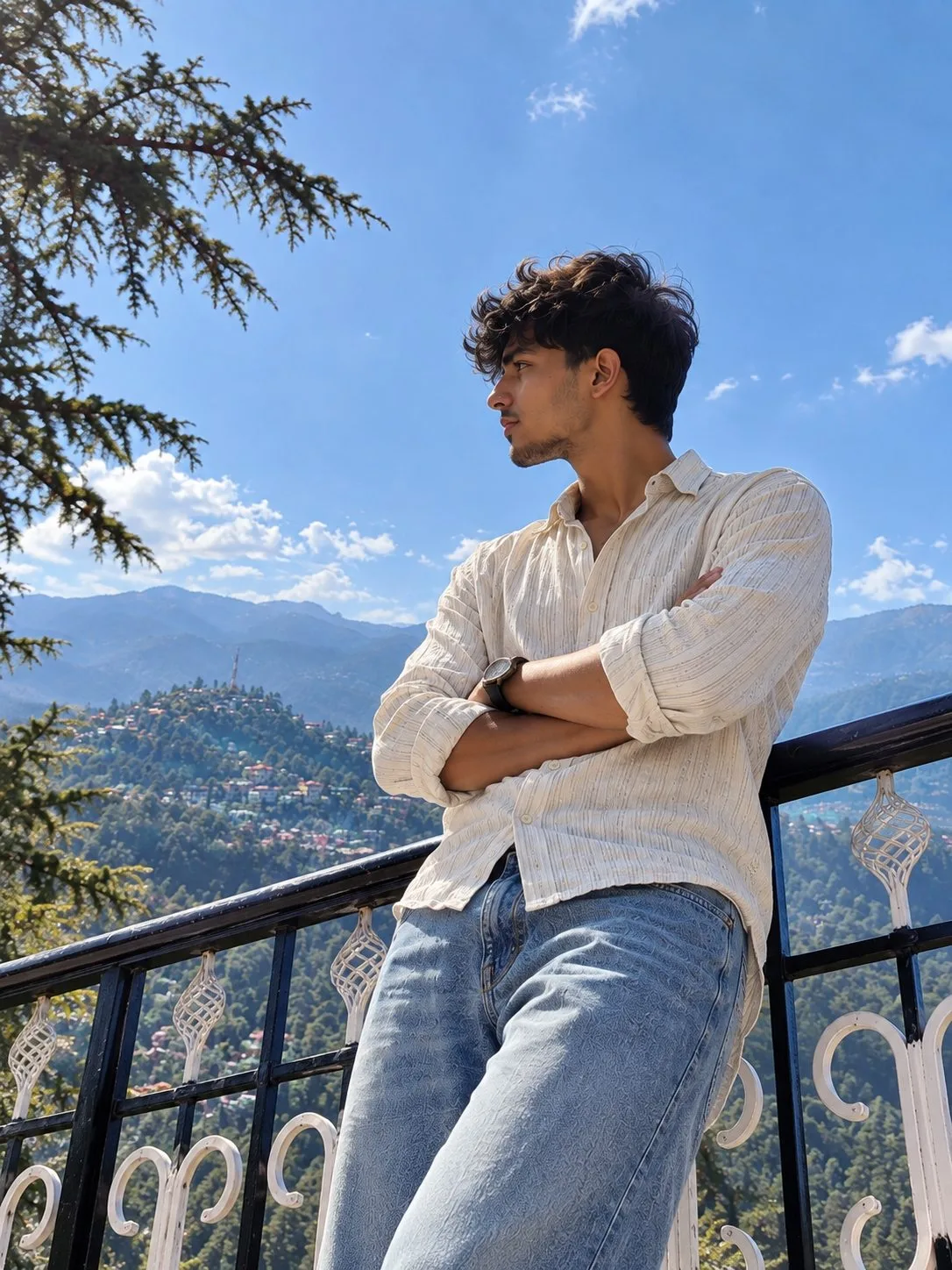
Low-Angle Cinematic Shimla Mountain Portrait
Use the uploaded person's photo as the identity reference. Preserve the person's facial identity accurately while recreating the complete pose, clothing, composition, location, lighting, camera angle and photographic style described below.
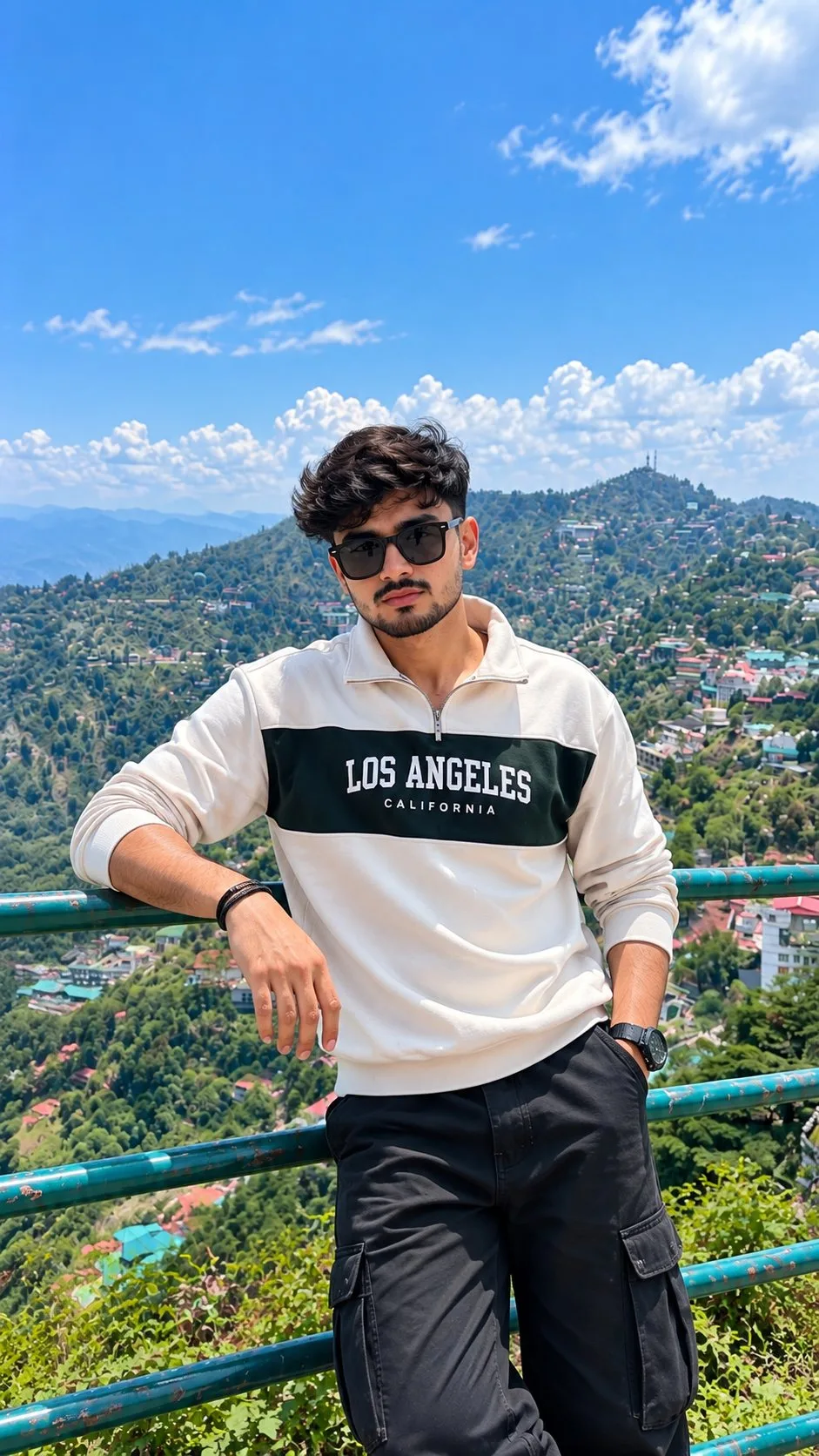
Create an ultra-photorealistic, high-resolution vertical 3:4 cinematic low-angle close-up travel portrait of a young Indian man at a scenic mountain viewpoint in Shimla, Himachal Pradesh, on a bright clear sunny day.
COMPOSITION & FRAMING:
Create a noticeably low-angle portrait, with the camera positioned below the subject's chest/waist level and tilted gently upward.
Frame the subject approximately from the upper thighs upward.
Place him slightly toward the right side of the frame while keeping a large amount of blue sky and Shimla mountain scenery visible around him.
The low camera position should make the subject appear confident and cinematic without creating exaggerated body proportions.
Keep his face, upper body and crossed arms as the primary visual focus.
SUBJECT & FACE:
Accurately preserve the facial identity of the person from the uploaded image.
Maintain his natural:
• face shape
• forehead
• eyebrows
• eyes
• nose
• lips
• cheek structure
• jawline
• ears
• Indian skin tone
Keep very light natural stubble along the upper lip, jaw and chin.
Show genuine skin pores, subtle tonal variation, tiny imperfections, natural under-eye texture and realistic facial asymmetry.
Do not excessively smooth or beautify the skin.
EXPRESSION & HEAD POSITION:
Give him a calm, thoughtful and slightly confident expression.
Turn his face toward the left side of the image.
He should look naturally toward the distant mountains instead of looking into the camera.
Keep his chin slightly raised because of the low-angle composition.
His expression should feel candid, as if he is quietly enjoying the Himalayan scenery.
HAIRSTYLE:
Give him thick, voluminous black hair with naturally wavy and loosely curly texture.
Keep plenty of volume across the crown and forehead.
Allow several messy strands to fall naturally toward the forehead.
Use slightly windswept styling suitable for an outdoor mountain location.
Show:
• individual hair strands
• curl separation
• natural density
• subtle flyaways
• realistic highlights
• believable hairline
CLOTHING:
Dress him in a lightweight cream/off-white casual button-down shirt.
Use a subtle thin vertical woven stripe/texture throughout the fabric.
Keep the fit relaxed and youthful.
Leave the upper one or two buttons naturally open.
Roll both sleeves casually to the forearms.
Show realistic:
• cotton/linen-like fibres
• fine vertical texture
• stitching
• seams
• sleeve folds
• wrinkles around elbows
• natural bunching around the waist
Pair the shirt with relaxed light-wash blue denim jeans.
The jeans should have a slightly loose contemporary fit with realistic denim grain, seams, folds and subtle faded variation.
Keep the outfit simple and suitable for an ordinary sunny sightseeing day in Shimla.
Do not add a jacket, coat or scarf.
ACCESSORY:
Add one simple dark wristwatch with a round metallic face.
Keep all other accessories minimal.
POSE:
Have the subject lean casually against the viewpoint railing.
Cross both arms comfortably across his chest.
Keep his elbows and hands anatomically natural.
His upper body should remain relaxed rather than stiff.
Let his hip rest subtly against the railing.
Use a natural weight shift through his lower body.
The pose should communicate quiet confidence rather than a deliberate fashion-model stance.
LOW-ANGLE PERSPECTIVE:
This is an important visual characteristic.
Position the camera significantly below normal eye level.
Angle the lens upward toward the subject.
The man's torso and crossed arms should appear slightly more dominant in the foreground.
His head should appear naturally against the open blue sky.
Do not distort his head, arms or body.
The perspective should resemble a photographer crouching slightly below the subject while shooting upward.
RAILING:
Keep the distinctive Shimla viewpoint railing clearly visible.
Use a black painted metal railing with decorative white ornamental inserts.
Include:
• glossy/weathered black top rail
• black vertical supports
• white curved symmetrical motifs
• white lattice-shaped decorative elements
Because of the low camera angle, allow the railing to travel diagonally upward through portions of the composition.
Show small scratches, paint wear and realistic daylight reflections.
SHIMLA LANDSCAPE:
Behind the subject, create an expansive realistic Shimla mountain panorama.
Show densely forested green hills covered with Himalayan pine/deodar trees.
Include a prominent smaller hill toward the left-middle background.
Scatter small colourful houses and buildings naturally across this hill.
Place a thin communication tower near its summit.
Behind it, show multiple layers of large Himalayan foothills extending across the horizon.
Use realistic atmospheric perspective:
• nearest hills = richer green detail
• middle hills = blue-green
• distant mountains = softer blue-grey
Do not make the mountains look painted or artificially smooth.
TREE FRAMING:
Allow large natural deodar/pine branches to enter from the upper-left corner.
Use detailed dark-green needles and irregular branch shapes.
The tree should naturally frame the subject and sky without covering his face.
SKY:
Fill a substantial portion of the upper frame with a vivid but realistic Himalayan blue sky.
Include scattered soft white clouds.
Use natural atmospheric gradients.
The sky should appear deeper blue overhead and slightly lighter toward the mountain horizon.
LIGHTING:
Use bright natural mountain daylight.
Sunlight should fall strongly but naturally across the subject.
Create soft warm highlights on:
• forehead
• cheek
• nose
• jawline
• neck
• forearms
• cream shirt
• hair edges
Keep believable shadows beneath:
• hair
• nose
• chin
• crossed arms
• shirt folds
Preserve natural Indian skin tone.
Do not create an artificial studio-light appearance.
The bright cream shirt must retain fabric detail instead of becoming overexposed.
CINEMATIC COLOUR:
Use clean premium travel-photography colour grading.
Maintain:
• natural warm skin
• cream clothing
• soft light-blue denim
• rich green pine forests
• blue-green mountain ridges
• deep Himalayan blue sky
• clean white clouds
Use moderate contrast and realistic saturation.
DEPTH OF FIELD:
Keep the man's face, hair, shirt and crossed arms extremely sharp.
The decorative railing should retain substantial detail.
Keep the nearest forested hill and its houses recognisable.
Allow distant mountain ridges to become progressively softer through atmospheric haze.
Do not create aggressive artificial background blur.
CAMERA & OPTICS:
Simulate a premium full-frame mirrorless camera.
Use approximately:
• 35–50mm equivalent lens
• low-angle camera position
• f/3.5–f/4
• ISO 100
• fast daylight shutter speed
• natural daylight white balance
• high dynamic range
Maintain realistic lens perspective.
Use professional optical sharpness without excessive digital sharpening.
PHOTOREALISM:
Prioritise maximum real-camera realism.
Clearly render:
• natural Indian skin pores
• subtle facial imperfections
• individual eyebrow hairs
• eyelashes
• fine stubble
• individual wavy hair strands
• realistic hairline
• forearm hairs
• cotton/linen shirt fibres
• tiny vertical shirt stripes
• realistic shirt wrinkles
• denim weave and fading
• watch glass and metal
• anatomically correct fingers
• weathered railing paint
• deodar needles
• individual hillside houses
• forest texture
• distant atmospheric haze
• natural clouds
• realistic sunlight and shadows
The result must look like a genuine high-quality photograph taken during a real Shimla trip, not digital artwork.
FINAL OUTPUT:
Ultra-photorealistic vertical 3:4 cinematic low-angle close-up portrait of a young Indian man at a scenic Shimla mountain viewpoint. He has thick naturally wavy black hair with a slightly windswept appearance, subtle facial stubble and a calm thoughtful expression while looking toward the mountains on his left. He wears a lightweight cream textured button-down shirt with sleeves casually rolled to his forearms, relaxed light-wash blue jeans and a simple dark wristwatch, with no jacket or scarf. He leans casually against an ornate black-and-white metal railing with both arms crossed. The low camera angle places his face beautifully against a vivid blue Himalayan sky while forest-covered Shimla hills, scattered hillside houses, a distant communication tower and layered mountain ridges remain visible behind him. Bright natural sunlight, authentic travel photography, realistic skin and fabric texture, cinematic perspective and maximum photorealism.
Create an ultra-photorealistic, high-resolution vertical 3:4 cinematic low-angle close-up travel portrait of a young Indian man at a scenic mountain viewpoint in Shimla, Himachal Pradesh, on a bright clear sunny day.
COMPOSITION & FRAMING:
Create a noticeably low-angle portrait, with the camera positioned below the subject's chest/waist level and tilted gently upward.
Frame the subject approximately from the upper thighs upward.
Place him slightly toward the right side of the frame while keeping a large amount of blue sky and Shimla mountain scenery visible around him.
The low camera position should make the subject appear confident and cinematic without creating exaggerated body proportions.
Keep his face, upper body and crossed arms as the primary visual focus.
SUBJECT & FACE:
Accurately preserve the facial identity of the person from the uploaded image.
Maintain his natural:
• face shape
• forehead
• eyebrows
• eyes
• nose
• lips
• cheek structure
• jawline
• ears
• Indian skin tone
Keep very light natural stubble along the upper lip, jaw and chin.
Show genuine skin pores, subtle tonal variation, tiny imperfections, natural under-eye texture and realistic facial asymmetry.
Do not excessively smooth or beautify the skin.
EXPRESSION & HEAD POSITION:
Give him a calm, thoughtful and slightly confident expression.
Turn his face toward the left side of the image.
He should look naturally toward the distant mountains instead of looking into the camera.
Keep his chin slightly raised because of the low-angle composition.
His expression should feel candid, as if he is quietly enjoying the Himalayan scenery.
HAIRSTYLE:
Give him thick, voluminous black hair with naturally wavy and loosely curly texture.
Keep plenty of volume across the crown and forehead.
Allow several messy strands to fall naturally toward the forehead.
Use slightly windswept styling suitable for an outdoor mountain location.
Show:
• individual hair strands
• curl separation
• natural density
• subtle flyaways
• realistic highlights
• believable hairline
CLOTHING:
Dress him in a lightweight cream/off-white casual button-down shirt.
Use a subtle thin vertical woven stripe/texture throughout the fabric.
Keep the fit relaxed and youthful.
Leave the upper one or two buttons naturally open.
Roll both sleeves casually to the forearms.
Show realistic:
• cotton/linen-like fibres
• fine vertical texture
• stitching
• seams
• sleeve folds
• wrinkles around elbows
• natural bunching around the waist
Pair the shirt with relaxed light-wash blue denim jeans.
The jeans should have a slightly loose contemporary fit with realistic denim grain, seams, folds and subtle faded variation.
Keep the outfit simple and suitable for an ordinary sunny sightseeing day in Shimla.
Do not add a jacket, coat or scarf.
ACCESSORY:
Add one simple dark wristwatch with a round metallic face.
Keep all other accessories minimal.
POSE:
Have the subject lean casually against the viewpoint railing.
Cross both arms comfortably across his chest.
Keep his elbows and hands anatomically natural.
His upper body should remain relaxed rather than stiff.
Let his hip rest subtly against the railing.
Use a natural weight shift through his lower body.
The pose should communicate quiet confidence rather than a deliberate fashion-model stance.
LOW-ANGLE PERSPECTIVE:
This is an important visual characteristic.
Position the camera significantly below normal eye level.
Angle the lens upward toward the subject.
The man's torso and crossed arms should appear slightly more dominant in the foreground.
His head should appear naturally against the open blue sky.
Do not distort his head, arms or body.
The perspective should resemble a photographer crouching slightly below the subject while shooting upward.
RAILING:
Keep the distinctive Shimla viewpoint railing clearly visible.
Use a black painted metal railing with decorative white ornamental inserts.
Include:
• glossy/weathered black top rail
• black vertical supports
• white curved symmetrical motifs
• white lattice-shaped decorative elements
Because of the low camera angle, allow the railing to travel diagonally upward through portions of the composition.
Show small scratches, paint wear and realistic daylight reflections.
SHIMLA LANDSCAPE:
Behind the subject, create an expansive realistic Shimla mountain panorama.
Show densely forested green hills covered with Himalayan pine/deodar trees.
Include a prominent smaller hill toward the left-middle background.
Scatter small colourful houses and buildings naturally across this hill.
Place a thin communication tower near its summit.
Behind it, show multiple layers of large Himalayan foothills extending across the horizon.
Use realistic atmospheric perspective:
• nearest hills = richer green detail
• middle hills = blue-green
• distant mountains = softer blue-grey
Do not make the mountains look painted or artificially smooth.
TREE FRAMING:
Allow large natural deodar/pine branches to enter from the upper-left corner.
Use detailed dark-green needles and irregular branch shapes.
The tree should naturally frame the subject and sky without covering his face.
SKY:
Fill a substantial portion of the upper frame with a vivid but realistic Himalayan blue sky.
Include scattered soft white clouds.
Use natural atmospheric gradients.
The sky should appear deeper blue overhead and slightly lighter toward the mountain horizon.
LIGHTING:
Use bright natural mountain daylight.
Sunlight should fall strongly but naturally across the subject.
Create soft warm highlights on:
• forehead
• cheek
• nose
• jawline
• neck
• forearms
• cream shirt
• hair edges
Keep believable shadows beneath:
• hair
• nose
• chin
• crossed arms
• shirt folds
Preserve natural Indian skin tone.
Do not create an artificial studio-light appearance.
The bright cream shirt must retain fabric detail instead of becoming overexposed.
CINEMATIC COLOUR:
Use clean premium travel-photography colour grading.
Maintain:
• natural warm skin
• cream clothing
• soft light-blue denim
• rich green pine forests
• blue-green mountain ridges
• deep Himalayan blue sky
• clean white clouds
Use moderate contrast and realistic saturation.
DEPTH OF FIELD:
Keep the man's face, hair, shirt and crossed arms extremely sharp.
The decorative railing should retain substantial detail.
Keep the nearest forested hill and its houses recognisable.
Allow distant mountain ridges to become progressively softer through atmospheric haze.
Do not create aggressive artificial background blur.
CAMERA & OPTICS:
Simulate a premium full-frame mirrorless camera.
Use approximately:
• 35–50mm equivalent lens
• low-angle camera position
• f/3.5–f/4
• ISO 100
• fast daylight shutter speed
• natural daylight white balance
• high dynamic range
Maintain realistic lens perspective.
Use professional optical sharpness without excessive digital sharpening.
PHOTOREALISM:
Prioritise maximum real-camera realism.
Clearly render:
• natural Indian skin pores
• subtle facial imperfections
• individual eyebrow hairs
• eyelashes
• fine stubble
• individual wavy hair strands
• realistic hairline
• forearm hairs
• cotton/linen shirt fibres
• tiny vertical shirt stripes
• realistic shirt wrinkles
• denim weave and fading
• watch glass and metal
• anatomically correct fingers
• weathered railing paint
• deodar needles
• individual hillside houses
• forest texture
• distant atmospheric haze
• natural clouds
• realistic sunlight and shadows
The result must look like a genuine high-quality photograph taken during a real Shimla trip, not digital artwork.
FINAL OUTPUT:
Ultra-photorealistic vertical 3:4 cinematic low-angle close-up portrait of a young Indian man at a scenic Shimla mountain viewpoint. He has thick naturally wavy black hair with a slightly windswept appearance, subtle facial stubble and a calm thoughtful expression while looking toward the mountains on his left. He wears a lightweight cream textured button-down shirt with sleeves casually rolled to his forearms, relaxed light-wash blue jeans and a simple dark wristwatch, with no jacket or scarf. He leans casually against an ornate black-and-white metal railing with both arms crossed. The low camera angle places his face beautifully against a vivid blue Himalayan sky while forest-covered Shimla hills, scattered hillside houses, a distant communication tower and layered mountain ridges remain visible behind him. Bright natural sunlight, authentic travel photography, realistic skin and fabric texture, cinematic perspective and maximum photorealism.