615

Mera Photo AI @meraphotoai
1,427 views
Shimla Ridge Statue Boy Photo
Use the uploaded person’s photo as the identity reference. Preserve the uploaded person’s facial identity accurately while recreating the hairstyle, clothing, pose, framing, monumental equestrian-statue location, Shimla hill-town background, cloudy atmosphere, lighting and professional cinematic photography style described below.
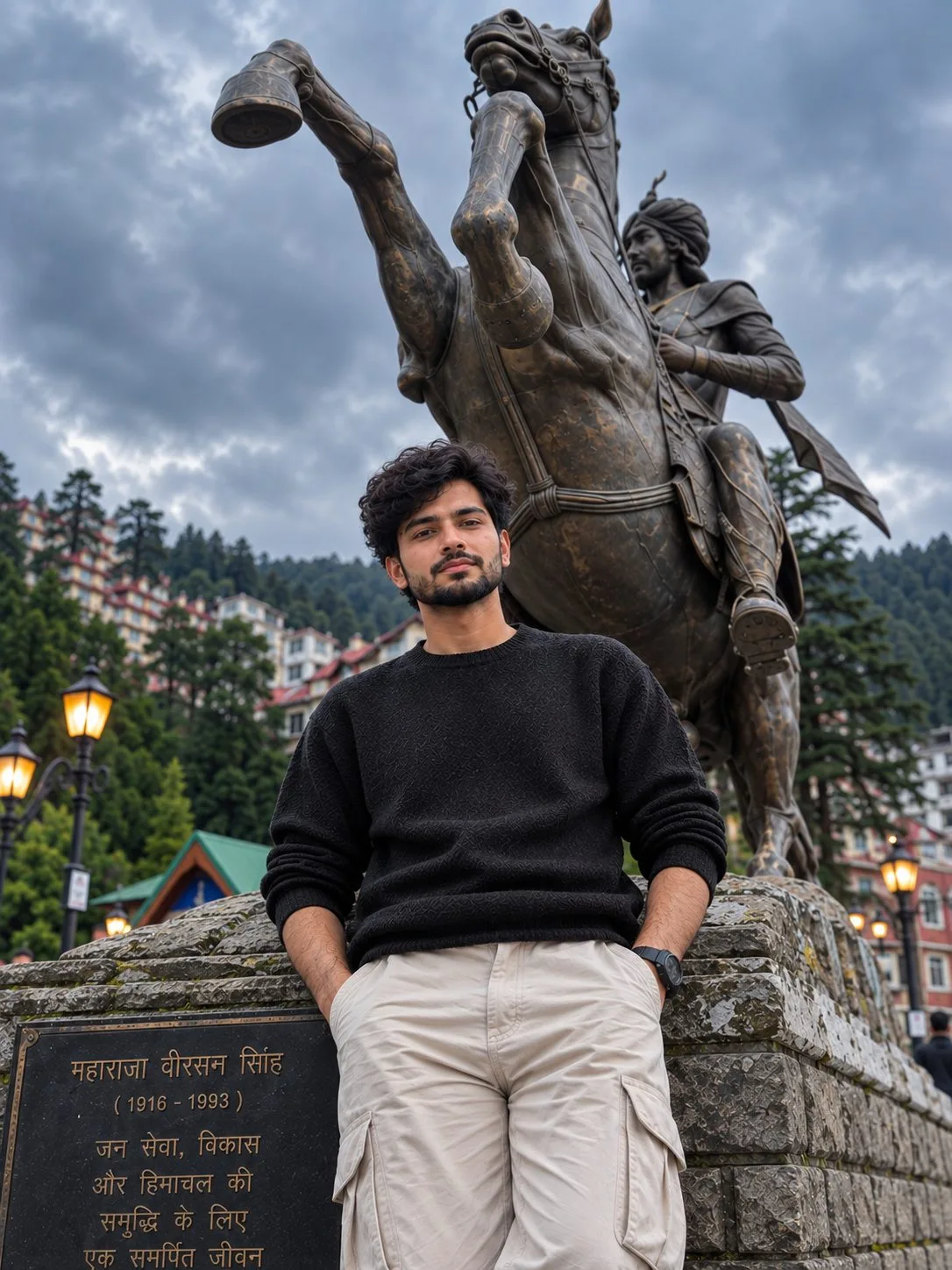
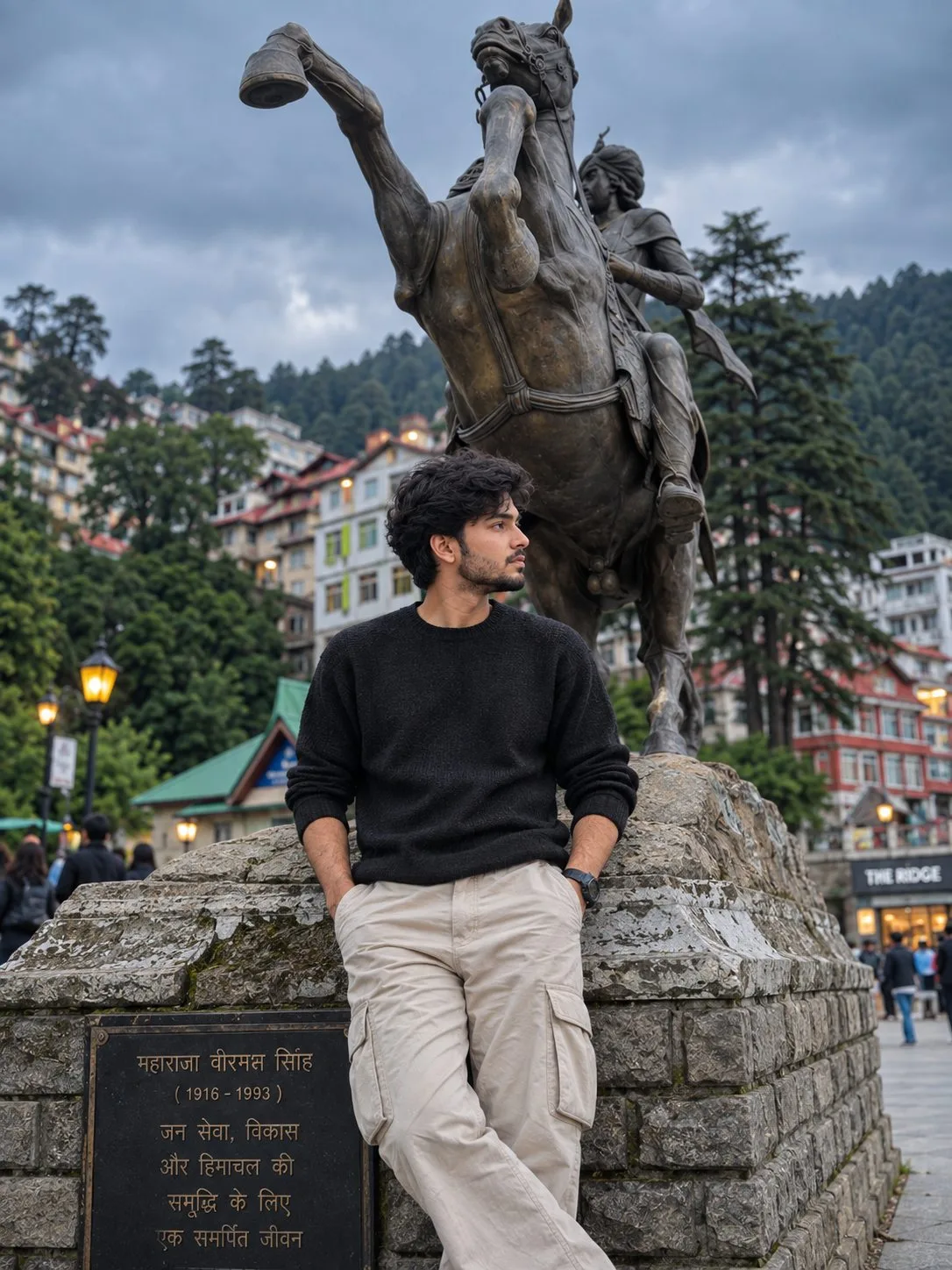
Create an ultra-photorealistic, high-resolution vertical 3:4 cinematic travel portrait of a young Indian man casually leaning against the weathered stone pedestal of a huge bronze equestrian statue at The Ridge area in Shimla, Himachal Pradesh.
The final result must look like a genuine professional full-frame camera photograph captured during a cool cloudy Shimla afternoon, with authentic Indian skin texture, realistic hair and clothing fibres, detailed aged stone, weathered bronze, atmospheric hill-town depth and natural optical background separation.
SUBJECT:
Show one young adult Indian man.
If an identity-reference photo is uploaded, accurately preserve his:
• natural face shape
• forehead
• eyebrow structure
• eye shape
• nose
• lips
• cheek structure
• jawline
• chin
• ears
• natural Indian complexion
Maintain subtle natural facial asymmetry and believable human proportions.
Do not excessively beautify, reshape or smooth his face.
NO SUNGLASSES:
Keep his face completely unobstructed.
Do not add sunglasses or eyeglasses.
His eyes, eyebrows and facial structure must remain clearly visible.
COMPOSITION & FRAMING:
Use a vertical 3:4 aspect ratio.
Create a cinematic medium-close travel portrait.
Frame the young man approximately from his head down to below his knees, while allowing enough surrounding space to establish the monument.
Place him slightly LEFT of centre.
Make his face, black textured sweater and cream cargo trousers the primary foreground elements.
Keep the massive bronze rearing horse and rider rising dramatically behind him.
The horse should occupy much of the upper half of the composition.
Keep enough of the statue visible to clearly communicate the equestrian monument while maintaining the man as the portrait subject.
Use the weathered stone pedestal directly behind his body.
Keep part of the dark memorial plaque visible toward the lower-left.
Show Shimla hillside buildings, tall evergreen trees, heritage lamps and small pedestrians in the background.
FACE ANGLE:
Keep his torso generally facing forward.
Turn his head strongly toward the RIGHT side of the frame.
Use a natural three-quarter/profile angle.
Keep his chin approximately level with a subtle upward lift.
His gaze should travel toward something outside the frame rather than directly into the camera.
Clearly preserve the nose profile, lips, cheek structure and jawline.
EXPRESSION:
Give him a calm, confident and thoughtful expression.
Keep his lips naturally closed and relaxed.
Avoid a broad smile.
The expression should feel candid, as though he has paused beside the monument and is quietly looking across The Ridge.
HAIRSTYLE:
Give him thick, naturally wavy dark brown-black hair.
Use:
• medium-length textured top
• dense natural volume
• irregular loose waves
• slightly messy front
• naturally shorter sides
• realistic hairline
• individual strands
• tiny flyaways
• subtle mountain-air movement
Avoid a perfectly sculpted salon hairstyle.
The hair should contain realistic strand irregularity and subtle natural volume.
FACIAL HAIR:
Give him a short natural beard and moustache.
Use:
• light-to-medium beard density
• visible individual follicles
• naturally connected moustache
• subtle cheek stubble
• short jawline beard
• realistic sideburn transition
• irregular natural density
Do not create an unnaturally sharp beard outline.
SKIN REALISM:
Because this is a close travel portrait, prioritise genuine human skin.
Clearly render:
• natural Indian skin pores
• forehead texture
• cheek texture
• subtle under-eye detail
• realistic nose texture
• natural lips
• tiny imperfections
• individual eyebrow hairs
• beard follicles
• fine facial hair
• subtle tonal variation
• realistic highlights
• natural shadow transitions
Avoid beauty-filter smoothing.
Keep the skin clean and sharp but naturally imperfect.
BLACK TEXTURED SWEATER:
Dress him in a completely plain charcoal-black knitted crew-neck sweater.
Use:
• relaxed modern fit
• round ribbed neckline
• long sleeves
• sleeves naturally pushed slightly upward
• ribbed cuffs
• soft medium-weight knit
• comfortable torso fit
Clearly render:
• individual knitted fibres
• tiny fabric fuzz
• irregular yarn texture
• neckline ribbing
• shoulder folds
• chest wrinkles
• sleeve bunching
• elbow compression
• subtle tonal variation inside the black fabric
Keep the sweater completely free from visible logos, graphics or text.
CREAM CARGO TROUSERS:
Dress him in relaxed warm cream/light-beige cargo trousers.
Use:
• loose modern fit
• straight/wide legs
• soft cotton-twill material
• natural waistband
• front pockets
• large side thigh cargo pockets
• rectangular pocket flaps
• visible stitching
• natural seams
• realistic folds
• subtle wrinkles
• slightly warm ivory/stone tone
The cream trousers should create a strong but natural contrast against the black sweater.
BLACK WRISTWATCH:
Place a simple dark wristwatch on his LEFT wrist.
Use:
• round black/charcoal dial
• black strap
• subtle metallic casing
• realistic glass reflection
• natural wrist placement
Keep it minimal and understated.
POSE:
Create a relaxed monument-side pose.
Let his lower back and hip rest lightly against the weathered stone pedestal.
Keep his torso upright and relaxed.
Place BOTH hands casually inside the front pockets of his cream cargo trousers.
Keep the elbows naturally bent.
Relax both shoulders.
Cross one ankle casually in front of the other.
Keep his body weight primarily supported by one leg and the stone pedestal.
Turn his head strongly toward the RIGHT side.
The pose should look effortless, confident and spontaneous rather than fashion-model stiff.
STONE PEDESTAL:
Preserve the large historic stone pedestal immediately behind and beside the man.
Use irregular grey stone blocks with:
• rough surfaces
• visible mortar
• chipped edges
• weathering
• small cracks
• darker stains
• pale mineral marks
• subtle moss
• tiny vegetation
• natural age-related discoloration
Render the stone nearest the subject with excellent micro-detail.
The pedestal should feel heavy, historic and genuinely weathered.
MEMORIAL PLAQUE:
Keep a dark rectangular memorial plaque mounted on the front-left section of the stone pedestal.
Use:
• dark charcoal/black metal
• thin aged border
• warm metallic engraved lettering
• several lines of Hindi text
• subtle weathering
• realistic attachment points
Keep the plaque naturally integrated into the monument.
The plaque is a secondary element and should not overpower the portrait.
BRONZE EQUESTRIAN STATUE:
Behind the young man, show a monumental dark bronze equestrian sculpture.
The horse should be dramatically rearing upward on its hind legs.
Show:
• powerful horse anatomy
• raised front legs
• muscular chest
• detailed head
• ears
• expressive sculpted face
• bridle
• reins
• harness details
• saddle
• bronze rider
• historic clothing on the rider
The rider should sit confidently on the rearing horse.
Use realistic sculpted bronze surfaces with:
• dark brown-bronze coloration
• aged patina
• lighter polished highlights
• subtle greenish oxidation in recesses
• scratches
• rain/weather marks
• sculptural texture
• believable metallic reflections
Keep the statue visually massive compared with the man.
LOW-ANGLE MONUMENT FEEL:
Although the portrait remains natural, use a subtly lower camera viewpoint so the rearing horse appears tall and dramatic behind the subject.
Avoid extreme distortion.
The monument should feel imposing without making the man's body proportions unnatural.
SHIMLA HILLSIDE:
Behind the monument, show a densely developed Shimla hillside.
Include:
• irregularly stacked mountain buildings
• cream houses
• white buildings
• muted red structures
• green and red roofs
• balconies
• windows
• narrow hillside architecture
• dark evergreen vegetation between buildings
Use atmospheric perspective so distant buildings become progressively softer.
DEODAR & EVERGREEN TREES:
Show tall dark-green Himalayan trees throughout the background.
Use:
• dense foliage
• irregular natural branches
• tall silhouettes
• visible trunks in some areas
• layered greenery
• realistic variation in height
Keep distant foliage optically softer than the subject.
HERITAGE STREET LAMPS:
Show several traditional black heritage lamps around the plaza.
Use:
• slim black poles
• classic lantern housings
• warm amber-yellow illumination
• realistic glass
• subtle glowing halos
The warm lamp glow should contrast gently with the cool cloudy environment.
THE RIDGE AREA:
Create the feeling of an active public plaza at The Ridge in Shimla.
Show:
• grey stone paving
• open pedestrian space
• scattered visitors
• small groups
• people walking naturally
• distant storefronts/buildings
• hill-station public-square atmosphere
Keep all background people secondary and softly focused.
Do not overcrowd the foreground.
BACKGROUND PEOPLE:
Include several naturally positioned tourists and local visitors.
Use varied:
• jackets
• trousers
• casual tops
• bags
• walking directions
• body positions
Keep them small and naturally blurred by optical depth.
Do not let anyone overlap the man's face.
CLOUDY SKY:
Use a dramatic but realistic cool grey-blue overcast Shimla sky.
Include:
• layered cloud formations
• soft tonal variation
• darker grey sections
• lighter cloud openings
• realistic mountain-weather atmosphere
Avoid artificial storm effects or lightning.
The weather should feel cool and moody but comfortable.
LIGHTING:
Use soft diffused mountain daylight from the overcast sky.
The clouds should act as a giant natural softbox.
Illuminate the man's face gently from the front-left/upper-left.
Create subtle highlights on:
• forehead
• eyes
• cheekbones
• nose
• lips
• jawline
• individual hair strands
• beard
• forearms
• black sweater texture
• wristwatch
• cream trousers
Use natural soft shadows beneath:
• hair
• eyebrows
• nose
• lower lip
• jawline
• chin
• sweater folds
• arms
Keep his Indian skin naturally warm compared with the cooler background.
Do not crush the texture of the black sweater.
Do not overexpose the cream trousers.
DEPTH OF FIELD:
Keep the young man exceptionally sharp.
Clearly resolve:
• eyes
• eyelashes
• eyebrows
• natural skin pores
• lips
• beard follicles
• individual hair strands
• black knitted fibres
• forearm hair
• watch details
• cargo fabric
• seams and stitching
Keep the nearby stone pedestal reasonably sharp.
Preserve substantial detail in the bronze statue because it is an important location element.
Use moderate optical softness on the distant buildings, trees, lamps and pedestrians.
The statue should remain recognisable and detailed rather than heavily blurred.
Avoid artificial smartphone portrait-mode blur.
CAMERA & OPTICS:
Simulate a premium full-frame mirrorless camera.
Use approximately:
• 70–85mm portrait lens
• vertical 3:4 composition
• slightly low camera position
• medium-close camera distance
• f/3.2–f/4
• ISO 160–250
• 1/320s shutter speed
• eye/face autofocus
• cloudy daylight white balance
• high dynamic range
• realistic optical sharpness
Use enough depth of field to retain useful detail in both the subject and monument.
Use natural portrait compression without making the background look artificially pasted in.
COLOR GRADING:
Use premium cinematic Shimla travel-photography grading.
Maintain:
• naturally warm Indian skin
• dark brown-black hair
• charcoal-black sweater
• warm cream cargo trousers
• dark wristwatch
• weathered grey stone
• aged dark bronze statue
• deep natural green trees
• restrained colourful hillside buildings
• warm amber heritage lamps
• cool grey-blue cloudy sky
• neutral grey plaza paving
Keep the subject subtly warmer than the surroundings.
Use moderate cinematic contrast.
Keep saturation restrained and natural.
Avoid aggressive teal-and-orange grading.
PHOTOREALISM:
Prioritise maximum genuine camera realism.
Clearly render:
• authentic Indian skin pores
• tiny facial imperfections
• individual beard follicles
• eyebrow hairs
• eyelashes
• individual wavy hair strands
• flyaways
• forearm hair
• knitted sweater fibres
• fabric fuzz
• cargo twill texture
• stitching
• wristwatch details
• rough stone grain
• mortar
• moss
• weather stains
• engraved plaque
• aged bronze patina
• sculpted horse anatomy
• harness details
• rider details
• evergreen foliage
• hillside architecture
• warm lamp glow
• realistic pedestrians
• cloudy atmospheric depth
FINAL RESULT:
Create an ultra-photorealistic high-resolution vertical 3:4 cinematic travel portrait of a young Indian man leaning casually against the historic stone pedestal of a monumental bronze equestrian statue at The Ridge in Shimla.
Frame him approximately from the head down to below the knees. Place him slightly left of centre while allowing the enormous rearing bronze horse and historic rider to rise dramatically behind him.
Give him thick naturally wavy dark hair and a short realistic beard and moustache. Keep his eyes completely visible with no sunglasses or eyeglasses.
Dress him in a completely plain charcoal-black textured knitted sweater, relaxed warm cream cargo trousers and a simple dark wristwatch.
Place both hands casually inside his trouser pockets, lean his lower back lightly against the stone monument and cross one ankle naturally in front of the other. Turn his head strongly toward the right with a calm, thoughtful expression.
Preserve the rough historic stone pedestal and a dark Hindi memorial plaque. Behind him, show the huge aged-bronze rearing horse and rider, Shimla hillside buildings, tall deodar trees, scattered visitors, grey plaza paving and several softly glowing heritage street lamps beneath a cool grey-blue cloudy mountain sky.
The final result must feature authentic Indian skin texture, individual wavy hair strands, realistic beard follicles, detailed black knit fibres, cream cargo fabric, highly detailed weathered stone and bronze patina, natural hill-town atmospheric depth and premium professional full-frame camera realism.
Create an ultra-photorealistic, high-resolution vertical 3:4 cinematic travel portrait of a young Indian man casually leaning against the weathered stone pedestal of a huge bronze equestrian statue at The Ridge area in Shimla, Himachal Pradesh.
The final result must look like a genuine professional full-frame camera photograph captured during a cool cloudy Shimla afternoon, with authentic Indian skin texture, realistic hair and clothing fibres, detailed aged stone, weathered bronze, atmospheric hill-town depth and natural optical background separation.
SUBJECT:
Show one young adult Indian man.
If an identity-reference photo is uploaded, accurately preserve his:
• natural face shape
• forehead
• eyebrow structure
• eye shape
• nose
• lips
• cheek structure
• jawline
• chin
• ears
• natural Indian complexion
Maintain subtle natural facial asymmetry and believable human proportions.
Do not excessively beautify, reshape or smooth his face.
NO SUNGLASSES:
Keep his face completely unobstructed.
Do not add sunglasses or eyeglasses.
His eyes, eyebrows and facial structure must remain clearly visible.
COMPOSITION & FRAMING:
Use a vertical 3:4 aspect ratio.
Create a cinematic medium-close travel portrait.
Frame the young man approximately from his head down to below his knees, while allowing enough surrounding space to establish the monument.
Place him slightly LEFT of centre.
Make his face, black textured sweater and cream cargo trousers the primary foreground elements.
Keep the massive bronze rearing horse and rider rising dramatically behind him.
The horse should occupy much of the upper half of the composition.
Keep enough of the statue visible to clearly communicate the equestrian monument while maintaining the man as the portrait subject.
Use the weathered stone pedestal directly behind his body.
Keep part of the dark memorial plaque visible toward the lower-left.
Show Shimla hillside buildings, tall evergreen trees, heritage lamps and small pedestrians in the background.
FACE ANGLE:
Keep his torso generally facing forward.
Turn his head strongly toward the RIGHT side of the frame.
Use a natural three-quarter/profile angle.
Keep his chin approximately level with a subtle upward lift.
His gaze should travel toward something outside the frame rather than directly into the camera.
Clearly preserve the nose profile, lips, cheek structure and jawline.
EXPRESSION:
Give him a calm, confident and thoughtful expression.
Keep his lips naturally closed and relaxed.
Avoid a broad smile.
The expression should feel candid, as though he has paused beside the monument and is quietly looking across The Ridge.
HAIRSTYLE:
Give him thick, naturally wavy dark brown-black hair.
Use:
• medium-length textured top
• dense natural volume
• irregular loose waves
• slightly messy front
• naturally shorter sides
• realistic hairline
• individual strands
• tiny flyaways
• subtle mountain-air movement
Avoid a perfectly sculpted salon hairstyle.
The hair should contain realistic strand irregularity and subtle natural volume.
FACIAL HAIR:
Give him a short natural beard and moustache.
Use:
• light-to-medium beard density
• visible individual follicles
• naturally connected moustache
• subtle cheek stubble
• short jawline beard
• realistic sideburn transition
• irregular natural density
Do not create an unnaturally sharp beard outline.
SKIN REALISM:
Because this is a close travel portrait, prioritise genuine human skin.
Clearly render:
• natural Indian skin pores
• forehead texture
• cheek texture
• subtle under-eye detail
• realistic nose texture
• natural lips
• tiny imperfections
• individual eyebrow hairs
• beard follicles
• fine facial hair
• subtle tonal variation
• realistic highlights
• natural shadow transitions
Avoid beauty-filter smoothing.
Keep the skin clean and sharp but naturally imperfect.
BLACK TEXTURED SWEATER:
Dress him in a completely plain charcoal-black knitted crew-neck sweater.
Use:
• relaxed modern fit
• round ribbed neckline
• long sleeves
• sleeves naturally pushed slightly upward
• ribbed cuffs
• soft medium-weight knit
• comfortable torso fit
Clearly render:
• individual knitted fibres
• tiny fabric fuzz
• irregular yarn texture
• neckline ribbing
• shoulder folds
• chest wrinkles
• sleeve bunching
• elbow compression
• subtle tonal variation inside the black fabric
Keep the sweater completely free from visible logos, graphics or text.
CREAM CARGO TROUSERS:
Dress him in relaxed warm cream/light-beige cargo trousers.
Use:
• loose modern fit
• straight/wide legs
• soft cotton-twill material
• natural waistband
• front pockets
• large side thigh cargo pockets
• rectangular pocket flaps
• visible stitching
• natural seams
• realistic folds
• subtle wrinkles
• slightly warm ivory/stone tone
The cream trousers should create a strong but natural contrast against the black sweater.
BLACK WRISTWATCH:
Place a simple dark wristwatch on his LEFT wrist.
Use:
• round black/charcoal dial
• black strap
• subtle metallic casing
• realistic glass reflection
• natural wrist placement
Keep it minimal and understated.
POSE:
Create a relaxed monument-side pose.
Let his lower back and hip rest lightly against the weathered stone pedestal.
Keep his torso upright and relaxed.
Place BOTH hands casually inside the front pockets of his cream cargo trousers.
Keep the elbows naturally bent.
Relax both shoulders.
Cross one ankle casually in front of the other.
Keep his body weight primarily supported by one leg and the stone pedestal.
Turn his head strongly toward the RIGHT side.
The pose should look effortless, confident and spontaneous rather than fashion-model stiff.
STONE PEDESTAL:
Preserve the large historic stone pedestal immediately behind and beside the man.
Use irregular grey stone blocks with:
• rough surfaces
• visible mortar
• chipped edges
• weathering
• small cracks
• darker stains
• pale mineral marks
• subtle moss
• tiny vegetation
• natural age-related discoloration
Render the stone nearest the subject with excellent micro-detail.
The pedestal should feel heavy, historic and genuinely weathered.
MEMORIAL PLAQUE:
Keep a dark rectangular memorial plaque mounted on the front-left section of the stone pedestal.
Use:
• dark charcoal/black metal
• thin aged border
• warm metallic engraved lettering
• several lines of Hindi text
• subtle weathering
• realistic attachment points
Keep the plaque naturally integrated into the monument.
The plaque is a secondary element and should not overpower the portrait.
BRONZE EQUESTRIAN STATUE:
Behind the young man, show a monumental dark bronze equestrian sculpture.
The horse should be dramatically rearing upward on its hind legs.
Show:
• powerful horse anatomy
• raised front legs
• muscular chest
• detailed head
• ears
• expressive sculpted face
• bridle
• reins
• harness details
• saddle
• bronze rider
• historic clothing on the rider
The rider should sit confidently on the rearing horse.
Use realistic sculpted bronze surfaces with:
• dark brown-bronze coloration
• aged patina
• lighter polished highlights
• subtle greenish oxidation in recesses
• scratches
• rain/weather marks
• sculptural texture
• believable metallic reflections
Keep the statue visually massive compared with the man.
LOW-ANGLE MONUMENT FEEL:
Although the portrait remains natural, use a subtly lower camera viewpoint so the rearing horse appears tall and dramatic behind the subject.
Avoid extreme distortion.
The monument should feel imposing without making the man's body proportions unnatural.
SHIMLA HILLSIDE:
Behind the monument, show a densely developed Shimla hillside.
Include:
• irregularly stacked mountain buildings
• cream houses
• white buildings
• muted red structures
• green and red roofs
• balconies
• windows
• narrow hillside architecture
• dark evergreen vegetation between buildings
Use atmospheric perspective so distant buildings become progressively softer.
DEODAR & EVERGREEN TREES:
Show tall dark-green Himalayan trees throughout the background.
Use:
• dense foliage
• irregular natural branches
• tall silhouettes
• visible trunks in some areas
• layered greenery
• realistic variation in height
Keep distant foliage optically softer than the subject.
HERITAGE STREET LAMPS:
Show several traditional black heritage lamps around the plaza.
Use:
• slim black poles
• classic lantern housings
• warm amber-yellow illumination
• realistic glass
• subtle glowing halos
The warm lamp glow should contrast gently with the cool cloudy environment.
THE RIDGE AREA:
Create the feeling of an active public plaza at The Ridge in Shimla.
Show:
• grey stone paving
• open pedestrian space
• scattered visitors
• small groups
• people walking naturally
• distant storefronts/buildings
• hill-station public-square atmosphere
Keep all background people secondary and softly focused.
Do not overcrowd the foreground.
BACKGROUND PEOPLE:
Include several naturally positioned tourists and local visitors.
Use varied:
• jackets
• trousers
• casual tops
• bags
• walking directions
• body positions
Keep them small and naturally blurred by optical depth.
Do not let anyone overlap the man's face.
CLOUDY SKY:
Use a dramatic but realistic cool grey-blue overcast Shimla sky.
Include:
• layered cloud formations
• soft tonal variation
• darker grey sections
• lighter cloud openings
• realistic mountain-weather atmosphere
Avoid artificial storm effects or lightning.
The weather should feel cool and moody but comfortable.
LIGHTING:
Use soft diffused mountain daylight from the overcast sky.
The clouds should act as a giant natural softbox.
Illuminate the man's face gently from the front-left/upper-left.
Create subtle highlights on:
• forehead
• eyes
• cheekbones
• nose
• lips
• jawline
• individual hair strands
• beard
• forearms
• black sweater texture
• wristwatch
• cream trousers
Use natural soft shadows beneath:
• hair
• eyebrows
• nose
• lower lip
• jawline
• chin
• sweater folds
• arms
Keep his Indian skin naturally warm compared with the cooler background.
Do not crush the texture of the black sweater.
Do not overexpose the cream trousers.
DEPTH OF FIELD:
Keep the young man exceptionally sharp.
Clearly resolve:
• eyes
• eyelashes
• eyebrows
• natural skin pores
• lips
• beard follicles
• individual hair strands
• black knitted fibres
• forearm hair
• watch details
• cargo fabric
• seams and stitching
Keep the nearby stone pedestal reasonably sharp.
Preserve substantial detail in the bronze statue because it is an important location element.
Use moderate optical softness on the distant buildings, trees, lamps and pedestrians.
The statue should remain recognisable and detailed rather than heavily blurred.
Avoid artificial smartphone portrait-mode blur.
CAMERA & OPTICS:
Simulate a premium full-frame mirrorless camera.
Use approximately:
• 70–85mm portrait lens
• vertical 3:4 composition
• slightly low camera position
• medium-close camera distance
• f/3.2–f/4
• ISO 160–250
• 1/320s shutter speed
• eye/face autofocus
• cloudy daylight white balance
• high dynamic range
• realistic optical sharpness
Use enough depth of field to retain useful detail in both the subject and monument.
Use natural portrait compression without making the background look artificially pasted in.
COLOR GRADING:
Use premium cinematic Shimla travel-photography grading.
Maintain:
• naturally warm Indian skin
• dark brown-black hair
• charcoal-black sweater
• warm cream cargo trousers
• dark wristwatch
• weathered grey stone
• aged dark bronze statue
• deep natural green trees
• restrained colourful hillside buildings
• warm amber heritage lamps
• cool grey-blue cloudy sky
• neutral grey plaza paving
Keep the subject subtly warmer than the surroundings.
Use moderate cinematic contrast.
Keep saturation restrained and natural.
Avoid aggressive teal-and-orange grading.
PHOTOREALISM:
Prioritise maximum genuine camera realism.
Clearly render:
• authentic Indian skin pores
• tiny facial imperfections
• individual beard follicles
• eyebrow hairs
• eyelashes
• individual wavy hair strands
• flyaways
• forearm hair
• knitted sweater fibres
• fabric fuzz
• cargo twill texture
• stitching
• wristwatch details
• rough stone grain
• mortar
• moss
• weather stains
• engraved plaque
• aged bronze patina
• sculpted horse anatomy
• harness details
• rider details
• evergreen foliage
• hillside architecture
• warm lamp glow
• realistic pedestrians
• cloudy atmospheric depth
FINAL RESULT:
Create an ultra-photorealistic high-resolution vertical 3:4 cinematic travel portrait of a young Indian man leaning casually against the historic stone pedestal of a monumental bronze equestrian statue at The Ridge in Shimla.
Frame him approximately from the head down to below the knees. Place him slightly left of centre while allowing the enormous rearing bronze horse and historic rider to rise dramatically behind him.
Give him thick naturally wavy dark hair and a short realistic beard and moustache. Keep his eyes completely visible with no sunglasses or eyeglasses.
Dress him in a completely plain charcoal-black textured knitted sweater, relaxed warm cream cargo trousers and a simple dark wristwatch.
Place both hands casually inside his trouser pockets, lean his lower back lightly against the stone monument and cross one ankle naturally in front of the other. Turn his head strongly toward the right with a calm, thoughtful expression.
Preserve the rough historic stone pedestal and a dark Hindi memorial plaque. Behind him, show the huge aged-bronze rearing horse and rider, Shimla hillside buildings, tall deodar trees, scattered visitors, grey plaza paving and several softly glowing heritage street lamps beneath a cool grey-blue cloudy mountain sky.
The final result must feature authentic Indian skin texture, individual wavy hair strands, realistic beard follicles, detailed black knit fibres, cream cargo fabric, highly detailed weathered stone and bronze patina, natural hill-town atmospheric depth and premium professional full-frame camera realism.