628

Mera Photo AI @meraphotoai
1,535 views
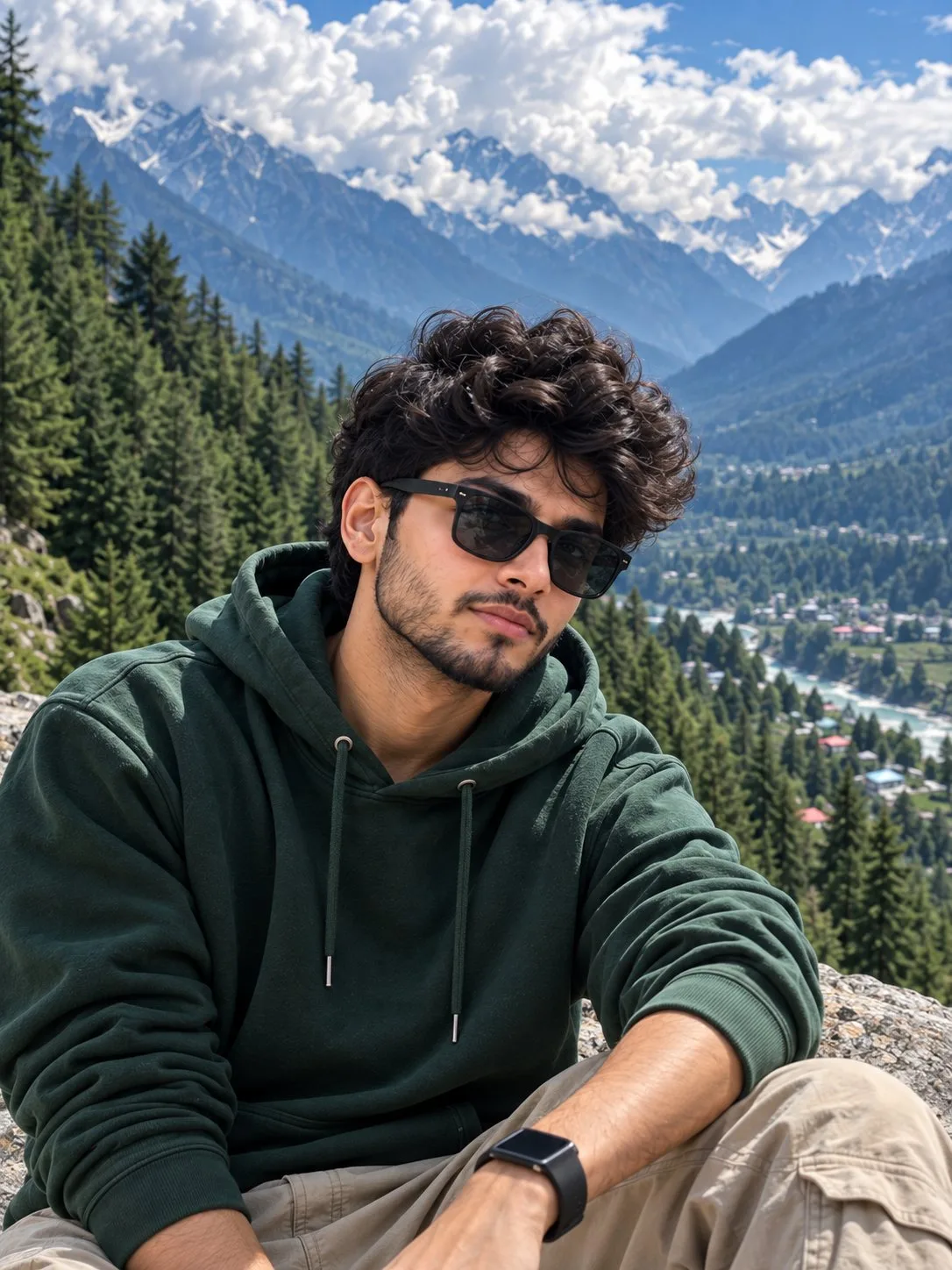
Manali Mountain Valley Boy Close-Up Photo
Use the uploaded person’s photo as the identity reference. Preserve the uploaded person’s facial identity accurately while recreating the hairstyle, clothing, seated close-up pose, mountain viewpoint, pine-covered valley, distant river and settlement, Himalayan peaks, dramatic clouds, lighting, composition and realistic professional photography style described below.
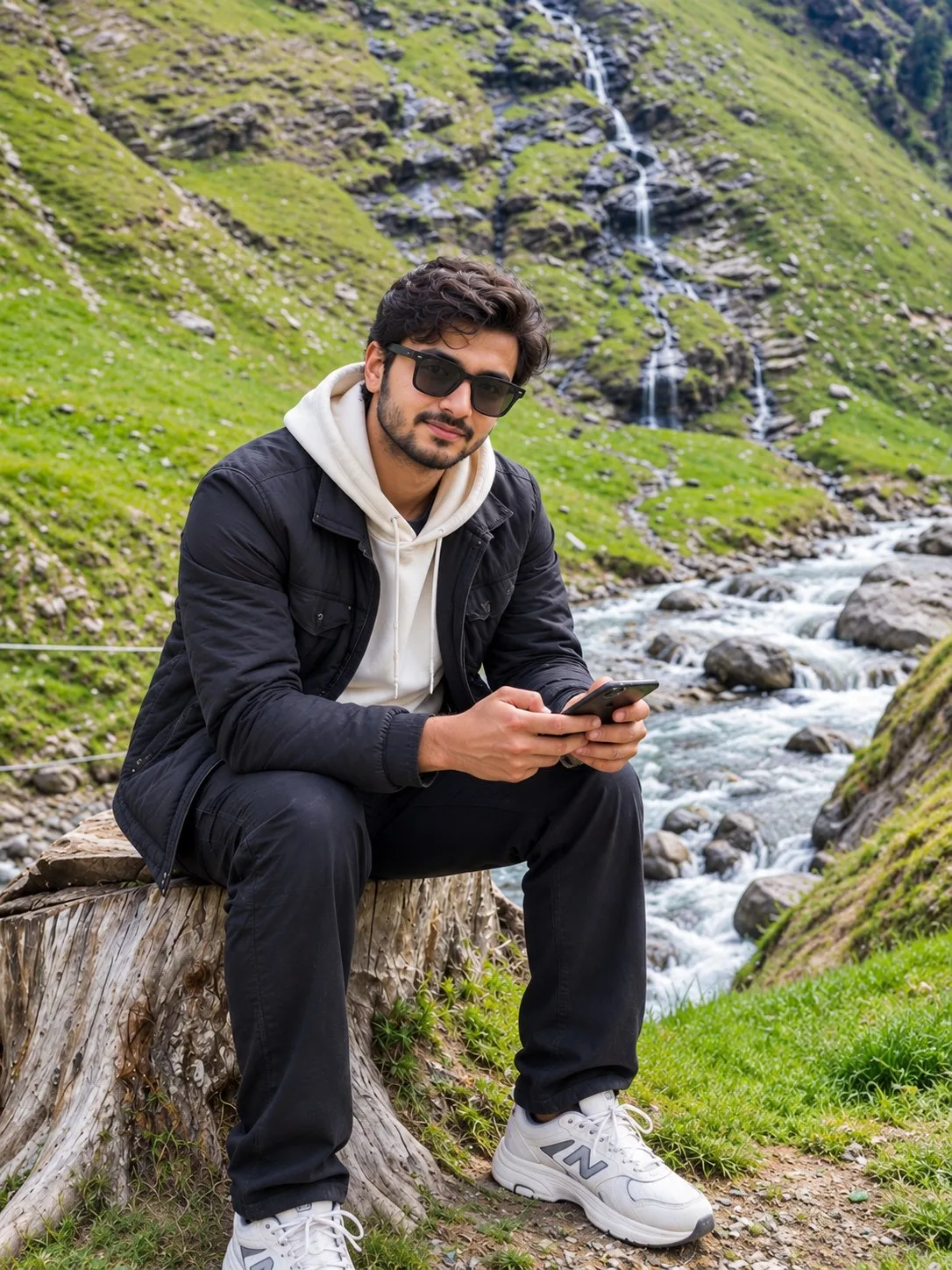
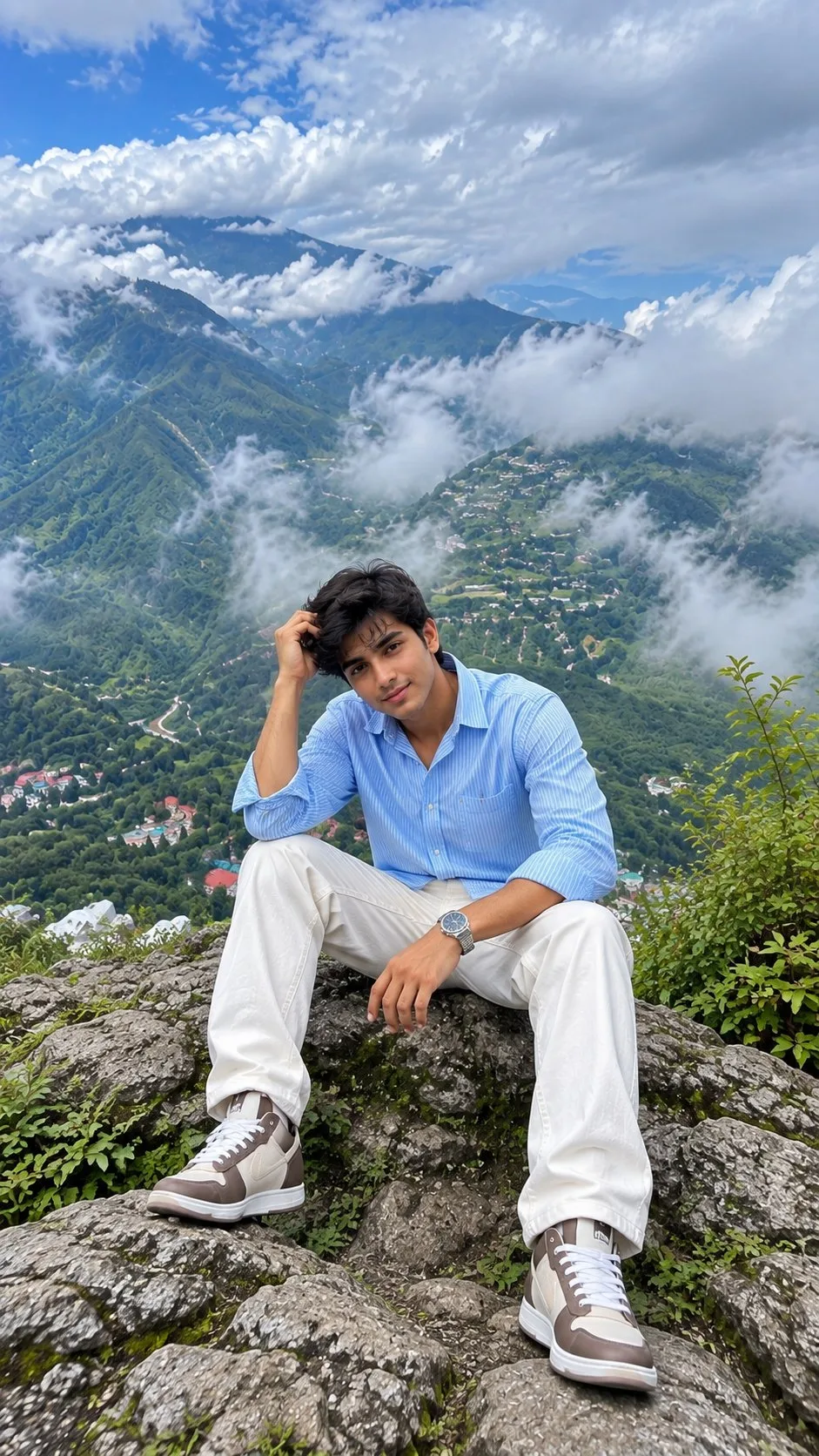
Create an ultra-photorealistic, high-resolution VERTICAL 3:4 CINEMATIC CLOSE-UP TRAVEL PORTRAIT of one young adult Indian man sitting naturally on a rough mountain rock at a scenic Himalayan viewpoint in Manali, Himachal Pradesh.
The final result must look like a genuine premium full-frame camera photograph captured during a bright, clear mountain day.
SUBJECT & IDENTITY:
Show ONLY ONE young adult Indian man.
If the user uploads his own identity-reference photograph, preserve his facial identity accurately, including:
• face shape
• forehead
• eyebrows
• eye region
• nose
• lips
• cheeks
• jawline
• chin
• ears
• natural Indian complexion
• distinctive facial proportions
Maintain natural facial asymmetry and authentic human characteristics.
Do not excessively beautify, reshape or smooth the face.
FACE POSITION:
Keep his face large and clearly visible.
Turn his face slightly toward the camera in a relaxed three-quarter angle.
Use:
• head slightly tilted
• chin naturally level
• relaxed forehead
• clearly visible nose
• defined natural jawline
• relaxed lips
• calm facial muscles
His expression should feel confident, peaceful and slightly thoughtful, like a candid moment while enjoying the mountain view.
HAIRSTYLE:
Give him thick, highly voluminous, naturally curly/wavy dark brown-black Indian hair.
Use:
• medium-length curls
• large irregular curl clusters
• naturally messy volume
• curls falling toward the forehead
• textured sides
• realistic hairline
• individual visible strands
• tiny flyaway hairs
• subtle frizz
• slight mountain-breeze movement
The curls should have realistic separation and shadow between individual strands.
Do not create a perfectly styled or artificial hairstyle.
FACIAL HAIR:
Give him short youthful facial hair.
Use:
• natural moustache
• short beard along the jawline
• light cheek stubble
• short chin growth
• individual beard follicles
• naturally uneven density
Keep the beard subtle and realistic.
BLACK SUNGLASSES:
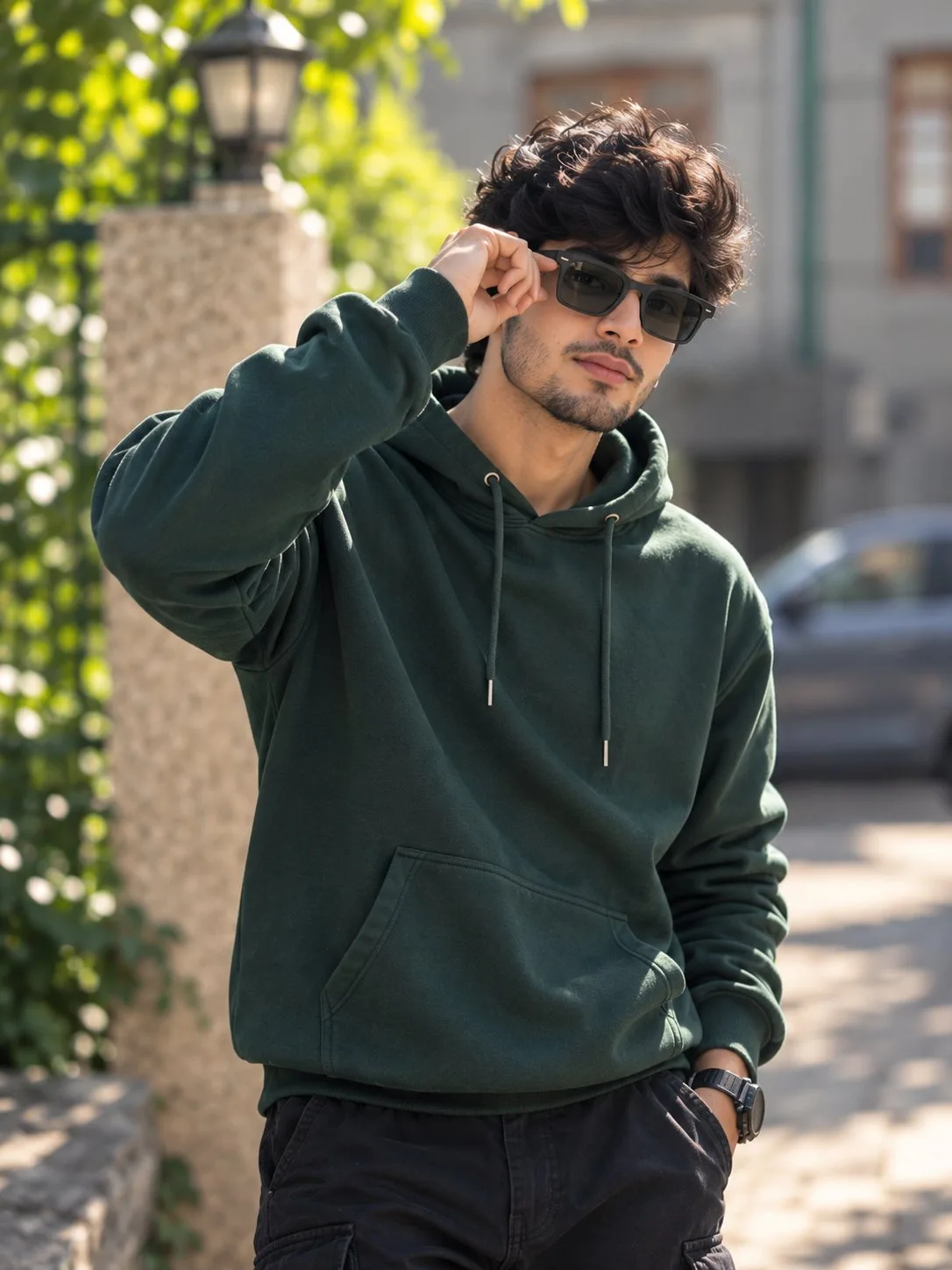
Give him simple matte-black rectangular sunglasses.
Use:
• medium-width black frame
• dark smoky lenses
• realistic nose bridge
• natural fit over ears
• subtle reflections from mountains and bright sky
• realistic highlights on the lenses
The sunglasses should sit naturally on his face and must not hide the overall facial structure.
FOREST-GREEN HOODIE:
Dress him in a completely plain DEEP FOREST-GREEN pullover hoodie.
Use:
• heavyweight cotton fleece
• relaxed slightly oversized fit
• full sleeves
• hood resting naturally around the back of his neck
• matching dark-green drawstrings
• small metallic drawstring tips
• front kangaroo pocket
• ribbed sleeve cuffs
• ribbed lower hem
• realistic stitching
• visible cotton fibres
• natural wrinkles
• realistic sleeve bunching
Keep the hoodie completely plain.
Do not add logos, graphics, text or branding.
BEIGE CARGO TROUSERS:
Dress him in loose BEIGE / LIGHT KHAKI cargo trousers.
Use:
• relaxed wide-leg construction
• soft matte cotton fabric
• large side cargo pocket
• realistic pocket flap
• visible stitching
• natural seams
• realistic folds around the raised knee
• fabric bunching around the hips
• subtle outdoor wear
Keep the trousers completely plain and unbranded.
BLACK SMARTWATCH:
Place a simple black smartwatch on the wrist closest to the camera.
Use:
• small rectangular black screen
• matte-black strap
• realistic wrist fit
• subtle glass reflection
• minimal modern design
Keep it understated.
CLOSE SEATED POSE:
Seat the man naturally on a rough grey mountain rock.
Use a relaxed close-up seated pose that feels different from a standard standing portrait.
Bring ONE knee upward prominently into the lower-right foreground.
Allow the OTHER leg to extend naturally toward the opposite lower side.
Rest ONE forearm casually across or near the raised knee.
Let the wrist with the black smartwatch remain clearly visible.
Keep the opposite arm naturally relaxed near the other leg.
Use:
• relaxed shoulders
• slight forward body lean
• natural spine
• believable elbow position
• realistic hip placement
• natural body weight
• correct arm proportions
• anatomically correct hands
The pose should feel spontaneous and comfortable, not stiff or overly staged.
CINEMATIC 3:4 CLOSE-UP:
Use a VERTICAL 3:4 aspect ratio.
Bring the camera VERY CLOSE to the subject.
Frame approximately from the COMPLETE TOP OF HIS CURLY HAIR down to around the raised knee and upper legs.
The FACE, HAIR, SUNGLASSES and FOREST-GREEN HOODIE must dominate the composition.
Keep the face large enough to clearly see:
• skin texture
• beard follicles
• individual curls
• sunglasses details
• lips
• jawline
Do not crop the top of his hair.
The raised beige cargo knee should enter prominently from the lower-right foreground and create strong natural depth.
Keep enough space behind and above his head to preserve the spectacular Manali mountain environment.
The final composition should clearly feel like a CLOSE-UP ENVIRONMENTAL PORTRAIT rather than a wide landscape photograph.
ROCK VIEWPOINT:
Preserve the natural rough mountain rock beneath the subject.
Show:
• coarse grey granite
• irregular mineral patterns
• small cracks
• rough surface
• tiny warm-coloured mineral areas
• natural weathering
• realistic shadows
• believable contact with clothing and body
Do not introduce artificial platforms or structures.
PINE FOREST:
Fill the lower and middle background with dense Himalayan pine/deodar forest.
Use:
• tall dark-green conifers
• irregular tree heights
• naturally overlapping trees
• individual treetops
• visible branches in closer areas
• varying shades of forest green
• lighter vegetation between trees
• natural gaps
• realistic mountain-slope distribution
The forest on the left should appear relatively close and richly detailed.
Trees farther into the valley should gradually become softer through atmospheric distance.
VALLEY:
Preserve a huge deep Himalayan valley behind the man.
Use naturally converging mountain slopes to form a broad V-shaped valley.
Show multiple layers of terrain extending far into the distance.
The valley must feel enormous compared with the subject.
DISTANT RIVER:
Far below, preserve a naturally winding pale blue/turquoise mountain river.
Show only the portions naturally visible between:
• pine trees
• valley vegetation
• distant buildings
• mountain terrain
Use realistic bright water reflections.
Keep the river physically distant and secondary.
DISTANT SETTLEMENT:
Retain the small existing mountain settlement visible across the valley.
Show:
• tiny scattered houses
• small rooftops
• occasional coloured roofs
• irregular spacing
• buildings partly hidden by trees
• realistic distant scale
Keep all buildings subtle.
Do not add new or invented structures.
HIMALAYAN MOUNTAINS:
Fill the upper background with enormous rugged Himalayan mountain ranges.
Show:
• dramatic jagged peaks
• steep blue-grey mountain faces
• irregular ridgelines
• dark exposed rock
• occasional distant snow patches
• overlapping mountain layers
• forested lower slopes
• deep valleys
• believable geological formations
The mountains should rise dramatically behind the man's curly hair.
Keep them naturally irregular and physically believable.
Do not create fantasy-shaped mountains.
DRAMATIC CLOUDS:
Preserve the spectacular huge white cumulus clouds around the upper Himalayan peaks.
Show:
• enormous billowing cloud formations
• irregular organic shapes
• bright sunlit white edges
• soft grey interior shadows
• multiple overlapping cloud layers
• realistic atmospheric volume
Allow some clouds to naturally pass in front of portions of the distant mountain peaks.
Keep the clouds dramatic but realistic.
BLUE SKY:
Preserve a bright natural Himalayan blue sky.
Use:
• clean blue tones
• natural tonal gradient
• lighter blue near distant mountains
• deeper blue higher in the frame
• scattered thinner white clouds
Avoid excessive saturation.
NATURAL LIGHTING:
Use bright crisp Himalayan daylight.
The light should illuminate the man's face naturally from above and slightly from the side.
Create realistic highlights on:
• individual curls
• forehead
• nose
• cheeks
• lips
• beard hairs
• sunglasses
• hoodie fabric
• forearms
• smartwatch
• beige cargo trousers
• nearby rock
• treetops
Maintain natural soft-to-medium shadows.
Do not create artificial studio lighting.
FACE & SKIN REALISM:
Because this is a close-up, facial realism is extremely important.
Clearly render:
• authentic Indian skin pores
• forehead texture
• cheek texture
• nose texture
• subtle under-eye details
• natural lips
• eyebrow hairs
• beard follicles
• moustache hairs
• fine facial hairs
• natural skin-tone variation
• slight sun exposure
• tiny realistic imperfections
Keep natural facial asymmetry.
Do not create waxy, plastic, excessively smooth or beauty-filtered skin.
CURLY HAIR DETAIL:
The hair should be one of the sharpest elements.
Clearly resolve:
• individual curls
• overlapping hair strands
• natural dark-brown highlights
• realistic root density
• flyaway hairs
• small frizz
• irregular curl direction
• realistic shadows between curls
The hair should look genuinely photographed.
HOODIE DETAIL:
Clearly show:
• cotton-fleece texture
• tiny fibres
• seams
• hood construction
• drawstrings
• metal drawstring tips
• ribbed cuffs
• kangaroo pocket
• realistic wrinkles
• sleeve bunching
CARGO DETAIL:
Clearly show:
• matte cotton weave
• cargo pocket
• pocket flap
• stitching
• seams
• knee creasing
• realistic folds
• subtle natural wear
ARM & HAND REALISM:
Render visible arms and hands anatomically correctly.
Show:
• natural forearm proportions
• realistic skin texture
• subtle arm hair
• correct wrist anatomy
• realistic hand size
• five natural fingers where visible
• believable fingernails
• relaxed positioning
The smartwatch must sit naturally around the wrist.
DEPTH OF FIELD:
Use premium optical depth of field.
Keep:
FACE — extremely sharp
CURLY HAIR — extremely sharp
SUNGLASSES — extremely sharp
HOODIE — highly detailed
FOREARMS — highly detailed
SMARTWATCH — sharp
RAISED KNEE — detailed
NEARBY ROCK — detailed
CLOSE PINE TREES — moderately sharp
DISTANT SETTLEMENT — gradually softer
RIVER — clearly recognisable
MOUNTAINS — naturally atmospheric
CLOUDS — detailed but distant
Do NOT blur the background excessively.
The Manali valley, pine forest and mountains must remain clearly recognisable.
CAMERA & OPTICS:
Simulate a premium full-frame mirrorless camera.
Use approximately:
• 70–85mm environmental portrait lens
• vertical 3:4 composition
• close camera-to-subject distance
• camera around eye level
• f/3.5–f/4
• ISO 100
• 1/800 sec
• continuous eye/face autofocus
• daylight white balance
• high dynamic range
• realistic lens compression
• professional optical sharpness
Expose carefully so both the man's face and bright white clouds retain detail.
COLOR GRADING:
Use premium cinematic Himalayan travel-photography grading.
Maintain:
• naturally warm Indian skin
• rich dark brown-black curly hair
• matte-black sunglasses
• deep forest-green hoodie
• warm beige cargo trousers
• neutral grey rock
• rich natural pine greens
• pale blue/turquoise distant river
• subtle distant rooftops
• cool blue-grey mountains
• clean natural blue sky
• bright white clouds with soft grey shadows
Keep skin slightly warmer than the surrounding green-blue landscape.
Use rich but realistic colours.
Do not oversaturate.
PHOTOREALISM:
Prioritise maximum real-camera authenticity.
Clearly render:
• natural facial asymmetry
• authentic skin pores
• beard follicles
• eyebrow hairs
• individual curly hair strands
• realistic sunglasses reflections
• hoodie cotton fibres
• cargo stitching
• smartwatch material
• arm hair
• rough granite
• individual pine trees
• distant houses
• winding river
• mountain geology
• atmospheric perspective
• volumetric cloud detail
Include subtle real-world photographic imperfections.
SCENE PRESERVATION:
Preserve only the elements naturally belonging to this Manali valley viewpoint scene.
Do not add any extra:
• board
• signboard
• placard
• text
• logo
• watermark
• advertisement
• artificial landmark
• decorative installation
• unrelated object
• unnecessary prop
• invented scene element
FINAL RESULT:
Create an ultra-photorealistic high-resolution VERTICAL 3:4 CINEMATIC CLOSE-UP travel portrait of one young adult Indian man sitting naturally on a rough mountain rock overlooking a spectacular Manali Himalayan valley.
Keep his face large and clearly visible with thick voluminous naturally curly dark hair, short realistic facial hair and matte-black rectangular sunglasses.
Dress him in a completely plain deep forest-green hoodie, loose beige cargo trousers and a minimal black smartwatch.
Use a relaxed seated close-up pose with one knee raised prominently into the foreground and one forearm resting naturally near/across that knee.
Bring the camera close enough that his face, curly hair and forest-green hoodie dominate the image.
Behind him, preserve the dense dark-green pine/deodar forest, winding distant river, tiny scattered valley settlement, enormous layered blue-grey Himalayan peaks and spectacular billowing white clouds beneath a clean blue sky.
Use crisp natural mountain daylight, authentic Indian skin texture, highly detailed curls and fabrics, realistic optical depth, natural atmospheric perspective and premium full-frame-camera realism.
The final result must look like a genuine close-up travel portrait professionally photographed at a scenic Manali mountain viewpoint, not an AI-generated image.
Create an ultra-photorealistic, high-resolution VERTICAL 3:4 CINEMATIC CLOSE-UP TRAVEL PORTRAIT of one young adult Indian man sitting naturally on a rough mountain rock at a scenic Himalayan viewpoint in Manali, Himachal Pradesh.
The final result must look like a genuine premium full-frame camera photograph captured during a bright, clear mountain day.
SUBJECT & IDENTITY:
Show ONLY ONE young adult Indian man.
If the user uploads his own identity-reference photograph, preserve his facial identity accurately, including:
• face shape
• forehead
• eyebrows
• eye region
• nose
• lips
• cheeks
• jawline
• chin
• ears
• natural Indian complexion
• distinctive facial proportions
Maintain natural facial asymmetry and authentic human characteristics.
Do not excessively beautify, reshape or smooth the face.
FACE POSITION:
Keep his face large and clearly visible.
Turn his face slightly toward the camera in a relaxed three-quarter angle.
Use:
• head slightly tilted
• chin naturally level
• relaxed forehead
• clearly visible nose
• defined natural jawline
• relaxed lips
• calm facial muscles
His expression should feel confident, peaceful and slightly thoughtful, like a candid moment while enjoying the mountain view.
HAIRSTYLE:
Give him thick, highly voluminous, naturally curly/wavy dark brown-black Indian hair.
Use:
• medium-length curls
• large irregular curl clusters
• naturally messy volume
• curls falling toward the forehead
• textured sides
• realistic hairline
• individual visible strands
• tiny flyaway hairs
• subtle frizz
• slight mountain-breeze movement
The curls should have realistic separation and shadow between individual strands.
Do not create a perfectly styled or artificial hairstyle.
FACIAL HAIR:
Give him short youthful facial hair.
Use:
• natural moustache
• short beard along the jawline
• light cheek stubble
• short chin growth
• individual beard follicles
• naturally uneven density
Keep the beard subtle and realistic.
BLACK SUNGLASSES:
Give him simple matte-black rectangular sunglasses.
Use:
• medium-width black frame
• dark smoky lenses
• realistic nose bridge
• natural fit over ears
• subtle reflections from mountains and bright sky
• realistic highlights on the lenses
The sunglasses should sit naturally on his face and must not hide the overall facial structure.
FOREST-GREEN HOODIE:
Dress him in a completely plain DEEP FOREST-GREEN pullover hoodie.
Use:
• heavyweight cotton fleece
• relaxed slightly oversized fit
• full sleeves
• hood resting naturally around the back of his neck
• matching dark-green drawstrings
• small metallic drawstring tips
• front kangaroo pocket
• ribbed sleeve cuffs
• ribbed lower hem
• realistic stitching
• visible cotton fibres
• natural wrinkles
• realistic sleeve bunching
Keep the hoodie completely plain.
Do not add logos, graphics, text or branding.
BEIGE CARGO TROUSERS:
Dress him in loose BEIGE / LIGHT KHAKI cargo trousers.
Use:
• relaxed wide-leg construction
• soft matte cotton fabric
• large side cargo pocket
• realistic pocket flap
• visible stitching
• natural seams
• realistic folds around the raised knee
• fabric bunching around the hips
• subtle outdoor wear
Keep the trousers completely plain and unbranded.
BLACK SMARTWATCH:
Place a simple black smartwatch on the wrist closest to the camera.
Use:
• small rectangular black screen
• matte-black strap
• realistic wrist fit
• subtle glass reflection
• minimal modern design
Keep it understated.
CLOSE SEATED POSE:
Seat the man naturally on a rough grey mountain rock.
Use a relaxed close-up seated pose that feels different from a standard standing portrait.
Bring ONE knee upward prominently into the lower-right foreground.
Allow the OTHER leg to extend naturally toward the opposite lower side.
Rest ONE forearm casually across or near the raised knee.
Let the wrist with the black smartwatch remain clearly visible.
Keep the opposite arm naturally relaxed near the other leg.
Use:
• relaxed shoulders
• slight forward body lean
• natural spine
• believable elbow position
• realistic hip placement
• natural body weight
• correct arm proportions
• anatomically correct hands
The pose should feel spontaneous and comfortable, not stiff or overly staged.
CINEMATIC 3:4 CLOSE-UP:
Use a VERTICAL 3:4 aspect ratio.
Bring the camera VERY CLOSE to the subject.
Frame approximately from the COMPLETE TOP OF HIS CURLY HAIR down to around the raised knee and upper legs.
The FACE, HAIR, SUNGLASSES and FOREST-GREEN HOODIE must dominate the composition.
Keep the face large enough to clearly see:
• skin texture
• beard follicles
• individual curls
• sunglasses details
• lips
• jawline
Do not crop the top of his hair.
The raised beige cargo knee should enter prominently from the lower-right foreground and create strong natural depth.
Keep enough space behind and above his head to preserve the spectacular Manali mountain environment.
The final composition should clearly feel like a CLOSE-UP ENVIRONMENTAL PORTRAIT rather than a wide landscape photograph.
ROCK VIEWPOINT:
Preserve the natural rough mountain rock beneath the subject.
Show:
• coarse grey granite
• irregular mineral patterns
• small cracks
• rough surface
• tiny warm-coloured mineral areas
• natural weathering
• realistic shadows
• believable contact with clothing and body
Do not introduce artificial platforms or structures.
PINE FOREST:
Fill the lower and middle background with dense Himalayan pine/deodar forest.
Use:
• tall dark-green conifers
• irregular tree heights
• naturally overlapping trees
• individual treetops
• visible branches in closer areas
• varying shades of forest green
• lighter vegetation between trees
• natural gaps
• realistic mountain-slope distribution
The forest on the left should appear relatively close and richly detailed.
Trees farther into the valley should gradually become softer through atmospheric distance.
VALLEY:
Preserve a huge deep Himalayan valley behind the man.
Use naturally converging mountain slopes to form a broad V-shaped valley.
Show multiple layers of terrain extending far into the distance.
The valley must feel enormous compared with the subject.
DISTANT RIVER:
Far below, preserve a naturally winding pale blue/turquoise mountain river.
Show only the portions naturally visible between:
• pine trees
• valley vegetation
• distant buildings
• mountain terrain
Use realistic bright water reflections.
Keep the river physically distant and secondary.
DISTANT SETTLEMENT:
Retain the small existing mountain settlement visible across the valley.
Show:
• tiny scattered houses
• small rooftops
• occasional coloured roofs
• irregular spacing
• buildings partly hidden by trees
• realistic distant scale
Keep all buildings subtle.
Do not add new or invented structures.
HIMALAYAN MOUNTAINS:
Fill the upper background with enormous rugged Himalayan mountain ranges.
Show:
• dramatic jagged peaks
• steep blue-grey mountain faces
• irregular ridgelines
• dark exposed rock
• occasional distant snow patches
• overlapping mountain layers
• forested lower slopes
• deep valleys
• believable geological formations
The mountains should rise dramatically behind the man's curly hair.
Keep them naturally irregular and physically believable.
Do not create fantasy-shaped mountains.
DRAMATIC CLOUDS:
Preserve the spectacular huge white cumulus clouds around the upper Himalayan peaks.
Show:
• enormous billowing cloud formations
• irregular organic shapes
• bright sunlit white edges
• soft grey interior shadows
• multiple overlapping cloud layers
• realistic atmospheric volume
Allow some clouds to naturally pass in front of portions of the distant mountain peaks.
Keep the clouds dramatic but realistic.
BLUE SKY:
Preserve a bright natural Himalayan blue sky.
Use:
• clean blue tones
• natural tonal gradient
• lighter blue near distant mountains
• deeper blue higher in the frame
• scattered thinner white clouds
Avoid excessive saturation.
NATURAL LIGHTING:
Use bright crisp Himalayan daylight.
The light should illuminate the man's face naturally from above and slightly from the side.
Create realistic highlights on:
• individual curls
• forehead
• nose
• cheeks
• lips
• beard hairs
• sunglasses
• hoodie fabric
• forearms
• smartwatch
• beige cargo trousers
• nearby rock
• treetops
Maintain natural soft-to-medium shadows.
Do not create artificial studio lighting.
FACE & SKIN REALISM:
Because this is a close-up, facial realism is extremely important.
Clearly render:
• authentic Indian skin pores
• forehead texture
• cheek texture
• nose texture
• subtle under-eye details
• natural lips
• eyebrow hairs
• beard follicles
• moustache hairs
• fine facial hairs
• natural skin-tone variation
• slight sun exposure
• tiny realistic imperfections
Keep natural facial asymmetry.
Do not create waxy, plastic, excessively smooth or beauty-filtered skin.
CURLY HAIR DETAIL:
The hair should be one of the sharpest elements.
Clearly resolve:
• individual curls
• overlapping hair strands
• natural dark-brown highlights
• realistic root density
• flyaway hairs
• small frizz
• irregular curl direction
• realistic shadows between curls
The hair should look genuinely photographed.
HOODIE DETAIL:
Clearly show:
• cotton-fleece texture
• tiny fibres
• seams
• hood construction
• drawstrings
• metal drawstring tips
• ribbed cuffs
• kangaroo pocket
• realistic wrinkles
• sleeve bunching
CARGO DETAIL:
Clearly show:
• matte cotton weave
• cargo pocket
• pocket flap
• stitching
• seams
• knee creasing
• realistic folds
• subtle natural wear
ARM & HAND REALISM:
Render visible arms and hands anatomically correctly.
Show:
• natural forearm proportions
• realistic skin texture
• subtle arm hair
• correct wrist anatomy
• realistic hand size
• five natural fingers where visible
• believable fingernails
• relaxed positioning
The smartwatch must sit naturally around the wrist.
DEPTH OF FIELD:
Use premium optical depth of field.
Keep:
FACE — extremely sharp
CURLY HAIR — extremely sharp
SUNGLASSES — extremely sharp
HOODIE — highly detailed
FOREARMS — highly detailed
SMARTWATCH — sharp
RAISED KNEE — detailed
NEARBY ROCK — detailed
CLOSE PINE TREES — moderately sharp
DISTANT SETTLEMENT — gradually softer
RIVER — clearly recognisable
MOUNTAINS — naturally atmospheric
CLOUDS — detailed but distant
Do NOT blur the background excessively.
The Manali valley, pine forest and mountains must remain clearly recognisable.
CAMERA & OPTICS:
Simulate a premium full-frame mirrorless camera.
Use approximately:
• 70–85mm environmental portrait lens
• vertical 3:4 composition
• close camera-to-subject distance
• camera around eye level
• f/3.5–f/4
• ISO 100
• 1/800 sec
• continuous eye/face autofocus
• daylight white balance
• high dynamic range
• realistic lens compression
• professional optical sharpness
Expose carefully so both the man's face and bright white clouds retain detail.
COLOR GRADING:
Use premium cinematic Himalayan travel-photography grading.
Maintain:
• naturally warm Indian skin
• rich dark brown-black curly hair
• matte-black sunglasses
• deep forest-green hoodie
• warm beige cargo trousers
• neutral grey rock
• rich natural pine greens
• pale blue/turquoise distant river
• subtle distant rooftops
• cool blue-grey mountains
• clean natural blue sky
• bright white clouds with soft grey shadows
Keep skin slightly warmer than the surrounding green-blue landscape.
Use rich but realistic colours.
Do not oversaturate.
PHOTOREALISM:
Prioritise maximum real-camera authenticity.
Clearly render:
• natural facial asymmetry
• authentic skin pores
• beard follicles
• eyebrow hairs
• individual curly hair strands
• realistic sunglasses reflections
• hoodie cotton fibres
• cargo stitching
• smartwatch material
• arm hair
• rough granite
• individual pine trees
• distant houses
• winding river
• mountain geology
• atmospheric perspective
• volumetric cloud detail
Include subtle real-world photographic imperfections.
SCENE PRESERVATION:
Preserve only the elements naturally belonging to this Manali valley viewpoint scene.
Do not add any extra:
• board
• signboard
• placard
• text
• logo
• watermark
• advertisement
• artificial landmark
• decorative installation
• unrelated object
• unnecessary prop
• invented scene element
FINAL RESULT:
Create an ultra-photorealistic high-resolution VERTICAL 3:4 CINEMATIC CLOSE-UP travel portrait of one young adult Indian man sitting naturally on a rough mountain rock overlooking a spectacular Manali Himalayan valley.
Keep his face large and clearly visible with thick voluminous naturally curly dark hair, short realistic facial hair and matte-black rectangular sunglasses.
Dress him in a completely plain deep forest-green hoodie, loose beige cargo trousers and a minimal black smartwatch.
Use a relaxed seated close-up pose with one knee raised prominently into the foreground and one forearm resting naturally near/across that knee.
Bring the camera close enough that his face, curly hair and forest-green hoodie dominate the image.
Behind him, preserve the dense dark-green pine/deodar forest, winding distant river, tiny scattered valley settlement, enormous layered blue-grey Himalayan peaks and spectacular billowing white clouds beneath a clean blue sky.
Use crisp natural mountain daylight, authentic Indian skin texture, highly detailed curls and fabrics, realistic optical depth, natural atmospheric perspective and premium full-frame-camera realism.
The final result must look like a genuine close-up travel portrait professionally photographed at a scenic Manali mountain viewpoint, not an AI-generated image.