1154

Mera Photo AI @meraphotoai
2,676 views
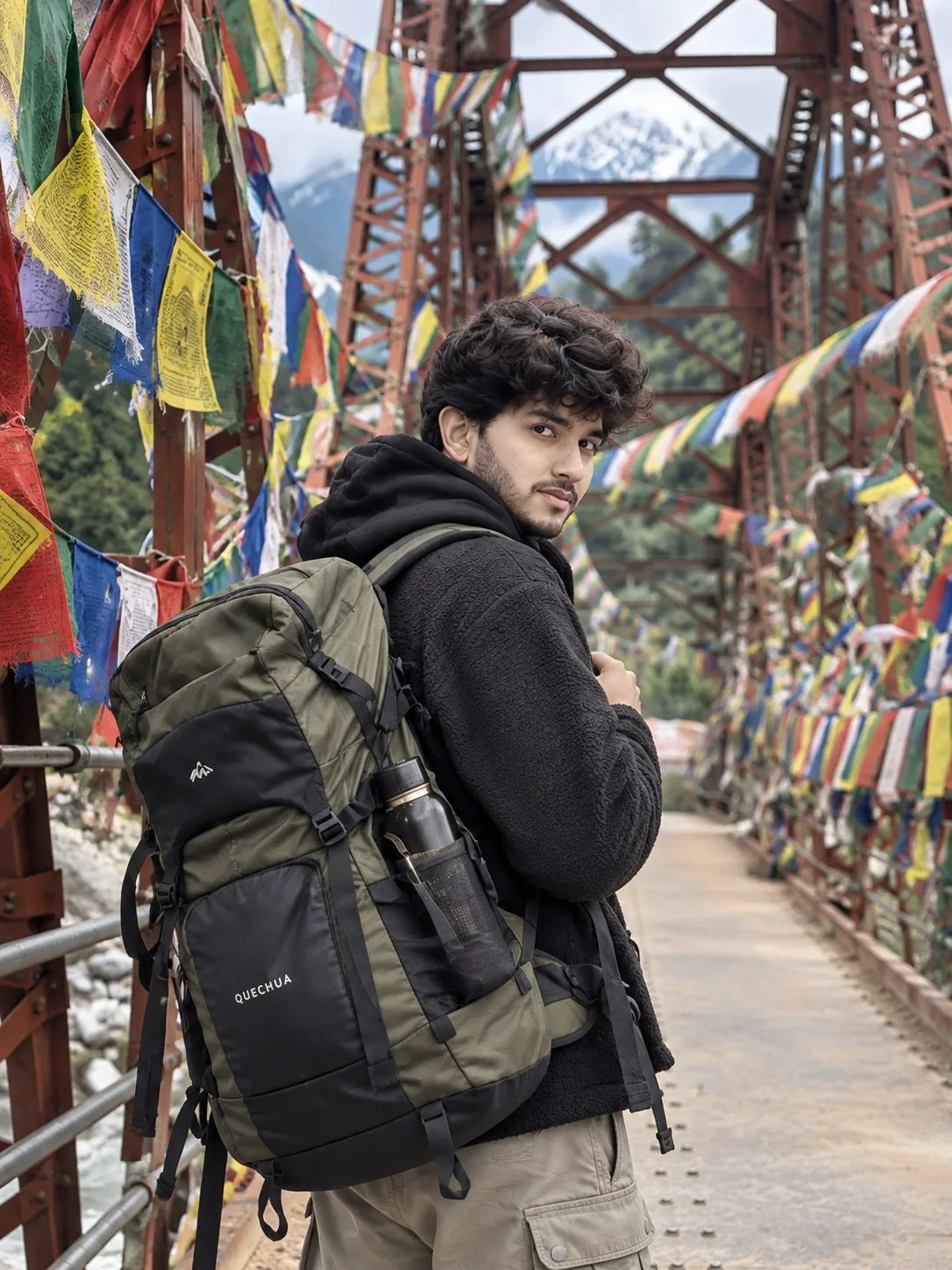
Manali Prayer Flag Bridge Boy Photo
Use the uploaded person’s photo as the identity reference. Preserve the uploaded person's facial identity accurately while recreating the hairstyle, trekking outfit, backpack, over-the-shoulder pose, cinematic close framing, historic iron bridge, colourful prayer flags and Himalayan mountain environment described below.
Create an ultra-photorealistic, high-resolution VERTICAL 3:4 CINEMATIC CLOSE-UP TRAVEL PORTRAIT of one young adult Indian man standing on an old rust-red iron truss bridge in the Manali region of Himachal Pradesh, surrounded by colourful Himalayan prayer flags.
The final image must look like a genuine professional travel photograph captured with a premium full-frame camera.
SUBJECT:
Show ONLY ONE young adult Indian man.
If the user uploads his own identity-reference image, preserve his facial identity accurately, including:
• face shape
• forehead
• eyebrows
• eye shape
• nose
• lips
• cheeks
• jawline
• chin
• ears
• natural Indian complexion
• distinctive facial proportions
Maintain realistic facial asymmetry.
Keep him naturally attractive and photogenic without excessively beautifying or reshaping his face.
FACE & HEAD POSITION:
The man's body should face mostly AWAY from the camera as though he is walking across the bridge.
Turn his head naturally BACK OVER HIS SHOULDER toward the camera.
Keep his face clearly visible in a natural three-quarter angle.
Both eyes should remain visible.
Use clear eye contact with the camera.
Keep:
• head naturally raised
• chin approximately level
• relaxed forehead
• unobstructed eyes
• clearly visible nose and lips
• natural jawline
The pose should look spontaneous, as though a photographer called him while he was walking and he naturally looked back.
EXPRESSION:
Give him a calm, confident and slightly curious expression.
Use a very subtle closed-mouth smile.
Keep the expression:
• relaxed
• youthful
• natural
• peaceful
• adventurous
• candid
Avoid an exaggerated fashion-model expression.
HAIRSTYLE:
Give him thick, medium-length, naturally curly/wavy dark brown-black Indian hair.
Use:
• high natural volume
• loose irregular curls
• slightly messy textured top
• soft curls falling toward the forehead
• realistic hairline
• individual visible strands
• natural flyaway hairs
• subtle mountain-breeze movement
Do not make the hairstyle excessively styled or perfectly symmetrical.
FACIAL HAIR:
Give him light youthful facial hair.
Use:
• subtle moustache
• short natural beard along jawline
• light chin growth
• realistic individual follicles
• natural uneven beard density
Keep the beard short and understated.
SKIN REALISM:
Because this is a close portrait, render extremely realistic Indian skin.
Clearly show:
• natural skin pores
• forehead texture
• cheek texture
• nose texture
• subtle under-eye details
• realistic lip texture
• individual eyebrow hairs
• eyelashes
• fine facial hairs
• beard follicles
• natural tonal variation
• tiny skin imperfections
• subtle outdoor-weather complexion
Do not create plastic, waxy or excessively airbrushed skin.
BLACK TEXTURED FLEECE:
Dress him in a plain BLACK textured fleece winter top.
Use:
• thick warm fleece material
• subtle teddy/sherpa-like texture
• relaxed contemporary fit
• full sleeves
• slightly oversized silhouette
• realistic seams
• natural shoulder folds
• believable fabric compression
• detailed individual fibres
Keep the fleece completely plain.
Do not add any unnecessary text, graphics or decorative patterns.
BLACK HOOD:
Show a simple thick black hood resting naturally around the back of his neck and shoulders.
The hood should blend naturally with the black fleece and create a layered winter-travel look.
Keep its cotton/fleece texture clearly visible.
CARGO TROUSERS:
Dress him in muted KHAKI / LIGHT OLIVE cargo trousers.
Only the upper portion needs to remain visible because of the close framing.
Use:
• relaxed trekking fit
• durable matte fabric
• visible cargo pocket
• flap detailing
• realistic stitching
• natural folds
• slightly weathered outdoor appearance
TREKKING BACKPACK:
Place a large practical trekking backpack naturally across his back.
Use a muted OLIVE GREEN and BLACK colour combination.
The backpack should have:
• tall hiking-pack construction
• padded shoulder straps
• multiple compartments
• black reinforced lower section
• side compression straps
• adjustable buckles
• webbing loops
• realistic zippers
• rugged outdoor fabric
• natural wear
• realistic fabric creases
The backpack should feel genuinely packed and weighted rather than empty.
It should sit naturally against his shoulders and upper back.
SIDE BOTTLE:
Place a dark reusable metal water bottle/thermos securely inside one side pocket of the backpack.
Use:
• dark metallic body
• practical screw lid
• realistic reflections
• slightly weathered outdoor appearance
Keep it secondary to the main portrait.
POSE:
Position the man in the centre-left portion of the bridge.
His BODY should face toward the far end of the bridge.
Turn his upper torso only slightly.
Turn his HEAD BACK over his shoulder toward the camera.
Keep one hand naturally holding or adjusting one backpack shoulder strap near his chest.
Keep the other arm naturally relaxed and mostly hidden by the body/backpack.
Use:
• relaxed shoulders
• natural spine
• slight body rotation
• believable backpack weight
• subtle travel movement
The pose should look candid rather than deliberately staged.
3:4 CINEMATIC CLOSE-UP:
Use a VERTICAL 3:4 aspect ratio.
Bring the camera close to the subject.
Frame approximately from the COMPLETE TOP OF HIS HAIR down to around the upper-thigh region.
The face, curly hair, black fleece and large trekking backpack should occupy most of the foreground.
Do not crop the top of his hair.
Keep enough environmental space above and beside him to clearly show:
• rust-red bridge structure
• colourful prayer flags
• distant Himalayan mountain
• pine forest
His face must remain large enough for skin and eye details to be clearly visible.
BRIDGE:
Preserve the old rust-red steel truss bridge as the core environment.
Use authentic heavy industrial construction.
Show:
• rust-red vertical steel beams
• diagonal cross-bracing
• horizontal beams
• rivets and bolts
• weathered painted metal
• natural oxidation
• repeating geometric truss patterns
• metal side railings
• narrow bridge walkway
The bridge structure should naturally converge toward the centre background, creating strong leading lines.
Keep the bridge aged and authentic rather than newly painted.
PRAYER FLAGS:
Cover both sides of the bridge with numerous existing colourful Himalayan/Tibetan-style prayer flags.
Use natural combinations of:
• red
• blue
• yellow
• green
• white
Show flags attached along:
• bridge railings
• diagonal ropes
• overhead lines
• steel trusses
Some should hang loosely while others flutter gently in the mountain breeze.
Render:
• thin woven fabric
• frayed edges
• wrinkles
• weathering
• faded areas
• small traditional printed prayer patterns/textures already inherent to the flags
• irregular spacing
Do not make every flag perfectly straight or identical.
The flags should create colourful layers around the subject while remaining secondary to his face.
BRIDGE WALKWAY:
Preserve the narrow weathered metal/concrete walkway extending behind the man.
Show:
• realistic worn surface
• small bolts/rivets
• natural dust
• subtle stains
• perspective lines
• authentic travel wear
The walkway should lead the viewer's eye toward the far end of the bridge.
HIMALAYAN FOREST:
Behind and around the bridge, show dense Himalayan pine/deodar forest.
Use:
• deep natural green trees
• irregular heights
• overlapping layers
• realistic branches
• natural mountain vegetation
• subtle atmospheric softness
Keep the forest recognisable without competing with the subject.
SNOW-COVERED MOUNTAIN:
Through the central/upper opening of the iron truss bridge, reveal a dramatic distant snow-covered Himalayan mountain peak.
The peak should be naturally framed by the geometric steel bridge structure.
Use:
• rugged irregular ridges
• white snow patches
• dark exposed rock
• natural mountain geology
• realistic enormous scale
• atmospheric distance
Do not create an artificial perfectly symmetrical mountain.
ATMOSPHERE:
Use mild Himalayan atmospheric haze around the distant mountain.
Keep:
• foreground bridge crisp
• subject extremely sharp
• nearby prayer flags detailed
• forest moderately detailed
• distant mountain naturally softened
This should create genuine depth.
LIGHTING:
Use soft natural OVERCAST Himalayan daylight.
The cloudy mountain sky should work like a giant natural softbox.
Illuminate the man's face gently and evenly.
Create subtle realistic highlights on:
• eyes
• nose
• cheeks
• lips
• individual curls
• beard hairs
• fleece fibres
• backpack fabric
• metal bottle
• nearby prayer flags
Keep shadows soft and believable.
Do not create artificial studio lighting.
FACE PRIORITY:
The face must be the sharpest and most important element.
Clearly resolve:
• pupils
• irises
• eyelashes
• eyebrow hairs
• skin pores
• lip texture
• beard follicles
• moustache hairs
• individual curls
• flyaway hair
Maintain natural photographic sharpness without excessive AI-style sharpening.
DEPTH OF FIELD:
Use premium professional-camera depth of field.
Keep:
FACE — extremely sharp
HAIR — extremely sharp
UPPER BODY — sharp
BACKPACK — highly detailed
NEARBY PRAYER FLAGS — moderately detailed
BRIDGE STRUCTURE — recognisable and gradually softer
FOREST — softly detailed
DISTANT SNOWY MOUNTAIN — naturally atmospheric
Do not blur the background excessively.
The bridge and Himalayan environment must remain immediately recognisable.
CAMERA & OPTICS:
Simulate a premium full-frame mirrorless camera.
Use approximately:
• 70–85mm portrait lens
• vertical 3:4 framing
• close camera-to-subject distance
• camera around eye level
• f/3.2–f/3.5
• ISO 160
• 1/500 sec
• continuous eye autofocus
• cloudy white balance
• high dynamic range
• realistic lens compression
• natural optical sharpness
Use enough depth of field to preserve the bridge's visual identity while maintaining strong subject separation.
COLOR GRADING:
Use premium cinematic Himalayan travel-photography grading.
Maintain:
• naturally warm Indian skin
• dark brown-black curly hair
• deep black textured fleece
• muted olive/black backpack
• khaki/light-olive trousers
• weathered rust-red bridge
• rich but natural red, blue, yellow, green and white prayer flags
• deep forest green
• cool blue-grey mountain shadows
• clean white mountain snow
• pale cloudy sky
Keep colours rich but realistic.
Do not oversaturate the prayer flags.
PHOTOREALISM:
Prioritise genuine full-frame-camera realism.
Clearly render:
• natural facial asymmetry
• authentic Indian skin pores
• eyelashes
• eyebrow hairs
• beard follicles
• individual curls
• flyaway hairs
• fleece fibres
• backpack stitching
• rugged backpack fabric
• straps and buckles
• metal bottle reflections
• weathered prayer-flag fabric
• frayed flag edges
• rusty steel texture
• bolts and rivets
• bridge walkway wear
• pine-tree details
• distant mountain geology
• atmospheric haze
The image should contain subtle real-world imperfections so it feels photographed rather than digitally constructed.
SCENE PRESERVATION:
Preserve the bridge scene itself.
Do not introduce unrelated extra scene elements.
Do not add any extra:
• advertising board
• placard
• artificial sign
• watermark
• decorative installation
• invented landmark
• unnecessary prop
• random building
• unrelated object
Keep only the existing bridge, prayer flags, natural mountain environment and necessary trekking equipment described above.
FINAL RESULT:
Create an ultra-photorealistic high-resolution VERTICAL 3:4 CINEMATIC CLOSE-UP travel portrait of one young adult Indian man standing on an old rust-red Himalayan iron truss bridge surrounded by colourful prayer flags in the Manali region.
Position his body mostly away from the camera while he naturally looks back over his shoulder directly toward the lens.
Keep his face clearly visible with calm direct eye contact, thick naturally curly dark hair, short youthful facial hair and authentic Indian skin texture.
Dress him in a plain black textured fleece with a black hood and muted khaki/light-olive cargo trousers.
Place a large rugged olive-green and black trekking backpack naturally on his back with a reusable dark metal bottle in the side pocket.
Frame him closely from the complete top of his hair to approximately the upper thighs.
Use the rust-red bridge beams and colourful prayer flags as strong leading lines around him.
Through the bridge structure, retain the dense green Himalayan forest and a distant rugged snow-covered mountain peak.
Use soft overcast mountain daylight, realistic shallow depth of field, natural colours and premium full-frame-camera detail.
The final result must look like a genuine cinematic travel photograph captured on a Himalayan bridge near Manali, not an AI-generated image.
Create an ultra-photorealistic, high-resolution VERTICAL 3:4 CINEMATIC CLOSE-UP TRAVEL PORTRAIT of one young adult Indian man standing on an old rust-red iron truss bridge in the Manali region of Himachal Pradesh, surrounded by colourful Himalayan prayer flags.
The final image must look like a genuine professional travel photograph captured with a premium full-frame camera.
SUBJECT:
Show ONLY ONE young adult Indian man.
If the user uploads his own identity-reference image, preserve his facial identity accurately, including:
• face shape
• forehead
• eyebrows
• eye shape
• nose
• lips
• cheeks
• jawline
• chin
• ears
• natural Indian complexion
• distinctive facial proportions
Maintain realistic facial asymmetry.
Keep him naturally attractive and photogenic without excessively beautifying or reshaping his face.
FACE & HEAD POSITION:
The man's body should face mostly AWAY from the camera as though he is walking across the bridge.
Turn his head naturally BACK OVER HIS SHOULDER toward the camera.
Keep his face clearly visible in a natural three-quarter angle.
Both eyes should remain visible.
Use clear eye contact with the camera.
Keep:
• head naturally raised
• chin approximately level
• relaxed forehead
• unobstructed eyes
• clearly visible nose and lips
• natural jawline
The pose should look spontaneous, as though a photographer called him while he was walking and he naturally looked back.
EXPRESSION:
Give him a calm, confident and slightly curious expression.
Use a very subtle closed-mouth smile.
Keep the expression:
• relaxed
• youthful
• natural
• peaceful
• adventurous
• candid
Avoid an exaggerated fashion-model expression.
HAIRSTYLE:
Give him thick, medium-length, naturally curly/wavy dark brown-black Indian hair.
Use:
• high natural volume
• loose irregular curls
• slightly messy textured top
• soft curls falling toward the forehead
• realistic hairline
• individual visible strands
• natural flyaway hairs
• subtle mountain-breeze movement
Do not make the hairstyle excessively styled or perfectly symmetrical.
FACIAL HAIR:
Give him light youthful facial hair.
Use:
• subtle moustache
• short natural beard along jawline
• light chin growth
• realistic individual follicles
• natural uneven beard density
Keep the beard short and understated.
SKIN REALISM:
Because this is a close portrait, render extremely realistic Indian skin.
Clearly show:
• natural skin pores
• forehead texture
• cheek texture
• nose texture
• subtle under-eye details
• realistic lip texture
• individual eyebrow hairs
• eyelashes
• fine facial hairs
• beard follicles
• natural tonal variation
• tiny skin imperfections
• subtle outdoor-weather complexion
Do not create plastic, waxy or excessively airbrushed skin.
BLACK TEXTURED FLEECE:
Dress him in a plain BLACK textured fleece winter top.
Use:
• thick warm fleece material
• subtle teddy/sherpa-like texture
• relaxed contemporary fit
• full sleeves
• slightly oversized silhouette
• realistic seams
• natural shoulder folds
• believable fabric compression
• detailed individual fibres
Keep the fleece completely plain.
Do not add any unnecessary text, graphics or decorative patterns.
BLACK HOOD:
Show a simple thick black hood resting naturally around the back of his neck and shoulders.
The hood should blend naturally with the black fleece and create a layered winter-travel look.
Keep its cotton/fleece texture clearly visible.
CARGO TROUSERS:
Dress him in muted KHAKI / LIGHT OLIVE cargo trousers.
Only the upper portion needs to remain visible because of the close framing.
Use:
• relaxed trekking fit
• durable matte fabric
• visible cargo pocket
• flap detailing
• realistic stitching
• natural folds
• slightly weathered outdoor appearance
TREKKING BACKPACK:
Place a large practical trekking backpack naturally across his back.
Use a muted OLIVE GREEN and BLACK colour combination.
The backpack should have:
• tall hiking-pack construction
• padded shoulder straps
• multiple compartments
• black reinforced lower section
• side compression straps
• adjustable buckles
• webbing loops
• realistic zippers
• rugged outdoor fabric
• natural wear
• realistic fabric creases
The backpack should feel genuinely packed and weighted rather than empty.
It should sit naturally against his shoulders and upper back.
SIDE BOTTLE:
Place a dark reusable metal water bottle/thermos securely inside one side pocket of the backpack.
Use:
• dark metallic body
• practical screw lid
• realistic reflections
• slightly weathered outdoor appearance
Keep it secondary to the main portrait.
POSE:
Position the man in the centre-left portion of the bridge.
His BODY should face toward the far end of the bridge.
Turn his upper torso only slightly.
Turn his HEAD BACK over his shoulder toward the camera.
Keep one hand naturally holding or adjusting one backpack shoulder strap near his chest.
Keep the other arm naturally relaxed and mostly hidden by the body/backpack.
Use:
• relaxed shoulders
• natural spine
• slight body rotation
• believable backpack weight
• subtle travel movement
The pose should look candid rather than deliberately staged.
3:4 CINEMATIC CLOSE-UP:
Use a VERTICAL 3:4 aspect ratio.
Bring the camera close to the subject.
Frame approximately from the COMPLETE TOP OF HIS HAIR down to around the upper-thigh region.
The face, curly hair, black fleece and large trekking backpack should occupy most of the foreground.
Do not crop the top of his hair.
Keep enough environmental space above and beside him to clearly show:
• rust-red bridge structure
• colourful prayer flags
• distant Himalayan mountain
• pine forest
His face must remain large enough for skin and eye details to be clearly visible.
BRIDGE:
Preserve the old rust-red steel truss bridge as the core environment.
Use authentic heavy industrial construction.
Show:
• rust-red vertical steel beams
• diagonal cross-bracing
• horizontal beams
• rivets and bolts
• weathered painted metal
• natural oxidation
• repeating geometric truss patterns
• metal side railings
• narrow bridge walkway
The bridge structure should naturally converge toward the centre background, creating strong leading lines.
Keep the bridge aged and authentic rather than newly painted.
PRAYER FLAGS:
Cover both sides of the bridge with numerous existing colourful Himalayan/Tibetan-style prayer flags.
Use natural combinations of:
• red
• blue
• yellow
• green
• white
Show flags attached along:
• bridge railings
• diagonal ropes
• overhead lines
• steel trusses
Some should hang loosely while others flutter gently in the mountain breeze.
Render:
• thin woven fabric
• frayed edges
• wrinkles
• weathering
• faded areas
• small traditional printed prayer patterns/textures already inherent to the flags
• irregular spacing
Do not make every flag perfectly straight or identical.
The flags should create colourful layers around the subject while remaining secondary to his face.
BRIDGE WALKWAY:
Preserve the narrow weathered metal/concrete walkway extending behind the man.
Show:
• realistic worn surface
• small bolts/rivets
• natural dust
• subtle stains
• perspective lines
• authentic travel wear
The walkway should lead the viewer's eye toward the far end of the bridge.
HIMALAYAN FOREST:
Behind and around the bridge, show dense Himalayan pine/deodar forest.
Use:
• deep natural green trees
• irregular heights
• overlapping layers
• realistic branches
• natural mountain vegetation
• subtle atmospheric softness
Keep the forest recognisable without competing with the subject.
SNOW-COVERED MOUNTAIN:
Through the central/upper opening of the iron truss bridge, reveal a dramatic distant snow-covered Himalayan mountain peak.
The peak should be naturally framed by the geometric steel bridge structure.
Use:
• rugged irregular ridges
• white snow patches
• dark exposed rock
• natural mountain geology
• realistic enormous scale
• atmospheric distance
Do not create an artificial perfectly symmetrical mountain.
ATMOSPHERE:
Use mild Himalayan atmospheric haze around the distant mountain.
Keep:
• foreground bridge crisp
• subject extremely sharp
• nearby prayer flags detailed
• forest moderately detailed
• distant mountain naturally softened
This should create genuine depth.
LIGHTING:
Use soft natural OVERCAST Himalayan daylight.
The cloudy mountain sky should work like a giant natural softbox.
Illuminate the man's face gently and evenly.
Create subtle realistic highlights on:
• eyes
• nose
• cheeks
• lips
• individual curls
• beard hairs
• fleece fibres
• backpack fabric
• metal bottle
• nearby prayer flags
Keep shadows soft and believable.
Do not create artificial studio lighting.
FACE PRIORITY:
The face must be the sharpest and most important element.
Clearly resolve:
• pupils
• irises
• eyelashes
• eyebrow hairs
• skin pores
• lip texture
• beard follicles
• moustache hairs
• individual curls
• flyaway hair
Maintain natural photographic sharpness without excessive AI-style sharpening.
DEPTH OF FIELD:
Use premium professional-camera depth of field.
Keep:
FACE — extremely sharp
HAIR — extremely sharp
UPPER BODY — sharp
BACKPACK — highly detailed
NEARBY PRAYER FLAGS — moderately detailed
BRIDGE STRUCTURE — recognisable and gradually softer
FOREST — softly detailed
DISTANT SNOWY MOUNTAIN — naturally atmospheric
Do not blur the background excessively.
The bridge and Himalayan environment must remain immediately recognisable.
CAMERA & OPTICS:
Simulate a premium full-frame mirrorless camera.
Use approximately:
• 70–85mm portrait lens
• vertical 3:4 framing
• close camera-to-subject distance
• camera around eye level
• f/3.2–f/3.5
• ISO 160
• 1/500 sec
• continuous eye autofocus
• cloudy white balance
• high dynamic range
• realistic lens compression
• natural optical sharpness
Use enough depth of field to preserve the bridge's visual identity while maintaining strong subject separation.
COLOR GRADING:
Use premium cinematic Himalayan travel-photography grading.
Maintain:
• naturally warm Indian skin
• dark brown-black curly hair
• deep black textured fleece
• muted olive/black backpack
• khaki/light-olive trousers
• weathered rust-red bridge
• rich but natural red, blue, yellow, green and white prayer flags
• deep forest green
• cool blue-grey mountain shadows
• clean white mountain snow
• pale cloudy sky
Keep colours rich but realistic.
Do not oversaturate the prayer flags.
PHOTOREALISM:
Prioritise genuine full-frame-camera realism.
Clearly render:
• natural facial asymmetry
• authentic Indian skin pores
• eyelashes
• eyebrow hairs
• beard follicles
• individual curls
• flyaway hairs
• fleece fibres
• backpack stitching
• rugged backpack fabric
• straps and buckles
• metal bottle reflections
• weathered prayer-flag fabric
• frayed flag edges
• rusty steel texture
• bolts and rivets
• bridge walkway wear
• pine-tree details
• distant mountain geology
• atmospheric haze
The image should contain subtle real-world imperfections so it feels photographed rather than digitally constructed.
SCENE PRESERVATION:
Preserve the bridge scene itself.
Do not introduce unrelated extra scene elements.
Do not add any extra:
• advertising board
• placard
• artificial sign
• watermark
• decorative installation
• invented landmark
• unnecessary prop
• random building
• unrelated object
Keep only the existing bridge, prayer flags, natural mountain environment and necessary trekking equipment described above.
FINAL RESULT:
Create an ultra-photorealistic high-resolution VERTICAL 3:4 CINEMATIC CLOSE-UP travel portrait of one young adult Indian man standing on an old rust-red Himalayan iron truss bridge surrounded by colourful prayer flags in the Manali region.
Position his body mostly away from the camera while he naturally looks back over his shoulder directly toward the lens.
Keep his face clearly visible with calm direct eye contact, thick naturally curly dark hair, short youthful facial hair and authentic Indian skin texture.
Dress him in a plain black textured fleece with a black hood and muted khaki/light-olive cargo trousers.
Place a large rugged olive-green and black trekking backpack naturally on his back with a reusable dark metal bottle in the side pocket.
Frame him closely from the complete top of his hair to approximately the upper thighs.
Use the rust-red bridge beams and colourful prayer flags as strong leading lines around him.
Through the bridge structure, retain the dense green Himalayan forest and a distant rugged snow-covered mountain peak.
Use soft overcast mountain daylight, realistic shallow depth of field, natural colours and premium full-frame-camera detail.
The final result must look like a genuine cinematic travel photograph captured on a Himalayan bridge near Manali, not an AI-generated image.