718

Mera Photo AI @meraphotoai
1,455 views
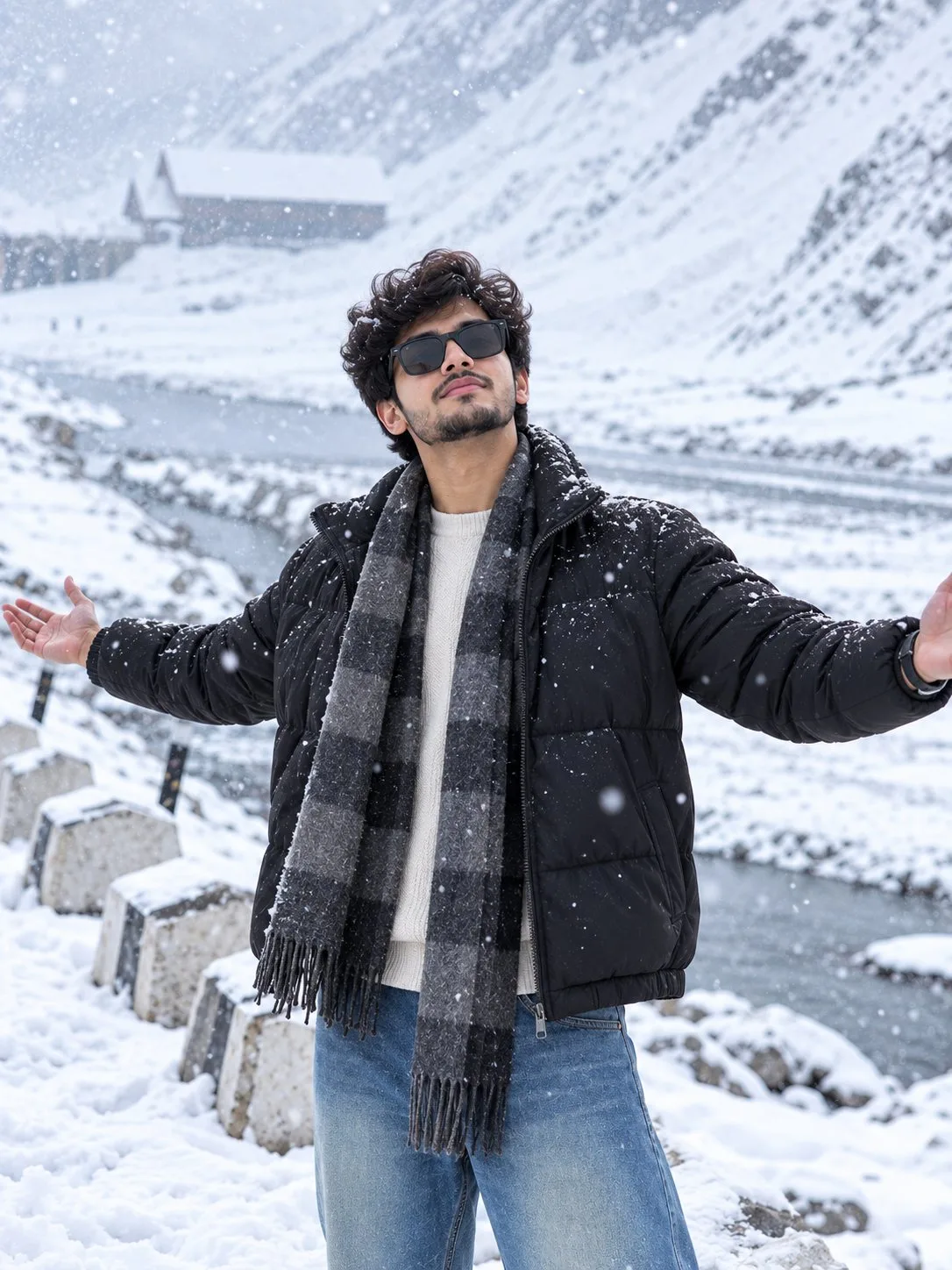
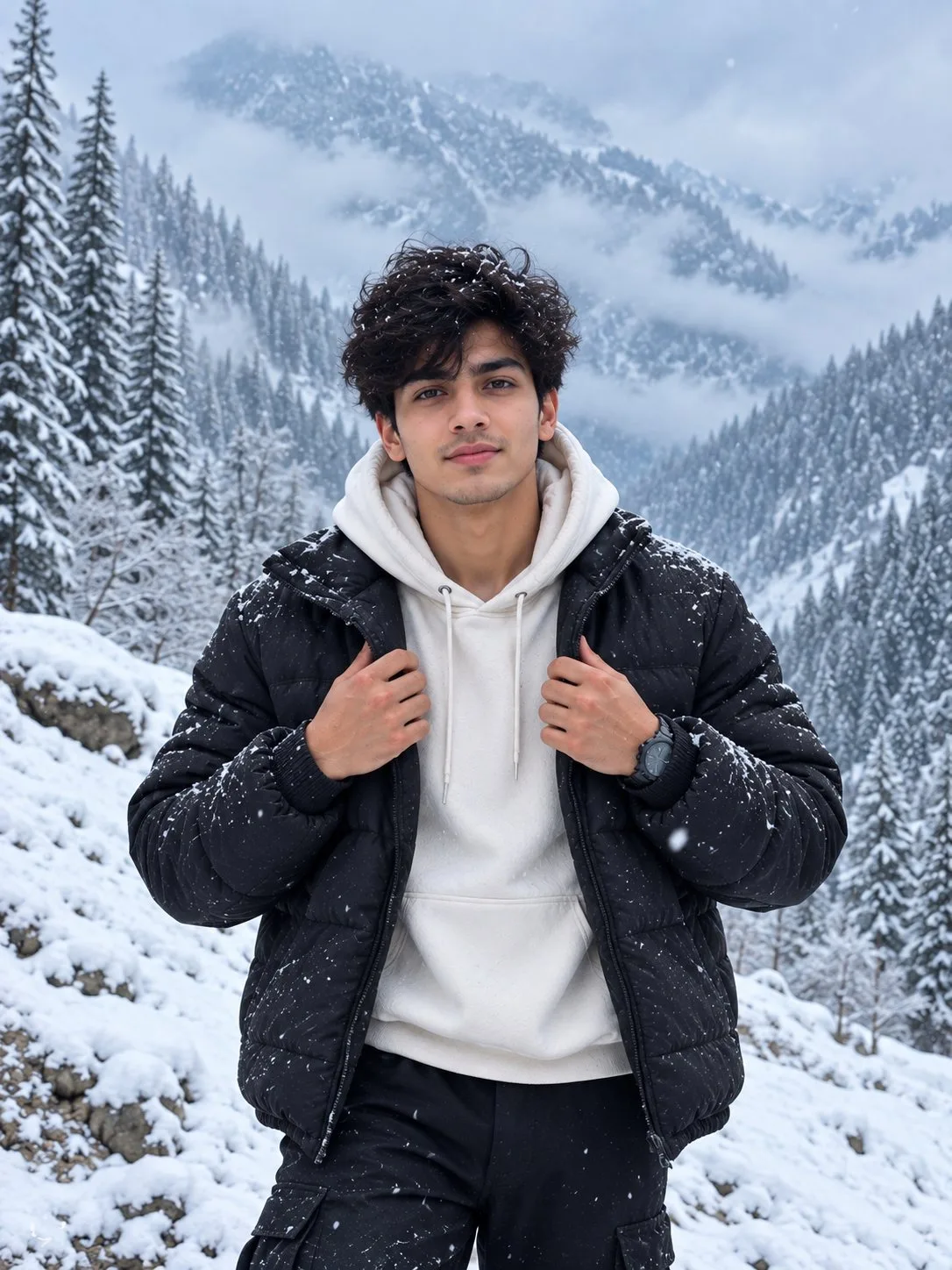
Manali Snowfall Boy Close-Up
Use the uploaded person’s photo as the identity reference. Preserve the uploaded person’s facial identity accurately while recreating the clothing, hairstyle, pose, snowy Himalayan environment, framing, lighting and realistic winter travel-photography style described below.
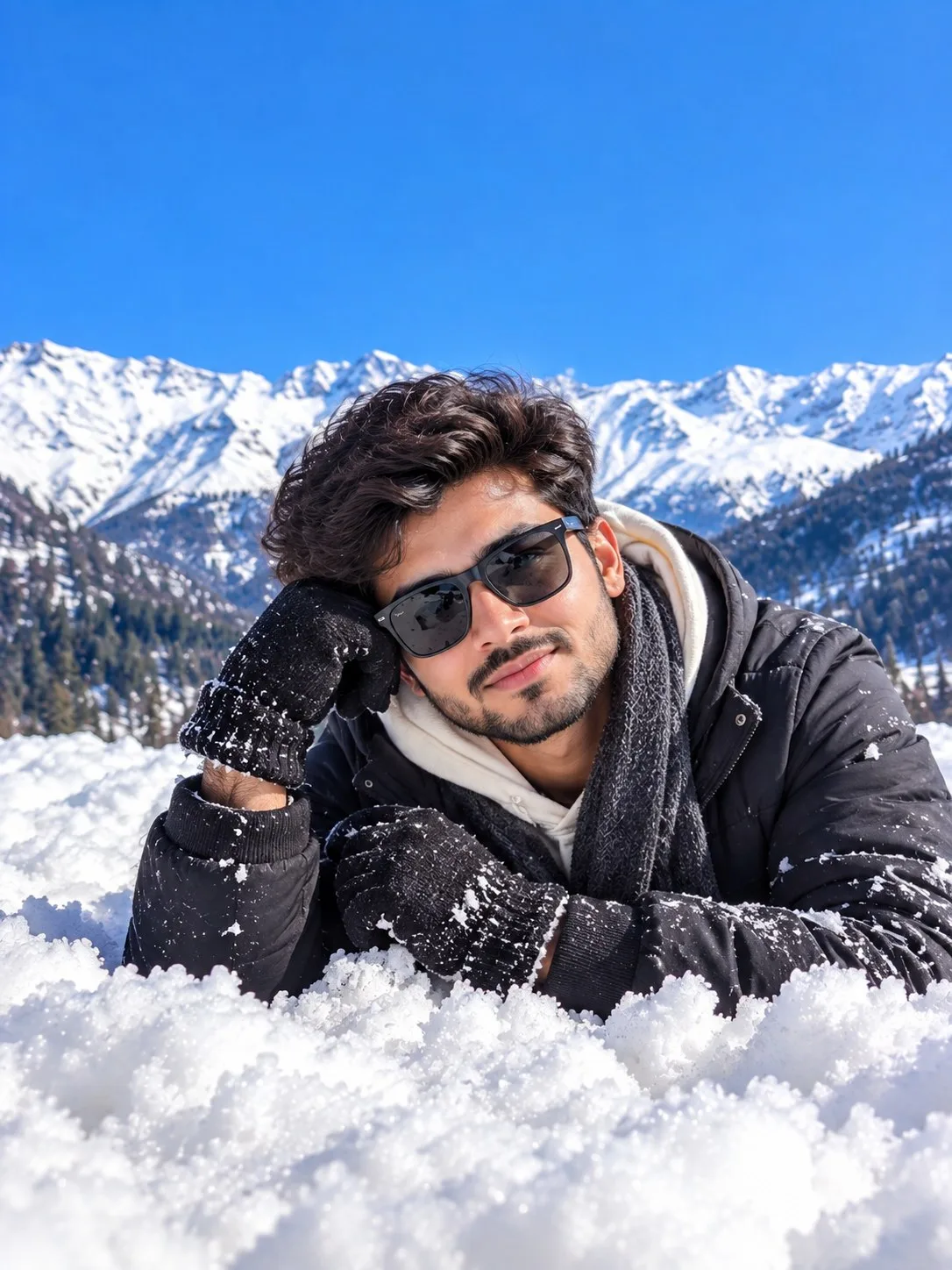
Create an ultra-photorealistic, high-resolution VERTICAL 3:4 CINEMATIC CLOSE-UP winter travel portrait of one young adult Indian man standing outdoors in a snowy mountain landscape in Manali, Himachal Pradesh.
The final result should look like a genuine professional full-frame camera photograph captured during fresh snowfall in the Himalayas.
SUBJECT:
Show only ONE young adult Indian man.
If the user uploads an identity-reference photo, accurately preserve his:
• face shape
• forehead
• eyebrows
• eyes
• nose
• lips
• cheeks
• jawline
• chin
• ears
• natural Indian complexion
• distinctive facial proportions
Maintain realistic facial asymmetry and authentic human features.
Do not excessively beautify or reshape the face.
Keep him youthful, naturally handsome and photogenic.
FACE POSITION:
Keep his FACE DIRECTLY TOWARD THE CAMERA.
His head should be raised naturally rather than looking downward.
Keep:
• chin level/slightly raised
• both eyes clearly visible
• face fully exposed
• shoulders approximately straight toward camera
• direct eye contact with the lens
The camera should clearly capture his complete facial structure.
EXPRESSION:
Give him a calm, confident and relaxed expression.
Use:
• direct natural eye contact
• relaxed eyebrows
• neutral-to-very-subtle closed-mouth smile
• relaxed jaw
• soft natural lips
• peaceful winter-travel mood
Avoid an exaggerated smile or fashion-model expression.
HAIRSTYLE:
Give him thick, medium-length, naturally curly/wavy dark brown-black hair.
Use:
• high natural volume
• loose curls
• tousled front
• slightly messy winter-weather styling
• strands falling naturally toward the forehead
• realistic hairline
• individually visible strands
• tiny flyaways
Allow small fresh snowflakes to settle naturally on several upper hair strands.
Hair should look soft, real and slightly affected by cold mountain weather.
FACIAL HAIR:
Keep very light youthful facial hair.
Use:
• subtle moustache
• fine chin hairs
• very light jaw stubble
• visible natural skin between hairs
Do not create a dense or heavily shaped beard.
SKIN REALISM:
Because this is a close portrait, prioritise extremely realistic facial detail.
Clearly render:
• authentic Indian skin pores
• forehead texture
• cheek texture
• nose texture
• natural under-eye detail
• realistic lip texture
• eyebrow hairs
• eyelashes
• fine facial hairs
• subtle beard follicles
• tiny natural imperfections
• realistic tonal variation
• soft cold-weather redness around cheeks/nose
• natural moisture and highlights
Keep skin clean but genuinely human.
Avoid plastic skin, waxy texture, aggressive beauty filters or excessive smoothing.
OUTFIT — BLACK PUFFER JACKET:
Dress him in a premium matte BLACK winter puffer jacket.
Use:
• thick insulated construction
• horizontal quilted sections
• slightly oversized contemporary fit
• high collar
• open front
• thick padded sleeves
• elastic/ribbed cuffs
• realistic zipper
• natural stitching
• believable fabric wrinkles
• subtle technical-fabric texture
The jacket should look warm and practical for Manali snowfall.
Add scattered fresh snowflakes and tiny melting snow particles naturally across:
• shoulders
• upper sleeves
• chest
• collar
Do not cover the jacket completely with snow.
OFF-WHITE HOODIE:
Underneath the black puffer jacket, dress him in a plain OFF-WHITE / CREAM pullover hoodie.
Use:
• warm cream-white colour
• thick cotton/fleece material
• hood resting around the neck
• two matching drawstrings
• large front kangaroo pocket
• ribbed lower hem
• realistic seams
• natural chest folds
• soft cotton texture
Keep the hoodie completely plain.
Do not add any text, logo, illustration or branding.
The off-white hoodie should create a clean visual contrast against the black puffer jacket.
BLACK CARGO TROUSERS:
At the lower portion of the frame, show black cargo trousers.
Use:
• relaxed modern fit
• matte black fabric
• large side cargo pocket
• flap detail
• realistic stitching
• natural folds
• subtle snow particles
Only the upper section of the trousers needs to remain visible because this is a close portrait.
WATCH:
Add a simple rugged black wristwatch on his LEFT wrist.
Use:
• round dark watch face
• black strap
• subtle glass reflection
• realistic dimensions
Keep it understated.
POSE:
Use a visibly natural winter portrait pose.
Raise both hands to chest level.
Let him gently hold the two open front edges/lapels of his black puffer jacket.
Use:
• right hand gripping the right jacket edge
• left hand gripping the left jacket edge
• naturally bent elbows
• relaxed shoulders
• straight but comfortable upper body
• face directly toward camera
Hands should have anatomically correct fingers, realistic nails and natural skin texture.
The pose should feel like he has just adjusted his jacket during snowfall.
3:4 CLOSE-UP COMPOSITION:
Use a VERTICAL 3:4 aspect ratio.
Move the camera relatively close to the subject.
Frame him approximately from the COMPLETE TOP OF HIS HAIR down to the upper-thigh area.
Do not crop his hairstyle.
His face and upper body should occupy most of the foreground.
Place him centrally.
His eyes should sit approximately around the upper-third region.
Keep enough space above and around his head to reveal the snowy Himalayan mountains.
The photograph should immediately communicate:
MANALI + SNOWFALL + HIMALAYAS + WINTER PORTRAIT.
SNOW-COVERED GROUND:
Surround him with naturally accumulated fresh snow.
Show:
• thick white snow
• uneven rocky terrain
• partially exposed grey-brown stones
• irregular snow accumulation
• soft natural depressions
• realistic snow texture
Do not make the snow surface perfectly smooth.
PINE & DEODAR FOREST:
Fill both sides and much of the middle background with tall Himalayan conifer trees.
Use:
• pine/deodar trees
• dark natural trunks
• dense branches
• fresh white snow accumulated on branches
• irregular tree heights
• realistic spacing
• layered forest depth
The trees on the LEFT side can appear slightly closer and more detailed.
Keep the distant forest progressively softer because of atmospheric depth.
HIMALAYAN MOUNTAINS:
Fill the upper background with enormous snow-covered Himalayan mountain slopes.
Use:
• steep mountain ridges
• rugged rocky formations
• dense conifer forest
• snow-filled crevices
• irregular snow accumulation
• dark exposed mountain sections
• multiple layers of mountain depth
The mountain should feel physically enormous compared with the person.
MIST & LOW CLOUD:
Add natural mountain mist drifting through the high peaks and forest.
Use:
• soft white-grey cloud bands
• mist around mountain ridges
• partially hidden upper peaks
• haze between mountain layers
• subtle fog among distant pine trees
Keep the fog naturally irregular.
Do not make it look like smoke.
SNOWFALL:
Show active gentle snowfall throughout the photograph.
Use different snowflake sizes depending on distance.
Include:
• tiny distant flakes
• medium flakes around the subject
• a few larger softly blurred flakes near the lens
• small flakes caught in his hair
• snow particles resting on the jacket
Snowfall should feel naturally random rather than evenly distributed.
Do not cover the face with large flakes.
WEATHER:
Create a cold, cloudy Himalayan winter atmosphere.
Use:
• cool blue-grey ambient light
• fresh snow
• high-altitude mist
• gentle snowfall
• moist winter air
The environment should feel cold while the subject remains comfortably dressed.
LIGHTING:
Use soft diffused natural daylight created by an overcast snowy sky.
The cloudy sky should act like a huge natural softbox.
Illuminate the face evenly.
Create gentle highlights along:
• forehead
• eyes
• nose
• cheekbones
• lips
• jawline
• hair strands
• hoodie
• jacket folds
• hands
Use extremely soft natural shadows.
Do not use harsh artificial lighting.
FACE PRIORITY:
The FACE must be the sharpest and most visually important element.
Clearly resolve:
• pupils and irises
• eyelashes
• eyebrows
• skin pores
• lips
• fine facial hairs
• individual curly hair strands
• tiny snowflakes on hair
Both eyes must remain naturally sharp.
DEPTH OF FIELD:
Use realistic professional-camera depth of field.
Keep the man exceptionally sharp.
The nearest snowy trees should retain moderate detail.
Gradually soften the distant forest, mountain ridges and mist.
However, do not excessively blur the environment.
The viewer should clearly understand that he is standing in a snow-covered Himalayan mountain valley.
Avoid artificial smartphone portrait-mode blur.
CAMERA & OPTICS:
Simulate a premium full-frame mirrorless camera.
Use approximately:
• 70–85mm portrait lens
• vertical 3:4 framing
• eye-level perspective
• close camera-to-subject distance
• f/3.5–f/4
• ISO 200
• 1/500 sec
• continuous eye autofocus
• overcast/cloudy white balance
• high dynamic range
• premium natural optical sharpness
Use enough shutter speed to preserve some falling snowflakes while allowing a few close flakes to appear naturally soft.
COLOR GRADING:
Use premium cinematic winter travel-photography grading.
Maintain:
• naturally warm Indian skin
• dark brown-black curly hair
• deep matte-black puffer jacket
• clean warm off-white hoodie
• black trousers
• dark watch
• natural white snow
• cool blue-grey mountain shadows
• dark pine trees
• subtle grey-brown exposed rocks
• pale misty sky
Keep the overall environment cool while preserving naturally warm and healthy skin tones.
Avoid excessive blue tint on the face.
PHOTOREALISM:
Prioritise genuine professional-camera realism.
Clearly render:
• natural facial asymmetry
• authentic Indian skin pores
• realistic eyes
• individual eyelashes
• eyebrow hairs
• fine facial hairs
• individual curly head hairs
• snow caught in hair
• jacket technical fabric
• quilting and stitching
• hoodie cotton fibres
• realistic drawstrings
• watch material
• anatomically correct fingers
• natural fingernails
• individual snowflakes
• irregular snow accumulation
• exposed rocks
• pine branches
• mountain geology
• atmospheric mist
SCENE PRESERVATION:
Do not add any extra signboard, placard, landmark, decorative board, text, logo, watermark, shop branding or invented scene object.
Keep the scene purely natural and based on the snowy Himalayan environment.
FINAL RESULT:
Create an ultra-photorealistic, high-resolution VERTICAL 3:4 cinematic close-up winter portrait of one young adult Indian man standing in a snowy Manali Himalayan landscape.
Keep his face raised and directly facing the camera with both eyes clearly visible and natural direct eye contact.
Give him thick tousled curly/wavy dark hair with small snowflakes caught naturally in the strands, very light youthful facial hair and authentic Indian skin texture.
Dress him in a plain off-white hoodie underneath an open matte-black quilted puffer jacket, paired with black cargo trousers and a black wristwatch.
Let both hands naturally hold the open edges of the jacket around chest level.
Frame him from the complete top of his hair down to approximately the upper thighs.
Surround him with thick natural snow, snow-covered pine/deodar trees, enormous Himalayan mountain slopes, drifting mist and gentle active snowfall.
Use soft overcast winter daylight, realistic cool atmospheric depth and warm natural skin.
The final image must look like a genuine high-resolution professional photograph captured during snowfall in Manali, not an AI-generated image.
Create an ultra-photorealistic, high-resolution VERTICAL 3:4 CINEMATIC CLOSE-UP winter travel portrait of one young adult Indian man standing outdoors in a snowy mountain landscape in Manali, Himachal Pradesh.
The final result should look like a genuine professional full-frame camera photograph captured during fresh snowfall in the Himalayas.
SUBJECT:
Show only ONE young adult Indian man.
If the user uploads an identity-reference photo, accurately preserve his:
• face shape
• forehead
• eyebrows
• eyes
• nose
• lips
• cheeks
• jawline
• chin
• ears
• natural Indian complexion
• distinctive facial proportions
Maintain realistic facial asymmetry and authentic human features.
Do not excessively beautify or reshape the face.
Keep him youthful, naturally handsome and photogenic.
FACE POSITION:
Keep his FACE DIRECTLY TOWARD THE CAMERA.
His head should be raised naturally rather than looking downward.
Keep:
• chin level/slightly raised
• both eyes clearly visible
• face fully exposed
• shoulders approximately straight toward camera
• direct eye contact with the lens
The camera should clearly capture his complete facial structure.
EXPRESSION:
Give him a calm, confident and relaxed expression.
Use:
• direct natural eye contact
• relaxed eyebrows
• neutral-to-very-subtle closed-mouth smile
• relaxed jaw
• soft natural lips
• peaceful winter-travel mood
Avoid an exaggerated smile or fashion-model expression.
HAIRSTYLE:
Give him thick, medium-length, naturally curly/wavy dark brown-black hair.
Use:
• high natural volume
• loose curls
• tousled front
• slightly messy winter-weather styling
• strands falling naturally toward the forehead
• realistic hairline
• individually visible strands
• tiny flyaways
Allow small fresh snowflakes to settle naturally on several upper hair strands.
Hair should look soft, real and slightly affected by cold mountain weather.
FACIAL HAIR:
Keep very light youthful facial hair.
Use:
• subtle moustache
• fine chin hairs
• very light jaw stubble
• visible natural skin between hairs
Do not create a dense or heavily shaped beard.
SKIN REALISM:
Because this is a close portrait, prioritise extremely realistic facial detail.
Clearly render:
• authentic Indian skin pores
• forehead texture
• cheek texture
• nose texture
• natural under-eye detail
• realistic lip texture
• eyebrow hairs
• eyelashes
• fine facial hairs
• subtle beard follicles
• tiny natural imperfections
• realistic tonal variation
• soft cold-weather redness around cheeks/nose
• natural moisture and highlights
Keep skin clean but genuinely human.
Avoid plastic skin, waxy texture, aggressive beauty filters or excessive smoothing.
OUTFIT — BLACK PUFFER JACKET:
Dress him in a premium matte BLACK winter puffer jacket.
Use:
• thick insulated construction
• horizontal quilted sections
• slightly oversized contemporary fit
• high collar
• open front
• thick padded sleeves
• elastic/ribbed cuffs
• realistic zipper
• natural stitching
• believable fabric wrinkles
• subtle technical-fabric texture
The jacket should look warm and practical for Manali snowfall.
Add scattered fresh snowflakes and tiny melting snow particles naturally across:
• shoulders
• upper sleeves
• chest
• collar
Do not cover the jacket completely with snow.
OFF-WHITE HOODIE:
Underneath the black puffer jacket, dress him in a plain OFF-WHITE / CREAM pullover hoodie.
Use:
• warm cream-white colour
• thick cotton/fleece material
• hood resting around the neck
• two matching drawstrings
• large front kangaroo pocket
• ribbed lower hem
• realistic seams
• natural chest folds
• soft cotton texture
Keep the hoodie completely plain.
Do not add any text, logo, illustration or branding.
The off-white hoodie should create a clean visual contrast against the black puffer jacket.
BLACK CARGO TROUSERS:
At the lower portion of the frame, show black cargo trousers.
Use:
• relaxed modern fit
• matte black fabric
• large side cargo pocket
• flap detail
• realistic stitching
• natural folds
• subtle snow particles
Only the upper section of the trousers needs to remain visible because this is a close portrait.
WATCH:
Add a simple rugged black wristwatch on his LEFT wrist.
Use:
• round dark watch face
• black strap
• subtle glass reflection
• realistic dimensions
Keep it understated.
POSE:
Use a visibly natural winter portrait pose.
Raise both hands to chest level.
Let him gently hold the two open front edges/lapels of his black puffer jacket.
Use:
• right hand gripping the right jacket edge
• left hand gripping the left jacket edge
• naturally bent elbows
• relaxed shoulders
• straight but comfortable upper body
• face directly toward camera
Hands should have anatomically correct fingers, realistic nails and natural skin texture.
The pose should feel like he has just adjusted his jacket during snowfall.
3:4 CLOSE-UP COMPOSITION:
Use a VERTICAL 3:4 aspect ratio.
Move the camera relatively close to the subject.
Frame him approximately from the COMPLETE TOP OF HIS HAIR down to the upper-thigh area.
Do not crop his hairstyle.
His face and upper body should occupy most of the foreground.
Place him centrally.
His eyes should sit approximately around the upper-third region.
Keep enough space above and around his head to reveal the snowy Himalayan mountains.
The photograph should immediately communicate:
MANALI + SNOWFALL + HIMALAYAS + WINTER PORTRAIT.
SNOW-COVERED GROUND:
Surround him with naturally accumulated fresh snow.
Show:
• thick white snow
• uneven rocky terrain
• partially exposed grey-brown stones
• irregular snow accumulation
• soft natural depressions
• realistic snow texture
Do not make the snow surface perfectly smooth.
PINE & DEODAR FOREST:
Fill both sides and much of the middle background with tall Himalayan conifer trees.
Use:
• pine/deodar trees
• dark natural trunks
• dense branches
• fresh white snow accumulated on branches
• irregular tree heights
• realistic spacing
• layered forest depth
The trees on the LEFT side can appear slightly closer and more detailed.
Keep the distant forest progressively softer because of atmospheric depth.
HIMALAYAN MOUNTAINS:
Fill the upper background with enormous snow-covered Himalayan mountain slopes.
Use:
• steep mountain ridges
• rugged rocky formations
• dense conifer forest
• snow-filled crevices
• irregular snow accumulation
• dark exposed mountain sections
• multiple layers of mountain depth
The mountain should feel physically enormous compared with the person.
MIST & LOW CLOUD:
Add natural mountain mist drifting through the high peaks and forest.
Use:
• soft white-grey cloud bands
• mist around mountain ridges
• partially hidden upper peaks
• haze between mountain layers
• subtle fog among distant pine trees
Keep the fog naturally irregular.
Do not make it look like smoke.
SNOWFALL:
Show active gentle snowfall throughout the photograph.
Use different snowflake sizes depending on distance.
Include:
• tiny distant flakes
• medium flakes around the subject
• a few larger softly blurred flakes near the lens
• small flakes caught in his hair
• snow particles resting on the jacket
Snowfall should feel naturally random rather than evenly distributed.
Do not cover the face with large flakes.
WEATHER:
Create a cold, cloudy Himalayan winter atmosphere.
Use:
• cool blue-grey ambient light
• fresh snow
• high-altitude mist
• gentle snowfall
• moist winter air
The environment should feel cold while the subject remains comfortably dressed.
LIGHTING:
Use soft diffused natural daylight created by an overcast snowy sky.
The cloudy sky should act like a huge natural softbox.
Illuminate the face evenly.
Create gentle highlights along:
• forehead
• eyes
• nose
• cheekbones
• lips
• jawline
• hair strands
• hoodie
• jacket folds
• hands
Use extremely soft natural shadows.
Do not use harsh artificial lighting.
FACE PRIORITY:
The FACE must be the sharpest and most visually important element.
Clearly resolve:
• pupils and irises
• eyelashes
• eyebrows
• skin pores
• lips
• fine facial hairs
• individual curly hair strands
• tiny snowflakes on hair
Both eyes must remain naturally sharp.
DEPTH OF FIELD:
Use realistic professional-camera depth of field.
Keep the man exceptionally sharp.
The nearest snowy trees should retain moderate detail.
Gradually soften the distant forest, mountain ridges and mist.
However, do not excessively blur the environment.
The viewer should clearly understand that he is standing in a snow-covered Himalayan mountain valley.
Avoid artificial smartphone portrait-mode blur.
CAMERA & OPTICS:
Simulate a premium full-frame mirrorless camera.
Use approximately:
• 70–85mm portrait lens
• vertical 3:4 framing
• eye-level perspective
• close camera-to-subject distance
• f/3.5–f/4
• ISO 200
• 1/500 sec
• continuous eye autofocus
• overcast/cloudy white balance
• high dynamic range
• premium natural optical sharpness
Use enough shutter speed to preserve some falling snowflakes while allowing a few close flakes to appear naturally soft.
COLOR GRADING:
Use premium cinematic winter travel-photography grading.
Maintain:
• naturally warm Indian skin
• dark brown-black curly hair
• deep matte-black puffer jacket
• clean warm off-white hoodie
• black trousers
• dark watch
• natural white snow
• cool blue-grey mountain shadows
• dark pine trees
• subtle grey-brown exposed rocks
• pale misty sky
Keep the overall environment cool while preserving naturally warm and healthy skin tones.
Avoid excessive blue tint on the face.
PHOTOREALISM:
Prioritise genuine professional-camera realism.
Clearly render:
• natural facial asymmetry
• authentic Indian skin pores
• realistic eyes
• individual eyelashes
• eyebrow hairs
• fine facial hairs
• individual curly head hairs
• snow caught in hair
• jacket technical fabric
• quilting and stitching
• hoodie cotton fibres
• realistic drawstrings
• watch material
• anatomically correct fingers
• natural fingernails
• individual snowflakes
• irregular snow accumulation
• exposed rocks
• pine branches
• mountain geology
• atmospheric mist
SCENE PRESERVATION:
Do not add any extra signboard, placard, landmark, decorative board, text, logo, watermark, shop branding or invented scene object.
Keep the scene purely natural and based on the snowy Himalayan environment.
FINAL RESULT:
Create an ultra-photorealistic, high-resolution VERTICAL 3:4 cinematic close-up winter portrait of one young adult Indian man standing in a snowy Manali Himalayan landscape.
Keep his face raised and directly facing the camera with both eyes clearly visible and natural direct eye contact.
Give him thick tousled curly/wavy dark hair with small snowflakes caught naturally in the strands, very light youthful facial hair and authentic Indian skin texture.
Dress him in a plain off-white hoodie underneath an open matte-black quilted puffer jacket, paired with black cargo trousers and a black wristwatch.
Let both hands naturally hold the open edges of the jacket around chest level.
Frame him from the complete top of his hair down to approximately the upper thighs.
Surround him with thick natural snow, snow-covered pine/deodar trees, enormous Himalayan mountain slopes, drifting mist and gentle active snowfall.
Use soft overcast winter daylight, realistic cool atmospheric depth and warm natural skin.
The final image must look like a genuine high-resolution professional photograph captured during snowfall in Manali, not an AI-generated image.