556

Mera Photo AI @meraphotoai
1,477 views
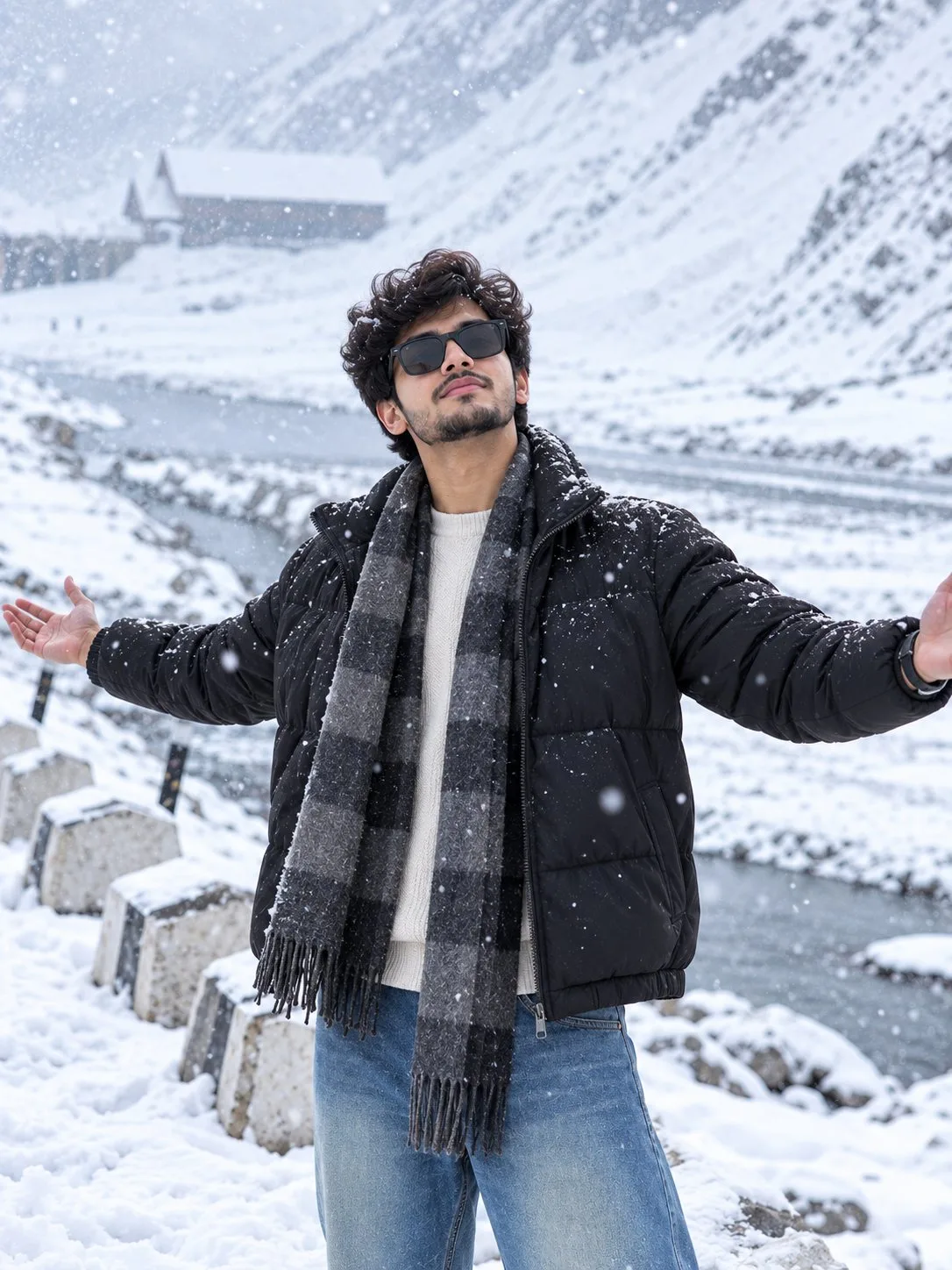
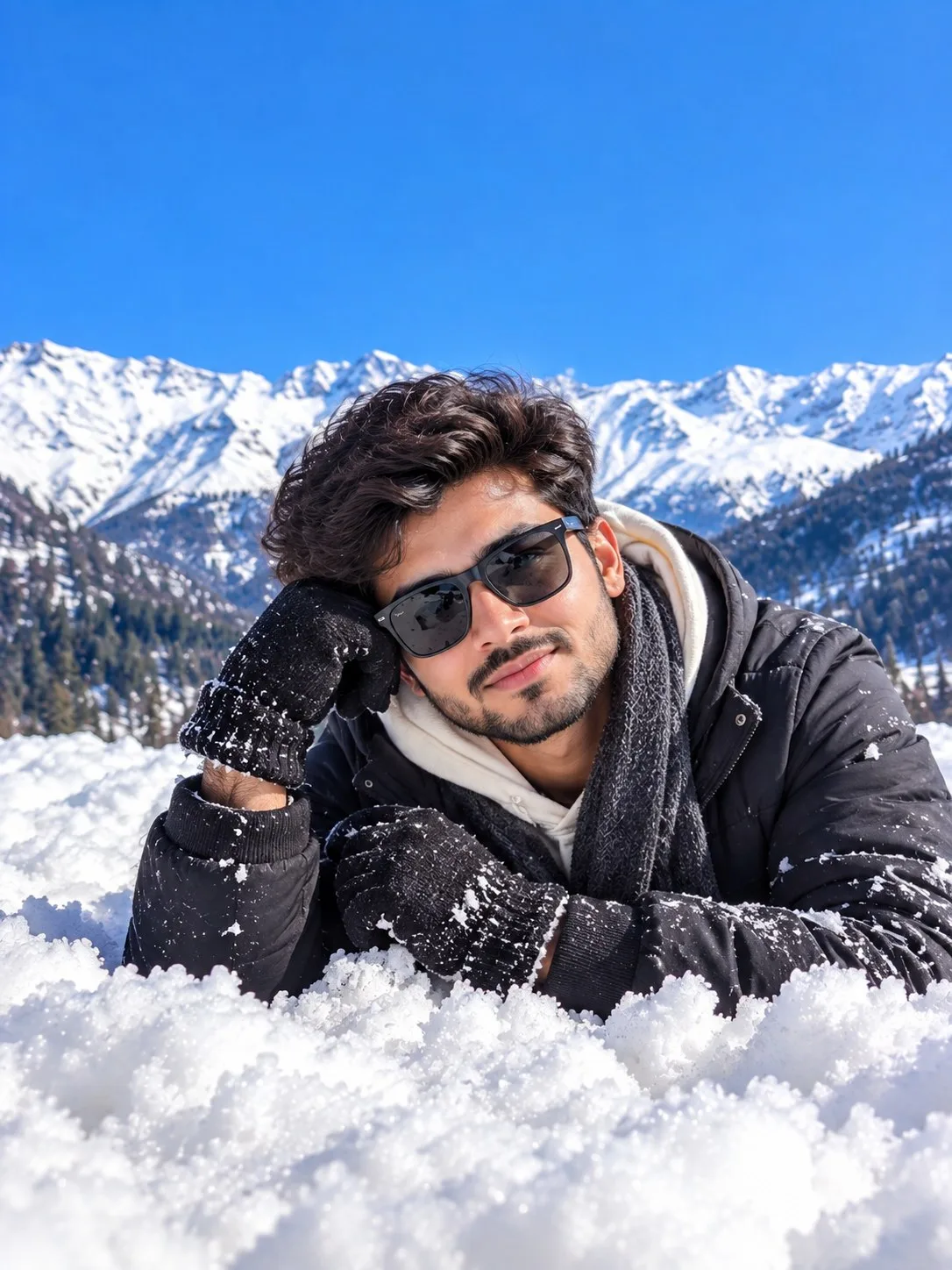
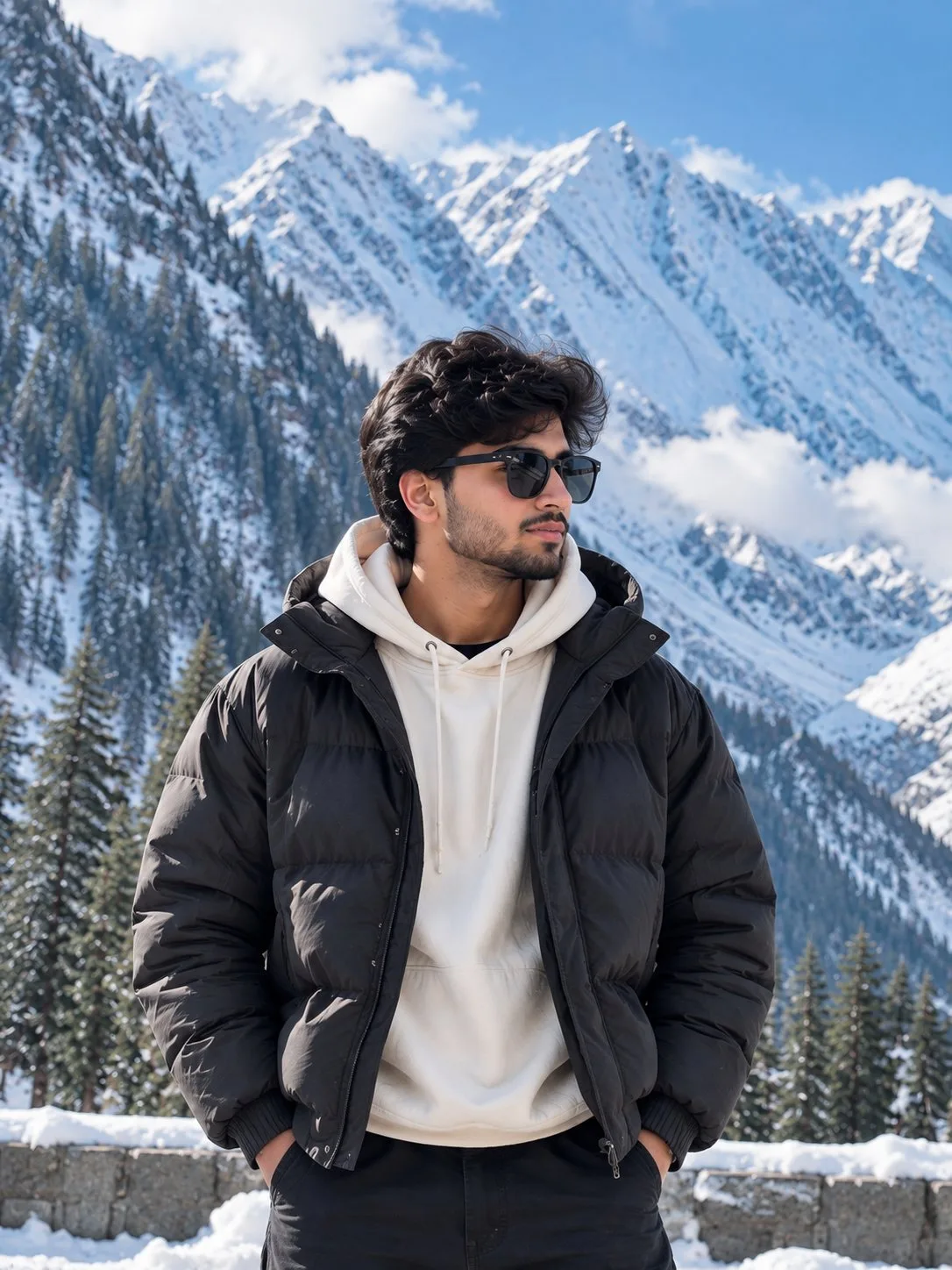
Snowy Manali Boy Close-Up Photo
Use the uploaded person’s photo as the identity reference. Preserve the uploaded person’s facial identity accurately while recreating the hairstyle, winter outfit, pose, close framing, snowy Himalayan environment, lighting and professional photography style described below.
Create an ultra-photorealistic, high-resolution VERTICAL 3:4 CINEMATIC CLOSE-UP WINTER TRAVEL PORTRAIT of one young adult Indian man standing naturally at a snowy mountain viewpoint in Manali, Himachal Pradesh, surrounded by snow-covered Himalayan peaks and dense pine forest.
The final result must look like a genuine premium full-frame camera photograph captured during a clear winter day in the Himalayas.
SUBJECT & IDENTITY:
Show ONLY ONE young adult Indian man.
If the user uploads his own identity-reference photo, accurately preserve his:
• face shape
• forehead
• eyebrows
• eye region
• nose
• lips
• cheeks
• jawline
• chin
• ears
• natural Indian complexion
• distinctive facial proportions
Maintain natural facial asymmetry and realistic human characteristics.
Do not excessively beautify, reshape or smooth the face.
FACE & EXPRESSION:
Keep his face clearly visible in a natural three-quarter direction.
Turn his head gently toward the side while keeping enough facial structure visible to the camera.
Use:
• slightly raised chin
• relaxed jaw
• confident posture
• neutral lips
• calm expression
• subtle thoughtful travel-photo mood
The expression should feel natural and candid rather than heavily posed.
HAIRSTYLE:
Give him thick, medium-length, naturally wavy/curly dark brown-black Indian hair.
Use:
• strong natural volume
• loose irregular waves
• textured front
• soft curls around the forehead
• naturally messy winter styling
• realistic hairline
• individual strands
• tiny flyaway hairs
• subtle movement from cold mountain breeze
Do not make the hairstyle perfectly symmetrical or overly styled.
FACIAL HAIR:
Give him short, neat youthful facial hair.
Include:
• subtle moustache
• short jawline beard
• light cheek stubble
• short chin growth
• individually visible follicles
• realistic uneven density
Keep the beard natural and understated.
SUNGLASSES:
Give him matte-black rectangular sunglasses with dark lenses.
Use:
• medium rectangular frame
• slightly thick black temples
• dark smoky lenses
• realistic nose placement
• subtle reflections of bright snow and sky
• physically believable lens highlights
Keep the sunglasses stylish but simple.
BLACK PUFFER JACKET:
Dress him in a completely plain BLACK winter puffer jacket.
Use:
• thick insulated construction
• relaxed contemporary fit
• horizontal padded sections
• raised open collar
• full sleeves
• elasticated cuffs
• front zipper
• realistic stitching
• natural fabric compression
• subtle matte sheen
• realistic wrinkles around elbows and waist
Keep the jacket completely unbranded.
Do not add any logo, lettering or graphic.
CREAM HOODIE:
Under the black puffer jacket, dress him in a completely plain CREAM / IVORY / OFF-WHITE pullover hoodie.
Use:
• thick heavyweight cotton fleece
• relaxed fit
• hood naturally sitting around the neck
• matching cream drawstrings
• kangaroo pocket
• ribbed lower hem
• realistic seams
• visible cotton fibres
• natural chest and waist folds
The cream hoodie should provide a strong but natural contrast against the black jacket.
Keep it completely plain and unbranded.
DARK TROUSERS:
Dress him in simple dark charcoal-black casual trousers.
Use:
• relaxed straight fit
• clean contemporary silhouette
• matte fabric
• realistic seams
• subtle folds around hips
• natural winter clothing texture
Keep them completely unbranded.
POSE:
Position the man naturally at the snowy mountain viewpoint.
Keep his body mostly facing the camera while his head turns gently toward the side.
Place BOTH HANDS casually inside his trouser pockets.
Use:
• relaxed shoulders
• straight but natural posture
• slight natural shift of body weight
• elbows angled outward slightly because of the puffer jacket
• relaxed chest
• believable body proportions
The pose should feel calm, confident and effortless.
Do not make it look like a fashion runway pose.
3:4 CINEMATIC CLOSE-UP COMPOSITION:
Use a VERTICAL 3:4 aspect ratio.
Bring the camera significantly closer than the original wide travel photograph.
Frame approximately from the COMPLETE TOP OF HIS HAIR down to around the upper thighs.
The FACE, HAIR, BLACK PUFFER JACKET and CREAM HOODIE should dominate the image.
Do not crop the top of his hair.
Keep enough snowy landscape visible behind him to establish the Manali winter location.
Place the man's head around the upper-middle area of the composition.
Use the mountain peaks as a dramatic natural backdrop without allowing them to overpower the subject.
The final composition should feel like a premium CLOSE ENVIRONMENTAL PORTRAIT rather than a distant full-body photograph.
SNOWY VIEWPOINT:
Preserve a natural winter mountain-viewpoint environment.
Behind the subject, retain a low stone boundary/ledge with naturally accumulated white snow.
Render:
• rough grey stone
• irregular stone texture
• patches of bright snow
• realistic contact between snow and stone
• subtle winter moisture
• natural uneven snow accumulation
Keep this element secondary to the portrait.
SNOW-COVERED PINE FOREST:
Fill the lower and middle background with dense Himalayan conifer forest.
Use:
• tall pine/deodar trees
• deep green needles
• irregular tree heights
• realistic tree trunks
• snow accumulated naturally on branches
• overlapping layers of trees
• small natural gaps
• varying density across mountain slopes
Some trees should remain darker green while others carry visible white snow.
Avoid repetitive or perfectly uniform trees.
HIMALAYAN MOUNTAINS:
Fill the upper and middle background with enormous rugged snow-covered Himalayan mountains.
Make the mountains one of the strongest environmental elements of the photograph.
Show:
• huge jagged mountain peaks
• steep irregular ridges
• deep valleys
• dramatic rocky faces
• thick white snow
• exposed dark-grey rock
• snow-filled gullies
• natural ridgelines
• overlapping mountain layers
• believable enormous scale
The mountain range should extend naturally across the background.
Do not create perfectly symmetrical or fantasy-style peaks.
SNOW DETAIL:
Render the mountain snow realistically.
Show:
• bright sunlit snow
• subtle blue shadows
• irregular snow accumulation
• exposed rocky sections
• wind-shaped snow patterns
• natural snow depth
• realistic texture along ridges
Avoid flat pure-white mountain surfaces.
ATMOSPHERIC DEPTH:
Use realistic Himalayan atmospheric perspective.
The closest pine trees should retain visible texture.
More distant forest layers should gradually lose contrast.
The huge mountain peaks should remain clearly detailed while showing subtle atmospheric softness.
Add only very light natural haze between distant mountain layers.
SKY:
Use a clean bright BLUE Himalayan winter sky.
Include several naturally shaped soft white clouds.
Keep:
• rich but realistic blue
• gentle tonal gradient
• scattered white clouds
• natural high-altitude clarity
• realistic winter atmosphere
Do not make the sky artificially oversaturated.
WINTER SUNLIGHT:
Use bright, crisp NATURAL MOUNTAIN DAYLIGHT.
The light should come naturally from the upper side of the frame.
Create believable highlights along:
• curls
• forehead
• cheekbones
• nose
• sunglasses frame
• black puffer jacket
• cream hoodie
• snowy mountain ridges
• snow-covered trees
Use realistic shadow direction.
The face should remain correctly exposed despite the bright snowy background.
SKIN REALISM:
Render highly realistic natural Indian skin.
Clearly preserve:
• natural pores
• forehead texture
• cheek texture
• nose texture
• subtle under-eye structure
• realistic lips
• eyebrow hairs
• beard follicles
• fine facial hairs
• natural complexion variation
• slightly cool-weather cheek tone
• tiny real-world imperfections
Do not create waxy, plastic or heavily airbrushed skin.
SUNGLASSES REFLECTION:
Because of the bright winter environment, create very subtle realistic reflections across the sunglasses.
The lenses may reflect:
• bright blue sky
• white snowy landscape
• surrounding mountain light
Keep these reflections understated and physically believable.
JACKET REALISM:
Make the black puffer jacket highly detailed.
Clearly render:
• individual stitched channels
• padded volume
• natural compression around arms
• zipper teeth
• subtle material highlights
• matte synthetic fabric
• tiny folds
• realistic shadow between padded sections
Do not make the jacket unnaturally glossy.
HOODIE REALISM:
Clearly render:
• cotton fleece texture
• stitching
• ribbing
• drawstring fibres
• small fabric wrinkles
• natural compression underneath the jacket
• subtle cream tonal variation
DEPTH OF FIELD:
Use realistic professional-camera depth of field.
Keep:
FACE — extremely sharp
HAIR — extremely sharp
SUNGLASSES — extremely sharp
JACKET & HOODIE — highly detailed
NEARBY SNOW — detailed
NEARBY PINE TREES — moderately detailed
DISTANT FOREST — gradually softer
HIMALAYAN PEAKS — clearly recognisable with natural atmospheric softness
SKY — naturally smooth
Do not use excessive artificial portrait-mode blur.
The spectacular snowy Himalayas must remain clearly recognisable.
CAMERA & OPTICS:
Simulate a premium full-frame mirrorless camera.
Use approximately:
• 70–85mm environmental portrait lens
• vertical 3:4 composition
• close camera-to-subject distance
• camera around eye level
• f/4
• ISO 100
• 1/1000 sec
• continuous face autofocus
• daylight white balance
• high dynamic range
• realistic lens compression
• natural optical sharpness
Expose carefully to preserve details in both the man's face and the bright white snow.
COLOR GRADING:
Use premium cinematic Himalayan winter travel-photography grading.
Maintain:
• naturally warm Indian skin
• rich dark brown-black hair
• matte black sunglasses
• deep charcoal-black puffer jacket
• warm cream/ivory hoodie
• dark trousers
• dark green pine/deodar trees
• clean white snow
• subtle blue snow shadows
• cool blue-grey exposed mountain rock
• crisp blue winter sky
• soft natural white clouds
Use subtle warm skin against the cooler blue-white Himalayan environment.
Keep the overall photograph crisp, clean and realistic.
PHOTOREALISM:
Prioritise maximum genuine professional-camera realism.
Clearly render:
• natural facial asymmetry
• authentic skin pores
• beard follicles
• individual eyebrow hairs
• individual wavy hair strands
• flyaway hairs
• realistic sunglasses reflections
• puffer-jacket stitching
• padded jacket texture
• hoodie cotton fibres
• trouser texture
• realistic snow
• individual pine branches
• mountain geology
• exposed rock
• atmospheric haze
• natural cloud texture
Include subtle real-world photographic imperfections.
SCENE PRESERVATION:
Preserve only the natural elements belonging to this snowy Himalayan scene.
Do not add any extra:
• board
• signboard
• placard
• written text
• logo
• watermark
• advertisement
• artificial landmark
• decorative installation
• unnecessary prop
• invented scene element
FINAL RESULT:
Create an ultra-photorealistic high-resolution VERTICAL 3:4 CINEMATIC CLOSE-UP winter travel portrait of one young adult Indian man standing at a snowy Himalayan viewpoint in Manali.
Keep his thick naturally wavy dark hair, short youthful beard and matte-black rectangular sunglasses clearly detailed.
Dress him in a completely plain black puffer jacket over a completely plain cream/ivory hoodie with simple dark trousers.
Use a calm hands-in-pockets pose with his torso mostly toward the camera and his head naturally turned slightly toward the side.
Frame him closely from the complete top of his hair to approximately the upper thighs so his face and winter outfit dominate the photograph.
Behind him, preserve a low snow-covered stone ledge, dense snow-covered Himalayan pine forest and enormous dramatic jagged mountains covered with bright white snow under a crisp blue sky with soft natural clouds.
Use bright natural winter daylight, authentic Indian skin texture, highly detailed hair and clothing, realistic snow texture, natural atmospheric depth and premium full-frame-camera realism.
The final result must look like a genuine professionally photographed Manali winter portrait, not an AI-generated image.
Create an ultra-photorealistic, high-resolution VERTICAL 3:4 CINEMATIC CLOSE-UP WINTER TRAVEL PORTRAIT of one young adult Indian man standing naturally at a snowy mountain viewpoint in Manali, Himachal Pradesh, surrounded by snow-covered Himalayan peaks and dense pine forest.
The final result must look like a genuine premium full-frame camera photograph captured during a clear winter day in the Himalayas.
SUBJECT & IDENTITY:
Show ONLY ONE young adult Indian man.
If the user uploads his own identity-reference photo, accurately preserve his:
• face shape
• forehead
• eyebrows
• eye region
• nose
• lips
• cheeks
• jawline
• chin
• ears
• natural Indian complexion
• distinctive facial proportions
Maintain natural facial asymmetry and realistic human characteristics.
Do not excessively beautify, reshape or smooth the face.
FACE & EXPRESSION:
Keep his face clearly visible in a natural three-quarter direction.
Turn his head gently toward the side while keeping enough facial structure visible to the camera.
Use:
• slightly raised chin
• relaxed jaw
• confident posture
• neutral lips
• calm expression
• subtle thoughtful travel-photo mood
The expression should feel natural and candid rather than heavily posed.
HAIRSTYLE:
Give him thick, medium-length, naturally wavy/curly dark brown-black Indian hair.
Use:
• strong natural volume
• loose irregular waves
• textured front
• soft curls around the forehead
• naturally messy winter styling
• realistic hairline
• individual strands
• tiny flyaway hairs
• subtle movement from cold mountain breeze
Do not make the hairstyle perfectly symmetrical or overly styled.
FACIAL HAIR:
Give him short, neat youthful facial hair.
Include:
• subtle moustache
• short jawline beard
• light cheek stubble
• short chin growth
• individually visible follicles
• realistic uneven density
Keep the beard natural and understated.
SUNGLASSES:
Give him matte-black rectangular sunglasses with dark lenses.
Use:
• medium rectangular frame
• slightly thick black temples
• dark smoky lenses
• realistic nose placement
• subtle reflections of bright snow and sky
• physically believable lens highlights
Keep the sunglasses stylish but simple.
BLACK PUFFER JACKET:
Dress him in a completely plain BLACK winter puffer jacket.
Use:
• thick insulated construction
• relaxed contemporary fit
• horizontal padded sections
• raised open collar
• full sleeves
• elasticated cuffs
• front zipper
• realistic stitching
• natural fabric compression
• subtle matte sheen
• realistic wrinkles around elbows and waist
Keep the jacket completely unbranded.
Do not add any logo, lettering or graphic.
CREAM HOODIE:
Under the black puffer jacket, dress him in a completely plain CREAM / IVORY / OFF-WHITE pullover hoodie.
Use:
• thick heavyweight cotton fleece
• relaxed fit
• hood naturally sitting around the neck
• matching cream drawstrings
• kangaroo pocket
• ribbed lower hem
• realistic seams
• visible cotton fibres
• natural chest and waist folds
The cream hoodie should provide a strong but natural contrast against the black jacket.
Keep it completely plain and unbranded.
DARK TROUSERS:
Dress him in simple dark charcoal-black casual trousers.
Use:
• relaxed straight fit
• clean contemporary silhouette
• matte fabric
• realistic seams
• subtle folds around hips
• natural winter clothing texture
Keep them completely unbranded.
POSE:
Position the man naturally at the snowy mountain viewpoint.
Keep his body mostly facing the camera while his head turns gently toward the side.
Place BOTH HANDS casually inside his trouser pockets.
Use:
• relaxed shoulders
• straight but natural posture
• slight natural shift of body weight
• elbows angled outward slightly because of the puffer jacket
• relaxed chest
• believable body proportions
The pose should feel calm, confident and effortless.
Do not make it look like a fashion runway pose.
3:4 CINEMATIC CLOSE-UP COMPOSITION:
Use a VERTICAL 3:4 aspect ratio.
Bring the camera significantly closer than the original wide travel photograph.
Frame approximately from the COMPLETE TOP OF HIS HAIR down to around the upper thighs.
The FACE, HAIR, BLACK PUFFER JACKET and CREAM HOODIE should dominate the image.
Do not crop the top of his hair.
Keep enough snowy landscape visible behind him to establish the Manali winter location.
Place the man's head around the upper-middle area of the composition.
Use the mountain peaks as a dramatic natural backdrop without allowing them to overpower the subject.
The final composition should feel like a premium CLOSE ENVIRONMENTAL PORTRAIT rather than a distant full-body photograph.
SNOWY VIEWPOINT:
Preserve a natural winter mountain-viewpoint environment.
Behind the subject, retain a low stone boundary/ledge with naturally accumulated white snow.
Render:
• rough grey stone
• irregular stone texture
• patches of bright snow
• realistic contact between snow and stone
• subtle winter moisture
• natural uneven snow accumulation
Keep this element secondary to the portrait.
SNOW-COVERED PINE FOREST:
Fill the lower and middle background with dense Himalayan conifer forest.
Use:
• tall pine/deodar trees
• deep green needles
• irregular tree heights
• realistic tree trunks
• snow accumulated naturally on branches
• overlapping layers of trees
• small natural gaps
• varying density across mountain slopes
Some trees should remain darker green while others carry visible white snow.
Avoid repetitive or perfectly uniform trees.
HIMALAYAN MOUNTAINS:
Fill the upper and middle background with enormous rugged snow-covered Himalayan mountains.
Make the mountains one of the strongest environmental elements of the photograph.
Show:
• huge jagged mountain peaks
• steep irregular ridges
• deep valleys
• dramatic rocky faces
• thick white snow
• exposed dark-grey rock
• snow-filled gullies
• natural ridgelines
• overlapping mountain layers
• believable enormous scale
The mountain range should extend naturally across the background.
Do not create perfectly symmetrical or fantasy-style peaks.
SNOW DETAIL:
Render the mountain snow realistically.
Show:
• bright sunlit snow
• subtle blue shadows
• irregular snow accumulation
• exposed rocky sections
• wind-shaped snow patterns
• natural snow depth
• realistic texture along ridges
Avoid flat pure-white mountain surfaces.
ATMOSPHERIC DEPTH:
Use realistic Himalayan atmospheric perspective.
The closest pine trees should retain visible texture.
More distant forest layers should gradually lose contrast.
The huge mountain peaks should remain clearly detailed while showing subtle atmospheric softness.
Add only very light natural haze between distant mountain layers.
SKY:
Use a clean bright BLUE Himalayan winter sky.
Include several naturally shaped soft white clouds.
Keep:
• rich but realistic blue
• gentle tonal gradient
• scattered white clouds
• natural high-altitude clarity
• realistic winter atmosphere
Do not make the sky artificially oversaturated.
WINTER SUNLIGHT:
Use bright, crisp NATURAL MOUNTAIN DAYLIGHT.
The light should come naturally from the upper side of the frame.
Create believable highlights along:
• curls
• forehead
• cheekbones
• nose
• sunglasses frame
• black puffer jacket
• cream hoodie
• snowy mountain ridges
• snow-covered trees
Use realistic shadow direction.
The face should remain correctly exposed despite the bright snowy background.
SKIN REALISM:
Render highly realistic natural Indian skin.
Clearly preserve:
• natural pores
• forehead texture
• cheek texture
• nose texture
• subtle under-eye structure
• realistic lips
• eyebrow hairs
• beard follicles
• fine facial hairs
• natural complexion variation
• slightly cool-weather cheek tone
• tiny real-world imperfections
Do not create waxy, plastic or heavily airbrushed skin.
SUNGLASSES REFLECTION:
Because of the bright winter environment, create very subtle realistic reflections across the sunglasses.
The lenses may reflect:
• bright blue sky
• white snowy landscape
• surrounding mountain light
Keep these reflections understated and physically believable.
JACKET REALISM:
Make the black puffer jacket highly detailed.
Clearly render:
• individual stitched channels
• padded volume
• natural compression around arms
• zipper teeth
• subtle material highlights
• matte synthetic fabric
• tiny folds
• realistic shadow between padded sections
Do not make the jacket unnaturally glossy.
HOODIE REALISM:
Clearly render:
• cotton fleece texture
• stitching
• ribbing
• drawstring fibres
• small fabric wrinkles
• natural compression underneath the jacket
• subtle cream tonal variation
DEPTH OF FIELD:
Use realistic professional-camera depth of field.
Keep:
FACE — extremely sharp
HAIR — extremely sharp
SUNGLASSES — extremely sharp
JACKET & HOODIE — highly detailed
NEARBY SNOW — detailed
NEARBY PINE TREES — moderately detailed
DISTANT FOREST — gradually softer
HIMALAYAN PEAKS — clearly recognisable with natural atmospheric softness
SKY — naturally smooth
Do not use excessive artificial portrait-mode blur.
The spectacular snowy Himalayas must remain clearly recognisable.
CAMERA & OPTICS:
Simulate a premium full-frame mirrorless camera.
Use approximately:
• 70–85mm environmental portrait lens
• vertical 3:4 composition
• close camera-to-subject distance
• camera around eye level
• f/4
• ISO 100
• 1/1000 sec
• continuous face autofocus
• daylight white balance
• high dynamic range
• realistic lens compression
• natural optical sharpness
Expose carefully to preserve details in both the man's face and the bright white snow.
COLOR GRADING:
Use premium cinematic Himalayan winter travel-photography grading.
Maintain:
• naturally warm Indian skin
• rich dark brown-black hair
• matte black sunglasses
• deep charcoal-black puffer jacket
• warm cream/ivory hoodie
• dark trousers
• dark green pine/deodar trees
• clean white snow
• subtle blue snow shadows
• cool blue-grey exposed mountain rock
• crisp blue winter sky
• soft natural white clouds
Use subtle warm skin against the cooler blue-white Himalayan environment.
Keep the overall photograph crisp, clean and realistic.
PHOTOREALISM:
Prioritise maximum genuine professional-camera realism.
Clearly render:
• natural facial asymmetry
• authentic skin pores
• beard follicles
• individual eyebrow hairs
• individual wavy hair strands
• flyaway hairs
• realistic sunglasses reflections
• puffer-jacket stitching
• padded jacket texture
• hoodie cotton fibres
• trouser texture
• realistic snow
• individual pine branches
• mountain geology
• exposed rock
• atmospheric haze
• natural cloud texture
Include subtle real-world photographic imperfections.
SCENE PRESERVATION:
Preserve only the natural elements belonging to this snowy Himalayan scene.
Do not add any extra:
• board
• signboard
• placard
• written text
• logo
• watermark
• advertisement
• artificial landmark
• decorative installation
• unnecessary prop
• invented scene element
FINAL RESULT:
Create an ultra-photorealistic high-resolution VERTICAL 3:4 CINEMATIC CLOSE-UP winter travel portrait of one young adult Indian man standing at a snowy Himalayan viewpoint in Manali.
Keep his thick naturally wavy dark hair, short youthful beard and matte-black rectangular sunglasses clearly detailed.
Dress him in a completely plain black puffer jacket over a completely plain cream/ivory hoodie with simple dark trousers.
Use a calm hands-in-pockets pose with his torso mostly toward the camera and his head naturally turned slightly toward the side.
Frame him closely from the complete top of his hair to approximately the upper thighs so his face and winter outfit dominate the photograph.
Behind him, preserve a low snow-covered stone ledge, dense snow-covered Himalayan pine forest and enormous dramatic jagged mountains covered with bright white snow under a crisp blue sky with soft natural clouds.
Use bright natural winter daylight, authentic Indian skin texture, highly detailed hair and clothing, realistic snow texture, natural atmospheric depth and premium full-frame-camera realism.
The final result must look like a genuine professionally photographed Manali winter portrait, not an AI-generated image.